

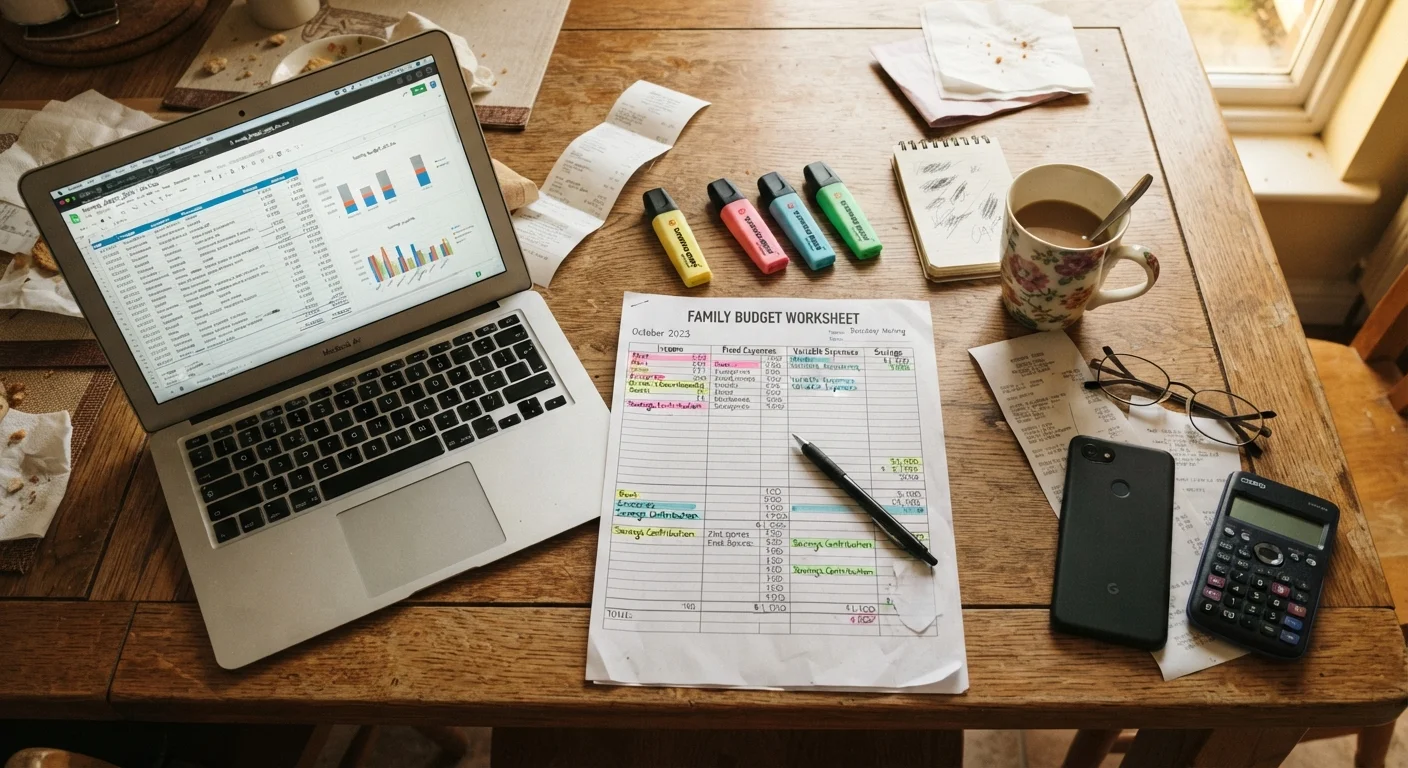
The Core Budget Categories Every Household Needs
A functional family budget doesn't require dozens of line items - it requires the right ones. Most household spending collapses into six foundational categories that should appear in every budget regardless of income level.
- Housing - Rent or mortgage, property taxes, HOA fees, and renters or homeowners insurance. This is typically a family's largest fixed expense.
- Food - Groceries and dining out. Many families track these separately once they realize how much restaurant spending inflates total food costs.
- Transportation - Car payment, fuel, insurance, registration, and maintenance. Don't forget parking and tolls if those are regular costs.
- Utilities & Services - Electricity, gas, water, internet, and phone. These are mostly fixed but worth reviewing annually.
- Healthcare - Insurance premiums paid out-of-pocket, copays, prescriptions, dental, and vision. Even insured families face meaningful out-of-pocket costs.
- Debt Payments - Minimum payments on credit cards, student loans, and personal loans. For a fuller picture of managing these obligations, visit the Debt & Credit hub.
These six categories give you enough structure to see where your money actually goes - without requiring a spreadsheet that takes 20 minutes to update every week.
How Much Detail Actually Helps
Budget granularity is a balance. Too few categories and you can't diagnose overspending. Too many and tracking becomes a chore families abandon within a month.
A useful rule of thumb: add a subcategory only when the spending inside a main category is large enough to influence decisions. For example, splitting Food into Groceries and Dining Out is almost always worthwhile - the two behave differently and respond to different changes in behavior. Splitting groceries further into Produce vs. Snacks rarely adds value for most households.
Treat Savings as a Non-Negotiable Line Item
Many families save whatever remains at month's end - which is often nothing. Assigning savings its own budget category, funded at the start of the month alongside fixed bills, is what separates consistent savers from occasional ones. Even a modest fixed amount builds the habit. If your budget method doesn't support this easily, it may be worth reviewing how you structure the entire budget. For a side-by-side look at two popular approaches, see our comparison of zero-based vs. percentage-based budgeting.
Similarly, Savings and Goals deserve their own category rather than being treated as whatever's left over at month's end. Whether you're building an emergency fund or saving for a vacation, giving savings a dedicated budget line is what makes it consistent. Goal-based saving - where different savings buckets are earmarked for specific purposes - can work well alongside this approach. And if you're unsure how much your emergency fund should hold, see what an emergency fund actually covers.
A practical starting point: aim for 10-15 budget lines total. That's enough granularity to spot patterns without overwhelming the person doing the tracking.
Categories Families Commonly Miss
Even well-organized budgets develop blind spots. The most common gaps fall into irregular or infrequent expenses - costs that don't show up every month but reliably arrive every year.
Fixed expense
A cost that stays the same from month to month, such as rent, mortgage, or a car payment. Fixed expenses are easier to predict and should be the first items entered in any budget.
Variable expense
A cost that changes in amount each month, such as groceries, fuel, or dining out. These categories require more active tracking and offer the most room for adjustment.
Irregular expense
A cost that doesn't occur every month but is predictable over the year - for example, annual insurance premiums or back-to-school shopping. Dividing the annual total by 12 and setting that amount aside monthly is a common strategy.
Budget category
A named grouping of related spending used to organize and track household finances. Categories give structure to raw transaction data and make patterns visible over time.
Savings rate
The percentage of take-home income a household sets aside rather than spends. It is a common measure of financial health, though the right level varies by family circumstances and goals.
- Personal care - Haircuts, toiletries, and similar expenses are small individually but meaningful in aggregate, especially with multiple family members.
- Children's expenses - School supplies, activity fees, sports equipment, and childcare are often underestimated and should be a dedicated line rather than absorbed into other categories.
- Subscriptions - Streaming services, software, gym memberships, and digital tools. These accumulate quietly; a quarterly audit often reveals surprises.
- Clothing - Families with growing children especially need a realistic clothing budget that reflects actual replacement cycles.
- Home maintenance - Repairs, appliances, and seasonal upkeep. A common guideline suggests budgeting roughly 1% of home value annually, though actual costs vary considerably.
For a longer list of frequently overlooked spending lines, see our guide to hidden budget categories.
Once you've settled on your categories, your next decision is how to track them. Spreadsheets, apps, and pen-and-paper methods each handle categories differently - and the format you'll actually use consistently matters more than the one that's theoretically perfect.
This article is for general informational purposes only and does not constitute personalized financial advice. Consult a qualified financial professional for guidance tailored to your household's situation.
The content provided on our blog site traverses numerous categories, offering readers valuable and practical information. Readers can use the editorial team’s research and data to gain more insights into their topics of interest. However, they are requested not to treat the articles as conclusive. The website team cannot be held responsible for differences in data or inaccuracies found across other platforms. Please also note that the site might also miss out on various schemes and offers available that the readers may find more beneficial than the ones we cover.