

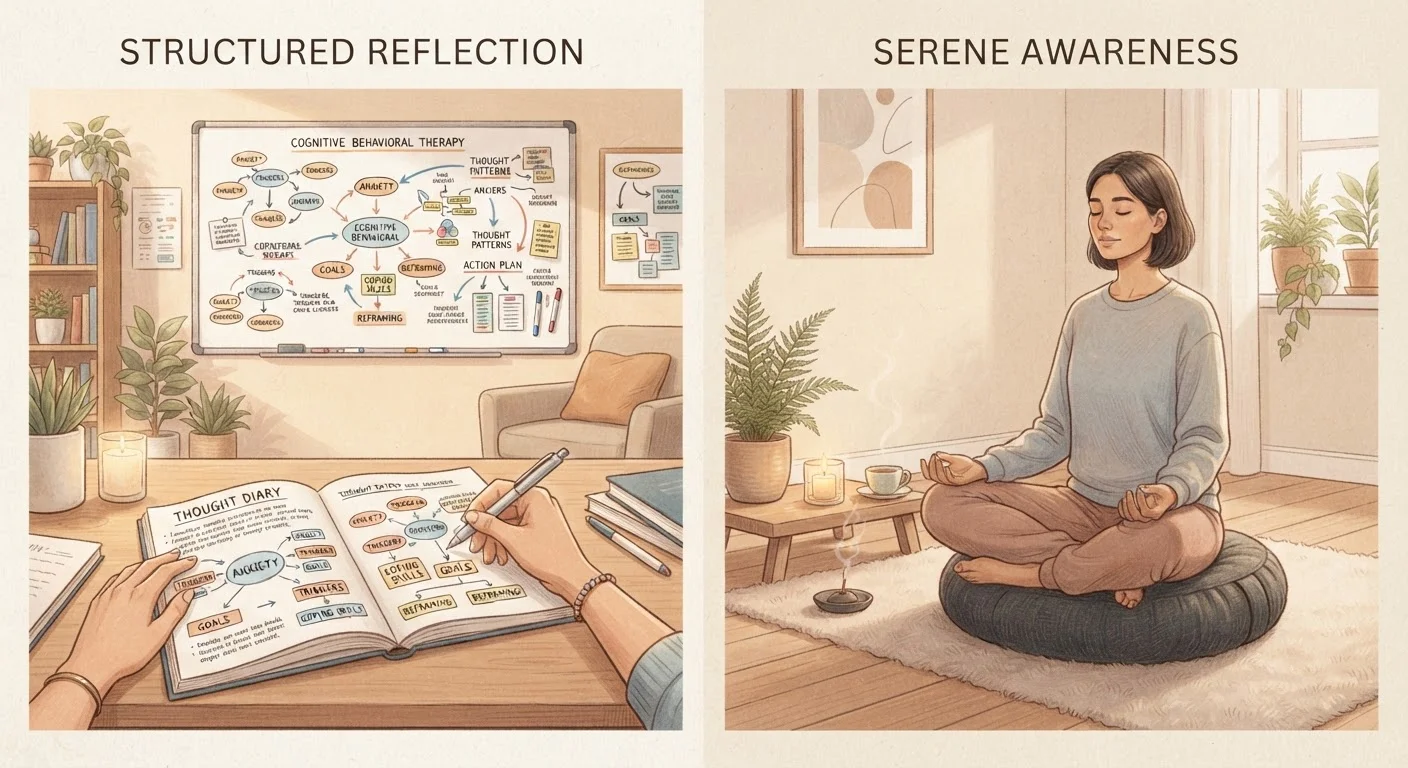
Option A
Cognitive Behavioral Therapy (CBT)
The structured, skills-focused approach to changing thought patterns.
Best for: People looking for a goal-oriented, time-limited framework to address specific thought and behavior patterns.
Option B
Mindfulness-Based Therapy (MBT)
The present-focused approach to building awareness and acceptance.
Best for: People seeking to develop a more open, non-reactive relationship with difficult emotions and recurring stress.
What Each Approach Actually Does
Cognitive Behavioral Therapy (CBT) is a structured, skills-based treatment grounded in the relationship between thoughts, feelings, and behaviors. A trained therapist works with the client to identify cognitive distortions - habitual patterns of thinking that can fuel anxiety, low mood, or unhelpful behavior - and then practice more balanced alternatives. Sessions typically include in-session exercises and between-session practice, often called homework. Because the techniques are teachable and replicable, CBT has been studied extensively and adapted for a wide range of concerns, from generalized anxiety disorder to insomnia.
Mindfulness-Based Therapy (MBT) is an umbrella term covering several formalized programs, most notably Mindfulness-Based Stress Reduction (MBSR) and Mindfulness-Based Cognitive Therapy (MBCT). Rather than directly challenging or restructuring thoughts, these approaches train practitioners to observe thoughts and feelings with curiosity and without automatic judgment. The core idea is that suffering is often amplified by our reaction to difficult experiences, and that building moment-to-moment awareness can interrupt that cycle. MBCT in particular was developed specifically to help people with a history of recurrent depression recognize early warning signs before they escalate.
To better understand the vocabulary used in both approaches, see our plain-language guide to mental health terms.
| Criterion | Cognitive Behavioral Therapy (CBT) | Mindfulness-Based Therapy (MBT) |
|---|---|---|
| Core mechanism | Restructure unhelpful thoughts and behaviors | Build non-judgmental awareness of thoughts and feelings |
| Orientation | Change-focused | Acceptance-focused |
| Typical format | Individual or group; 12-20 structured sessions | Group programs (e.g., 8-week MBSR) or integrated therapy |
| Between-session practice | Thought records, behavioral experiments | Daily meditation, body scans, breathing exercises |
| Strongest evidence for | Anxiety disorders, depression, OCD, PTSD | Stress reduction, depressive relapse prevention, chronic illness |
| Session structure | Highly structured with agenda and goals | More exploratory and experiential |
| Who tends to respond well | Those who prefer clear frameworks and measurable progress | Those drawn to self-observation and daily contemplative practice |
Evidence Base and Typical Applications
Both approaches are supported by substantial bodies of peer-reviewed research, though the evidence profile differs by condition.
CBT has one of the broadest evidence bases in clinical psychology. It is widely recommended in clinical guidelines for depression, anxiety disorders, post-traumatic stress, eating disorders, and obsessive-compulsive disorder, among others. Its structured format also makes it more readily studied in randomized controlled trials, contributing to a particularly rich research record.
Mindfulness-based approaches have a growing body of evidence, particularly for stress reduction, preventing depressive relapse, and improving quality of life in people managing chronic illness. MBCT, for instance, has been found in multiple trials to reduce the risk of depressive relapse in people who have experienced three or more episodes of depression. MBSR, developed by Jon Kabat-Zinn at the University of Massachusetts in the late 1970s, has been studied in diverse populations and settings.
~50-60%
Response rate for CBT in anxiety disorders
Meta-analyses published in peer-reviewed psychology journals consistently find CBT produces meaningful symptom reduction in a majority of anxiety disorder cases.
~43%
Reduction in depressive relapse with MBCT
Multiple randomized controlled trials have found MBCT reduces relapse rates for people with three or more prior depressive episodes compared to treatment as usual.
8 weeks
Standard length of MBSR program
The Mindfulness-Based Stress Reduction program developed at the University of Massachusetts runs for eight weeks with weekly group sessions and daily home practice.
It is worth noting that research quality varies across studies, and outcomes depend heavily on the individual, the therapist's training, and how faithfully the approach is delivered. If you are weighing therapy options, our article on therapy, counseling, and coaching differences can help clarify what kind of support you might be looking for.
Key Differences at a Glance - and How to Choose
While CBT and MBT share some common ground - both value self-awareness and both involve deliberate practice outside of sessions - their orientations differ in important ways. CBT is primarily change-focused: the goal is to modify specific thoughts and behaviors. MBT is primarily acceptance-focused: the goal is to change one's relationship to thoughts and experiences, rather than the thoughts themselves.
Neither is universally superior. Some people find CBT's structured assignments empowering; others find the directive approach less comfortable and respond better to the open, observational quality of mindfulness practice. Therapist fit, personal learning style, and the nature of the presenting concern all matter. Many practitioners today draw on both frameworks - an approach sometimes called third-wave CBT - recognizing that changing thoughts and cultivating acceptance are complementary, not competing, goals.
Integration Is Increasingly Common
Many contemporary therapists do not work from a single model exclusively. Approaches such as Dialectical Behavior Therapy (DBT) and Acceptance and Commitment Therapy (ACT) explicitly combine cognitive-behavioral principles with mindfulness-based ones. If a therapist describes using an integrative or 'third-wave' approach, this often means drawing from both traditions. Asking a potential therapist about their training and methods is always a reasonable step when exploring care options.
If your family is navigating stress or anxiety and you are not yet sure which path to explore, our overview of the difference between stress and anxiety may help you identify the right starting point. And if you are new to mental health support generally, our beginner's guide to mental wellness provides a practical first step.
This article is for general informational and educational purposes only and does not constitute medical or mental health advice. Always consult a qualified mental health professional regarding your specific circumstances or before starting any therapeutic program.
The content provided on our blog site traverses numerous categories, offering readers valuable and practical information. Readers can use the editorial team’s research and data to gain more insights into their topics of interest. However, they are requested not to treat the articles as conclusive. The website team cannot be held responsible for differences in data or inaccuracies found across other platforms. Please also note that the site might also miss out on various schemes and offers available that the readers may find more beneficial than the ones we cover.