

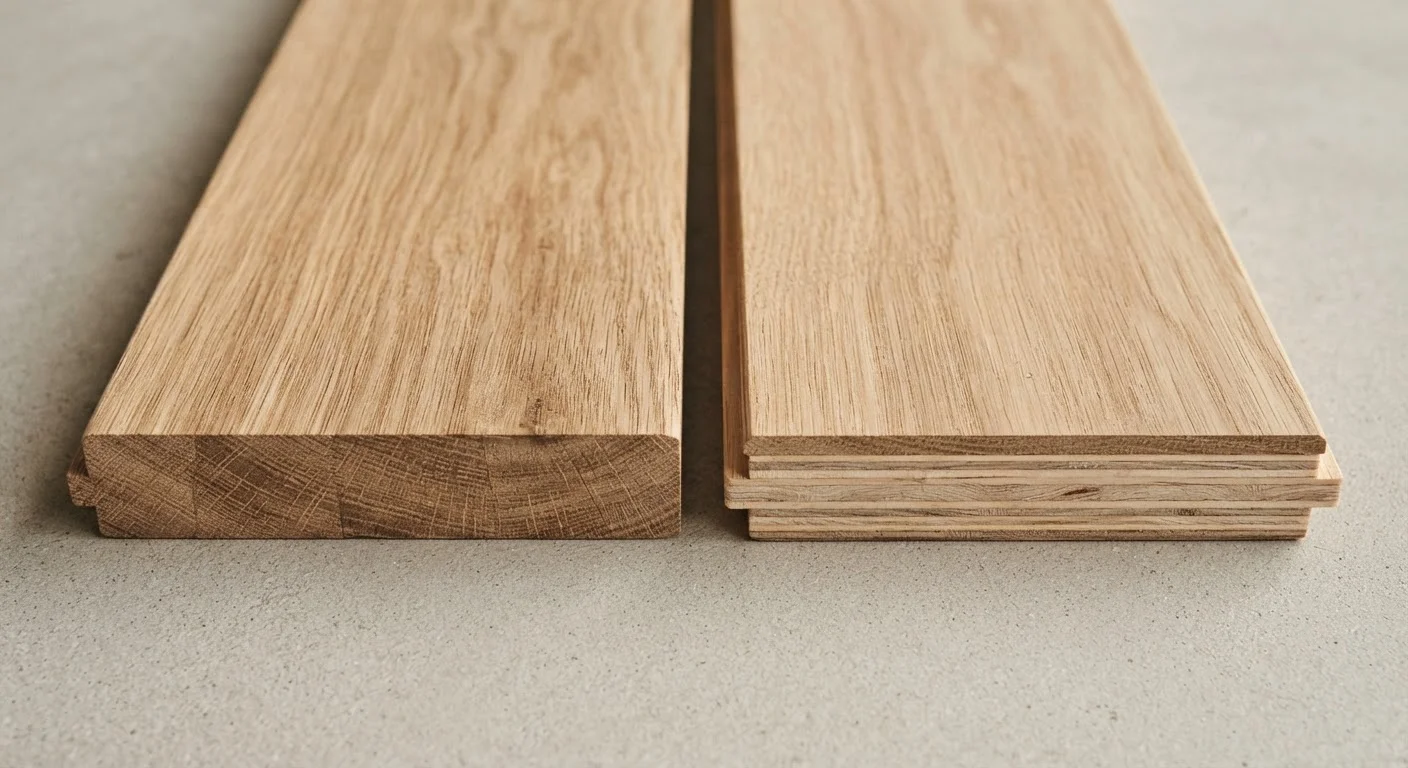
Option A
Solid Hardwood Flooring
The time-tested, refinishable classic.
Best for: Dry main-level living spaces where long-term refinishing potential and resale value matter most.
Option B
Engineered Hardwood Flooring
The moisture-resilient, versatile modern option.
Best for: Basements, kitchens, or humidity-prone rooms where dimensional stability is a priority.
What's Actually Inside Each Plank
Solid hardwood is exactly what it sounds like: a single, uniform piece of lumber milled to a consistent thickness, typically ¾ inch. Species like oak, maple, hickory, and cherry are common choices. Because the entire plank is wood, it can be sanded down and refinished repeatedly - often five or more times over its lifetime.
Engineered hardwood is constructed differently. A thin layer of real hardwood (the veneer, usually 1-6 mm thick) is bonded to multiple cross-directional plywood or high-density fiberboard (HDF) layers beneath. This cross-grain construction is the key to its behavior: the layers work against each other to resist expansion and contraction caused by humidity changes. The surface looks and feels identical to solid wood because it is real wood - just not all the way through.
The number of times engineered flooring can be refinished depends on the veneer thickness. Thinner veneers (around 1-2 mm) may allow only one light sand; thicker veneers (4-6 mm) can typically be refinished two to three times.
Cost, Installation, and Where Each Can Go
| Criterion | Solid Hardwood | Engineered Hardwood |
|---|---|---|
| Typical material cost | Higher per sq. ft. | Moderate per sq. ft. |
| Installation method | Nail or staple only | Nail, glue, or float |
| Suitable subfloors | Wood subfloor only | Wood or concrete |
| Below-grade use | Not recommended | Often approved |
| Moisture resistance | Low | Moderate to good |
| Refinishing potential | 5+ times | 1-3 times (veneer-dependent) |
| Typical lifespan | 50-100 years | 25-40 years |
| Acclimation needed | Yes, 3-5 days minimum | Yes, typically 48-72 hours |
Installation method matters as much as material cost. Solid hardwood must be nailed or stapled to a wood subfloor and requires a controlled acclimation period - usually 3-5 days in the room - before installation. It cannot be installed below grade (basements) because ground moisture will cause it to warp.
Engineered hardwood offers more flexibility. It can be glued down, stapled, or installed as a floating floor (planks click together without fasteners), which lowers labor costs and suits concrete subfloors. Many engineered products are approved for basement installation, though you should always verify the manufacturer's specific moisture and subfloor requirements before proceeding.
Always Check Local Building Codes
Flooring installation in finished basements or over radiant heat systems may be subject to local building codes or warranty requirements. Before purchasing, confirm with the flooring manufacturer that your chosen product is rated for your specific subfloor type and environmental conditions. A flooring installer or contractor can conduct a moisture test on your subfloor - a step that's strongly recommended before committing to either material.
Durability, Maintenance, and Long-Term Considerations
¾ inch
Standard solid hardwood plank thickness
This fixed thickness is what allows solid hardwood to be sanded and refinished repeatedly over its lifespan.
1-6 mm
Engineered hardwood veneer thickness range
Thicker veneers allow more refinishing cycles; always check veneer depth before purchasing engineered flooring.
3-5 days
Solid hardwood acclimation period
Flooring manufacturers generally recommend acclimating solid hardwood in the installation room before fitting to reduce post-installation movement.
Day-to-day maintenance is similar for both: sweep or vacuum regularly, wipe spills promptly, and use cleaning products formulated for hardwood floors. Neither type should be wet-mopped repeatedly, as standing water damages both wood surfaces and adhesives.
For high-traffic households with pets or young children, the hardness of the species matters more than whether the plank is solid or engineered. Janka hardness ratings measure a species' resistance to denting - hickory and white oak score higher than softer species like pine. Both flooring types use real wood on their surface, so hardness comparisons apply equally to both.
Over the very long term - 40 to 80 years - solid hardwood has an edge because it can be refinished more times, essentially renewing the floor's appearance multiple times across a home's life. Engineered hardwood, while durable, will eventually reach the end of its refinish cycles and need replacement. That said, for most families, a quality engineered floor will last 25-30 years or more with proper care, making replacement less pressing than it might appear on paper.
The content provided on our blog site traverses numerous categories, offering readers valuable and practical information. Readers can use the editorial team’s research and data to gain more insights into their topics of interest. However, they are requested not to treat the articles as conclusive. The website team cannot be held responsible for differences in data or inaccuracies found across other platforms. Please also note that the site might also miss out on various schemes and offers available that the readers may find more beneficial than the ones we cover.