

Why Records Matter More Than You Might Expect
Many homeschooling parents begin with the best of intentions and quickly discover that informal notes scattered across notebooks and email threads don't hold up when they need them most. Whether a child eventually re-enters a traditional school, applies to college, or simply needs to demonstrate progress to a state official, a clear paper trail makes every transition smoother.
Records serve three distinct purposes: legal compliance, academic accountability, and family planning. Each state sets its own standards - some require annual assessments and detailed attendance logs, others ask for almost nothing. Before you decide what to track, consult your state's current requirements. Our article on state homeschooling laws is a useful starting point for understanding the legal landscape where you live.
Records Requirements Vary Significantly by State
Some states require homeschooling parents to submit annual portfolios or standardized test scores to a local school district; others impose no reporting requirements at all. Because these rules change and vary so widely, this article provides general guidance rather than state-specific legal advice. Always verify current requirements directly with your state's Department of Education or a local homeschool association before deciding what to keep.
What to Document: The Core Categories
Regardless of where you live, the following categories form the foundation of a defensible, useful homeschool record:
Keep a daily or weekly attendance and activity log.
Most states that regulate homeschooling require proof of instructional days. Even in low-regulation states, a log gives you a clear picture of how time is actually being used across the school year.
Retain samples of student work across all core subjects.
Written work, math worksheets, science lab notes, and creative projects serve as concrete evidence of skill development over time. They are far more persuasive than a parent's verbal summary when a school administrator or testing official asks for progress evidence.
Record assessment results, including informal ones.
Formal standardized tests are only part of the picture. Documenting quiz scores, oral narrations, project rubrics, or reading-level checks gives a fuller account of learning that can be shared with future teachers or college admissions reviewers.
Create a curriculum log that tracks materials used and when.
Knowing which textbook, program, or approach you used in a given year helps enormously when a child moves to a new school or when you're planning future grades. It also prevents the common problem of accidentally repeating or skipping content across years.
Document extracurricular activities and learning outside the home.
Field trips, co-op classes, sports, community service, and online courses all contribute to a child's education but are easy to overlook in formal records. Capturing them strengthens a transcript and reflects the full scope of a homeschool education.
Together, these categories create a portfolio that reflects both what you planned and what your child actually learned - two things that don't always match, and both worth documenting.
How to Organize and Store Your Records
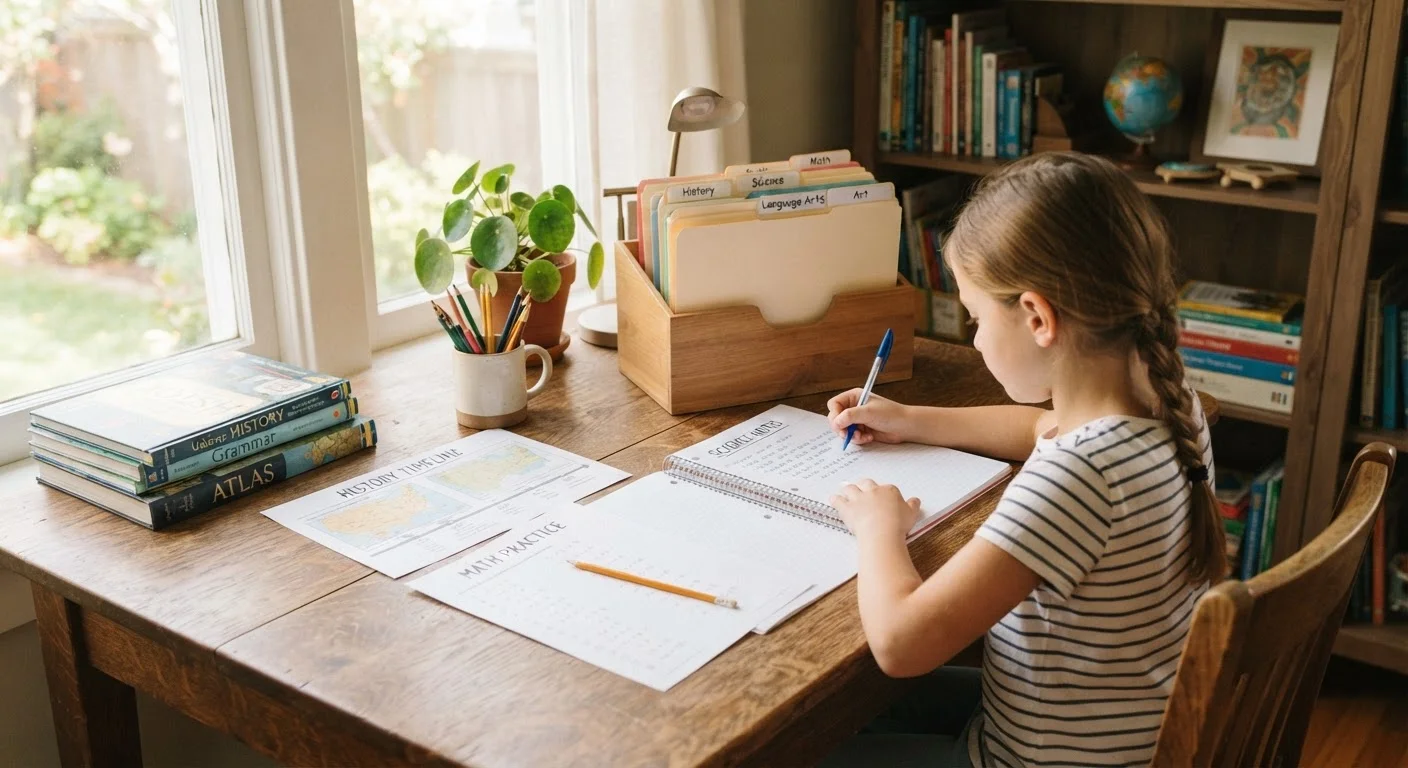
The best system is one you'll actually use. Many families find success with a hybrid approach: a physical binder for the current school year (divided by subject) and a digital backup stored in a cloud folder. Date every entry; it takes seconds and pays dividends later.
For families thinking about long-term planning alongside their homeschool budget, our family budgeting hub offers practical strategies that can help you allocate resources for curriculum and materials alongside your record-keeping tools.
Using Records to Improve Learning - Not Just Prove It
Records aren't only a compliance exercise. Reviewed regularly, they reveal patterns: a subject where your child consistently excels, a teaching method that isn't clicking, or a period of unusually low productivity that coincides with a family stressor. This is the reflective side of record-keeping that many parents underutilize.
~3.3M
Homeschooled students in the U.S.
The National Center for Education Statistics estimated approximately 3.3 million K-12 students were homeschooled in the U.S. as of its most recent survey data.
50
Different sets of state homeschool regulations
Every U.S. state sets its own homeschooling regulations, meaning record-keeping requirements can differ dramatically depending on where a family lives.
Our end-of-year homeschool review guide walks through a structured checklist for doing exactly this kind of assessment before each new term. For a broader view of everything home education involves, see The Complete Picture of Learning at Home, which covers curriculum selection, socialization, and long-term planning in one place.
Build Your Portfolio as You Go
Trying to reconstruct a year's worth of records in June is stressful and often incomplete. Instead, spend five minutes at the end of each school week filing work samples, updating your log, and noting any curriculum changes. Small consistent habits make end-of-year reviews - and any unexpected compliance requests - much less daunting.
The content provided on our blog site traverses numerous categories, offering readers valuable and practical information. Readers can use the editorial team’s research and data to gain more insights into their topics of interest. However, they are requested not to treat the articles as conclusive. The website team cannot be held responsible for differences in data or inaccuracies found across other platforms. Please also note that the site might also miss out on various schemes and offers available that the readers may find more beneficial than the ones we cover.