

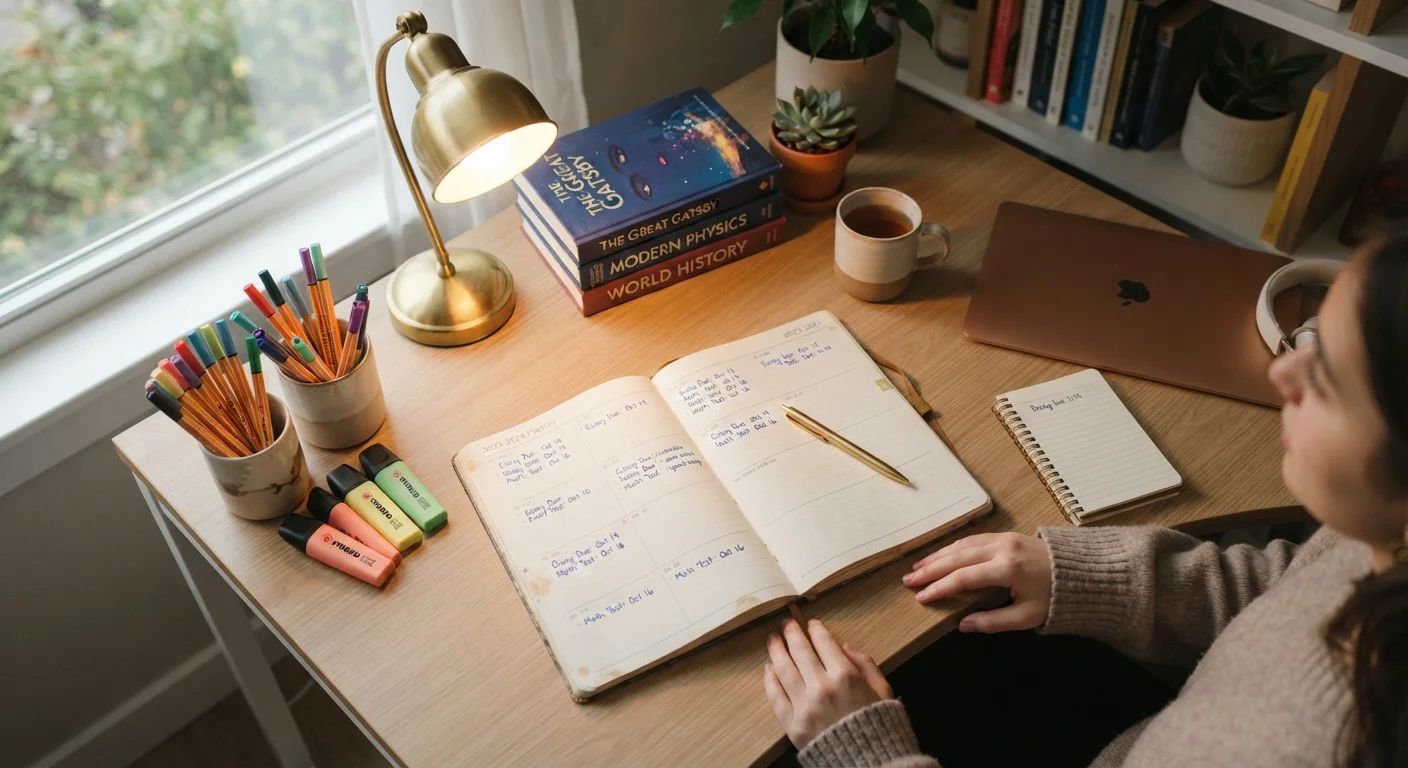
Why Routine Beats Willpower
Students who perform consistently well academically are rarely more motivated than their peers - they are more habituated. Habit research, including widely cited work from cognitive psychology, shows that routine automates behaviour and reduces the mental energy required to begin a task. Once 'study time' is anchored to a reliable cue - a specific time, a particular place, a brief ritual - students spend less mental effort deciding whether to study and more time actually doing it.
This matters especially for families navigating school life pressures across multiple children or grade levels simultaneously. A shared household routine reduces friction for everyone. See also building a morning routine that gets kids to school on time for a complementary approach to structuring the school day from the start.
Routine Is Not One-Size-Fits-All
What works for a third grader will not work for a high school junior. Resist copying someone else's schedule wholesale. The steps below give you a framework - but the specific timing, session length, and methods must reflect your student's age, workload, and energy patterns. Revisit and adjust the routine at the start of each new semester.
The steps below are designed to be modular - apply what fits your student's current grade and revisit the framework as they advance.
What you will need
How to Build the Routine: Step-by-Step
Follow these steps in order the first time. Once the routine is established, most students will only need to revisit steps one and six at the start of each new term.
Weekly planner or academic diary
Maps out study blocks alongside school, activities, and rest so sessions are scheduled, not squeezed in.
Timer (phone, clock, or dedicated app)
Used to enforce focused work intervals and structured breaks, such as the Pomodoro technique.
Subject-specific materials (textbooks, notes, past papers)
Ensures each planned session can begin immediately without hunting for resources.
Noise-cancelling headphones or earplugs
Reduces ambient distraction in shared living spaces, particularly helpful for older students.
Audit your current schedule honestly
Before designing a new routine, map everything already committed to your week: school hours, transportation, meals, extracurriculars, and sleep. What remains is your discretionary time. Students often discover they have more usable pockets than they thought - or fewer, which is equally valuable to know. Elementary students typically need 10-30 minutes of focused study daily; middle schoolers around 45-90 minutes; high schoolers 1.5-3 hours depending on course load.
Choose anchor times that match your energy
Cognitive performance varies throughout the day. Many students find their sharpest focus in the late morning or early-to-mid afternoon - not late at night. Identify one or two consistent 'anchor' slots each day when the student is reliably alert. Anchor times create the habit loop: same time, same place, same routine. Consistency is what turns a plan into an automatic behaviour over several weeks.
Design a grade-appropriate session structure
Session length and structure should fit the student's developmental stage:
- Grades K-3: 10-15 minute focused blocks with physical movement breaks. A parent or caregiver should be nearby to redirect attention.
- Grades 4-6: 20-25 minute blocks. Students can begin setting their own micro-goals with light coaching.
- Grades 7-10: 30-45 minute blocks using a timer. Introduce spaced practice across subjects rather than spending all time on one.
- Grades 11-12 and college: 45-60 minute focused intervals, paired with active retrieval methods. Independence should be nearly complete.
For a deeper look at how retrieval practice builds stronger memory, that guide is worth reviewing alongside this one.
Set up a dedicated, consistent environment
The brain forms associations between context and behaviour. Studying in the same physical space signals that it's time to focus. The space does not need to be elaborate - a cleared kitchen table works as well as a dedicated desk - but it should be as distraction-free as possible. Remove unrelated screens, silence notifications, and ensure adequate lighting. For younger students, parents should help establish this space; older students can own the setup themselves.
Select active study methods over passive ones
Re-reading notes or highlighting text feels productive but delivers weak results. Research on memory consistently favours active techniques: self-testing with flashcards, writing summaries from memory, solving practice problems, or explaining concepts aloud. Build at least one active method into every session. Understanding why passive review falls short can help students and parents make the case for changing old habits. Pair active study with organised notes - effective note-taking systems make self-testing far easier.
Review and adjust the routine regularly
A routine built in September may not suit November's exam schedule or January's new semester. Schedule a brief weekly review - five minutes on Sunday works well - to check whether sessions happened, what felt difficult, and whether anything needs shifting. Treat the routine as a living document, not a fixed contract. For comprehensive exam-period planning, this exam preparation reference provides detailed scheduling frameworks.
Start Every Session With Intention
Before opening a single textbook, spend two minutes identifying exactly what you want to accomplish. A clear micro-goal - 'complete the first ten practice problems' rather than 'do math' - keeps sessions focused and gives a natural stopping point. Our pre-session readiness checklist walks through this habit in detail.
Avoid Scheduling Study Time Too Late in the Evening
Research on adolescent sleep consistently shows that learning consolidates during sleep. Pushing homework past 9 p.m. regularly can interfere with memory formation and wellbeing. If evenings are packed, look for pockets earlier in the afternoon or directly after school. For guidance on protecting sleep quality alongside study time, see building a wind-down routine.
If you notice signs of persistent exhaustion or resistance that go beyond normal adjustment, it may indicate study fatigue rather than a routine problem. Recognising and managing study fatigue is a useful companion guide for families at that point.
The content provided on our blog site traverses numerous categories, offering readers valuable and practical information. Readers can use the editorial team’s research and data to gain more insights into their topics of interest. However, they are requested not to treat the articles as conclusive. The website team cannot be held responsible for differences in data or inaccuracies found across other platforms. Please also note that the site might also miss out on various schemes and offers available that the readers may find more beneficial than the ones we cover.