

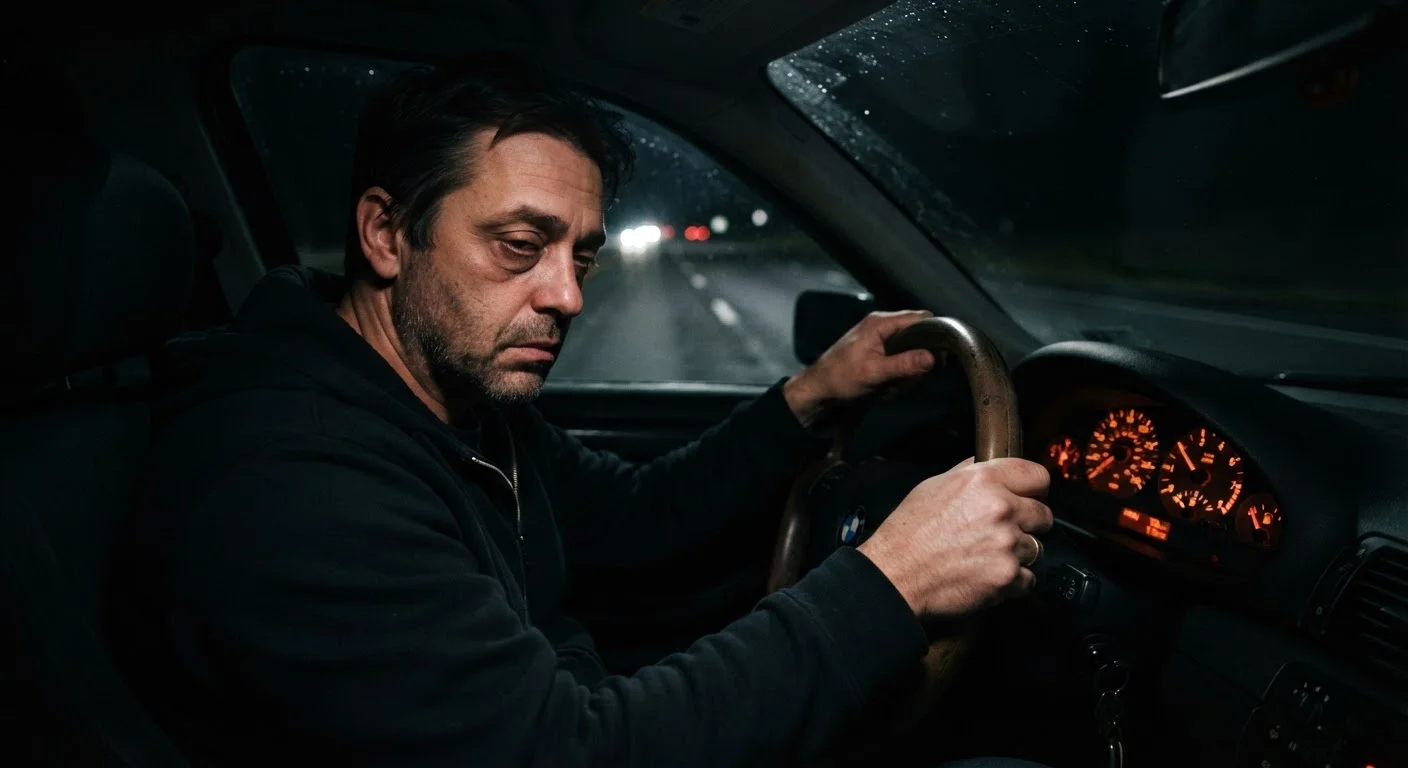
Option A
Drowsy Driving
The silent impairment most drivers underestimate.
Best for: Understanding the risks that apply to anyone who has missed sleep or driven long hours, especially on overnight family trips.
Option B
Drunk Driving
The well-known impairment with established legal limits.
Best for: Understanding a widely recognized hazard with clear legal consequences and measurable blood alcohol thresholds.
The Science of Impairment: What Your Brain Does When Deprived
Both alcohol and sleep deprivation interfere with the brain's prefrontal cortex - the region responsible for judgment, reaction speed, and attention. Research published by the AAA Foundation for Traffic Safety found that drivers who slept only 6-7 hours in a 24-hour period were twice as likely to be involved in a crash compared to those who slept 8 or more hours. Drivers sleeping fewer than 5 hours faced a crash risk comparable to driving with a blood alcohol concentration (BAC) above the legal limit of 0.08%.
The critical similarity is this: both impairments degrade the neural pathways that allow a driver to anticipate hazards, brake quickly, and maintain lane position. The key difference is self-awareness. A driver who has consumed alcohol may recognize they feel different. A drowsy driver, however, frequently underestimates their impairment - a well-documented phenomenon sometimes called "sleep inertia blindness." This makes fatigue particularly insidious behind the wheel.
18 hrs
Awake time equivalent to 0.05% BAC
AAA Foundation for Traffic Safety research links 18 hours without sleep to impairment equivalent to a 0.05% blood alcohol concentration.
~100,000
Police-reported drowsy driving crashes annually
NHTSA estimates approximately 100,000 police-reported crashes per year involve drowsy driving, though the true figure is considered higher due to underreporting.
4-5 sec
Duration of a typical microsleep episode
At 60 mph, a 5-second microsleep means traveling the length of a football field with no driver input, according to NHTSA safety data.
Head-to-Head: How the Two Impairments Compare
When researchers put drowsy and drunk driving side by side, the overlaps are striking - but so are the differences in how each is detected and legally managed.
| Criterion | Drowsy Driving | Drunk Driving |
|---|---|---|
| Reaction time impact | Significantly slowed; worsens with hours awake | Significantly slowed; correlates with BAC level |
| Driver self-awareness | Often absent; impairment is underestimated | Partially present; impairment is sometimes recognized |
| Roadside detection | No objective test available | Breathalyzer and blood tests available |
| Legal threshold | No universal BAC-style limit exists | 0.08% BAC legal limit in all US states |
| Microsleep risk | High; involuntary sleep episodes can occur | Lower; sedation differs from sleep mechanism |
| Crash characteristics | Often high-speed, no braking; single vehicle | Varied; may include swerving and delayed braking |
| Recovery method | Sleep; no quick fix eliminates fatigue | Time; body metabolizes alcohol at a set rate |
One critical distinction is that alcohol impairment degrades in a predictable, measurable way as the body metabolizes it. Fatigue does not follow a neat curve - accumulated sleep debt can linger for days, and a brief sense of alertness (such as the temporary boost from caffeine or a short nap) can mask lingering impairment. For a fuller view of how attention deteriorates behind the wheel, see our article on distracted driving beyond the phone.
Warning Signs Drivers Should Never Ignore
Because there is no breathalyzer for fatigue, drivers must rely on recognizing their own warning signs. The National Highway Traffic Safety Administration (NHTSA) identifies several key indicators of dangerous drowsiness:
- Frequent yawning or eye-rubbing - your body's demand for rest is overriding your effort to stay alert
- Lane drifting or missing exits - divided attention and microsleeps erode lane discipline
- Difficulty remembering the last few miles - a sign that brief sleep episodes may already be occurring
- Heavy eyelids or head nodding - the body is actively fighting to sleep
- Irritability or restlessness - cognitive load from fatigue raises emotional reactivity
If any of these signs appear, the safest response is to exit the road and rest - not to push through. Caffeine can provide a temporary boost of 30-45 minutes, but it does not restore full alertness or eliminate accumulated sleep debt. Nighttime driving amplifies all of these risks; our guide on why night driving is riskier than most people think explains why darkness compounds fatigue further.
The same cognitive decline that makes a fatigued student struggle through late-night study sessions applies directly to driving. Understanding the signs of fatigue in any context - explored in our piece on managing study fatigue - helps build broader awareness of when the brain is no longer performing safely.
Caffeine Is a Temporary Measure, Not a Solution
Caffeine can help a rested driver stay alert on a short drive, but it cannot compensate for significant sleep debt. Studies suggest caffeine's alerting effect wears off within 45-90 minutes and does not restore the cognitive functions most impaired by fatigue. If you are genuinely sleep-deprived, the only safe remedy before driving is sleep.
Practical Steps to Reduce Risk for Your Family
The most effective prevention is adequate sleep before any significant drive - adults generally need 7-9 hours, though individual needs vary. For family road trips, building planned rest stops every two hours or 100 miles is a widely recommended strategy. Sharing driving duties with another rested adult is one of the most reliable risk-reduction tools available.
It is also worth understanding that legal consequences differ sharply between the two impairments. Drunk driving carries established criminal penalties, license suspension, and per-se BAC limits enforced by law enforcement. Drowsy driving, while increasingly recognized in some state laws, is much harder to prosecute because impairment cannot be objectively measured at the roadside. This legal asymmetry should not suggest drowsy driving is less serious - it simply means the responsibility falls more directly on the individual driver to self-regulate.
Families planning overnight journeys should weigh these risks carefully and build in flexibility to stop and rest if needed, rather than pushing through fatigue to meet an arrival time.
This article provides general safety information for educational purposes. It does not constitute legal or medical advice. Consult appropriate professionals for guidance specific to your circumstances.
The content provided on our blog site traverses numerous categories, offering readers valuable and practical information. Readers can use the editorial team’s research and data to gain more insights into their topics of interest. However, they are requested not to treat the articles as conclusive. The website team cannot be held responsible for differences in data or inaccuracies found across other platforms. Please also note that the site might also miss out on various schemes and offers available that the readers may find more beneficial than the ones we cover.