

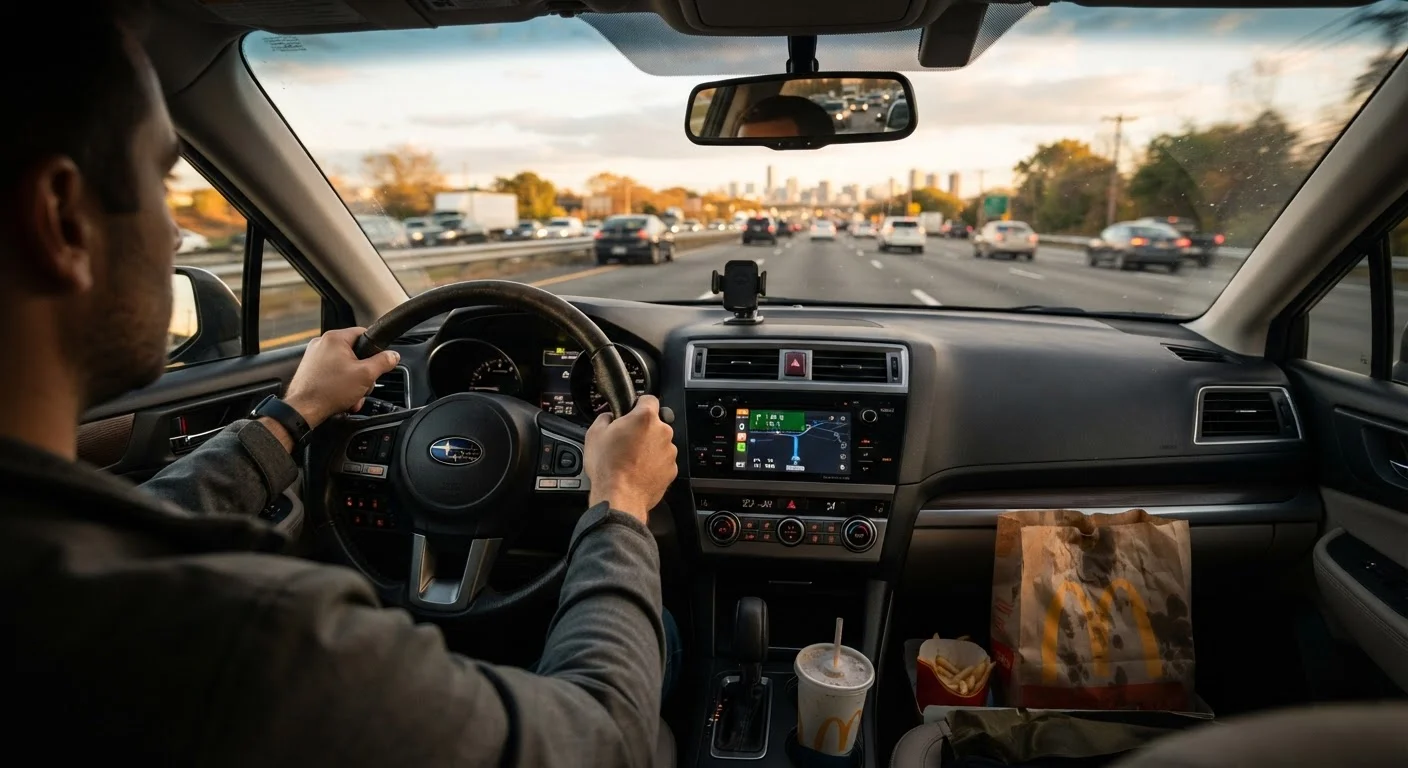
The Distraction Problem Is Wider Than Most Drivers Realize
When lawmakers and safety campaigns target distracted driving, the focus almost always lands on smartphones. That emphasis is warranted - handheld phone use is dangerous and well-documented. But research from the National Highway Traffic Safety Administration (NHTSA) consistently shows that phones are far from the only threat. Eating, talking to passengers, adjusting in-vehicle controls, and even daydreaming all divert attention from the task of driving.
Researchers group distraction into three categories: visual (eyes off the road), manual (hands off the wheel), and cognitive (mind off driving). The most hazardous activities - including texting - hit all three simultaneously. But many overlooked distractors score high on at least one category, and that's enough to significantly raise crash risk.
At 60 mph, a vehicle travels roughly 88 feet per second. A two-second glance to unwrap a sandwich or silence a back-seat argument covers nearly half a football field of road without the driver's eyes engaged. Understanding the full landscape of distraction is the first step toward genuinely safer habits. See our complete family driving reference for a broader look at everyday road safety.
Eating and drinking while driving
Drive-throughs are designed for convenience, but consuming food or beverages while moving is a significant manual and visual distraction. Unwrapping food, reaching for a drink, and managing spills each pull at least one hand off the wheel and often draw the driver's gaze downward. NHTSA data has identified eating and drinking as a contributing factor in a notable share of distraction-related crashes.
The practical fix is straightforward: if you're picking up food on the go, park and eat before resuming your trip. For long drives where a meal stop isn't realistic, pre-packaged, easy-to-handle snacks consumed only when stopped at a light are a lower-risk option - though parked or pulled-over eating is always safest.
Unwrapping a burger at speed means one hand off the wheel and eyes scanning downward - a double distraction.
Navigation and in-vehicle touchscreens
GPS navigation has replaced wrong turns with a different problem: drivers repeatedly glancing at - or interacting with - screens mounted inside the vehicle. Modern infotainment systems often require multiple taps to complete a simple task, generating both visual and manual distraction. Some studies have found that interacting with in-dash systems can take a driver's eyes off the road for longer than a text message.
The solution is to treat navigation setup like pre-flight checks: enter your destination, set the volume, and confirm the route before pulling out of the driveway. If you miss a turn, don't try to re-route while moving - pull safely off the road to adjust. Pairing navigation audio with a phone mount you never need to touch during the drive keeps eyes forward. Our article on hands-free device myths explores why even voice-controlled systems aren't distraction-free.
Set your route before you leave the driveway - mid-drive navigation adjustments are among the longest visual distractions.
Passenger conversations and backseat activity
Talking to a passenger is a normal part of driving, but the cognitive load of conversation is real. Research has found that engaging conversations reduce the visual scanning behavior drivers use to monitor their environment - even when both hands stay on the wheel. This is classified as cognitive distraction, and it can be surprisingly powerful.
Backseat passengers - particularly young children - add a physical dimension: drivers may turn their heads, reach back, or become emotionally reactive to conflict. Studies have estimated that children can be a significant source of distraction per trip, primarily because of the reactive attention they demand.
Practical steps include setting clear expectations before trips, keeping children engaged with age-appropriate entertainment options, and using the simple rule: if a child needs attention, pull over safely rather than attending to them while moving.
Even hands-on-wheel conversations can reduce the visual scanning that helps drivers spot hazards early.
Grooming and personal care
Applying makeup, shaving, fixing hair, or checking appearance in the rearview mirror are activities that belong firmly outside the car. Each one simultaneously removes hands from the wheel and redirects the driver's gaze away from the road. Despite being widely acknowledged as dangerous, grooming behind the wheel remains common, particularly during morning commutes when drivers feel pressed for time.
The underlying issue is usually time management rather than carelessness. Leaving home five minutes earlier, completing grooming tasks at home or in a parked vehicle, and using the commute only for driving can eliminate this category of distraction entirely.
Grooming in a moving vehicle combines hand removal and gaze redirection - a preventable risk solved simply by leaving earlier.
Daydreaming and mind-wandering
Pure cognitive distraction - mind-wandering with no external trigger - is among the most frequently reported forms of distraction in crash investigations, yet it's the least discussed. A driver can appear fully attentive while their mind is elsewhere entirely, processing a work problem, replaying an argument, or simply drifting. This form of distraction is invisible to other road users and difficult to self-monitor.
Fatigue amplifies the risk considerably; a tired brain is more prone to drifting attention even without external stimuli. Strategies that help include keeping the cabin at a cooler temperature, selecting engaging but not distracting audio (podcasts or music at moderate volume), taking regular breaks on longer trips, and recognizing when fatigue is affecting concentration. If your mind keeps wandering and you can't refocus, pulling over for a short break is the right call.
Mind-wandering with no phone in sight is one of the most frequently cited factors in crash investigations.
Interacting with objects inside the vehicle
Reaching for a dropped item, searching through a bag on the passenger seat, adjusting a pet carrier, or fiddling with radio controls all share a common thread: they move attention - and often hands - away from driving. These seem like brief, low-risk moments, but even a one-to-two-second diversion at highway speed covers significant distance with the driver effectively unaware of what's ahead.
The mitigation is pre-trip organization. Stow bags and items in the trunk or secured in the back seat before departure. Keep frequently accessed items - toll cards, sunglasses - in fixed, easy-to-reach locations. If a pet travels with you, use an appropriately sized crate or safety harness designed for vehicle use, reducing the likelihood they'll move unpredictably and draw your attention.
Reaching for a dropped item at highway speed means traveling dozens of feet with attention fully off the road.
Turning Awareness Into Action
Knowing which distractions exist matters less than building the routines that prevent them. The most reliable approach is a consistent pre-trip setup: enter your destination before leaving the driveway, secure loose items, adjust mirrors and climate controls, and brief any passengers on expectations - especially children. These two or three minutes of preparation eliminate the need for most mid-drive adjustments.
Make Pre-Trip Setup a Non-Negotiable Habit
Before every trip - not just long ones - take 60 to 90 seconds to set navigation, adjust mirrors, secure loose items, and silence non-urgent notifications. This brief routine eliminates the most common triggers for mid-drive distraction. Drivers who make pre-trip checks automatic report feeling more focused and less reactive once on the road.
For families, setting clear in-car norms is particularly valuable. Children who grow up seeing focused, distraction-aware driving are more likely to practice it themselves when they reach driving age. If you want to go deeper on building consistent habits, our article on safer driving habits that actually stick offers evidence-informed strategies for turning good intentions into reliable behavior.
Finally, remember that distraction rarely operates in isolation. A driver who is fatigued and also eating behind the wheel faces compounding impairments. For a closer look at how fatigue alone affects your ability to drive safely, see how drowsy driving compares to drunk driving.
This article is for general informational purposes only. Consult applicable traffic laws in your state for specific legal requirements around distracted driving.
The content provided on our blog site traverses numerous categories, offering readers valuable and practical information. Readers can use the editorial team’s research and data to gain more insights into their topics of interest. However, they are requested not to treat the articles as conclusive. The website team cannot be held responsible for differences in data or inaccuracies found across other platforms. Please also note that the site might also miss out on various schemes and offers available that the readers may find more beneficial than the ones we cover.