

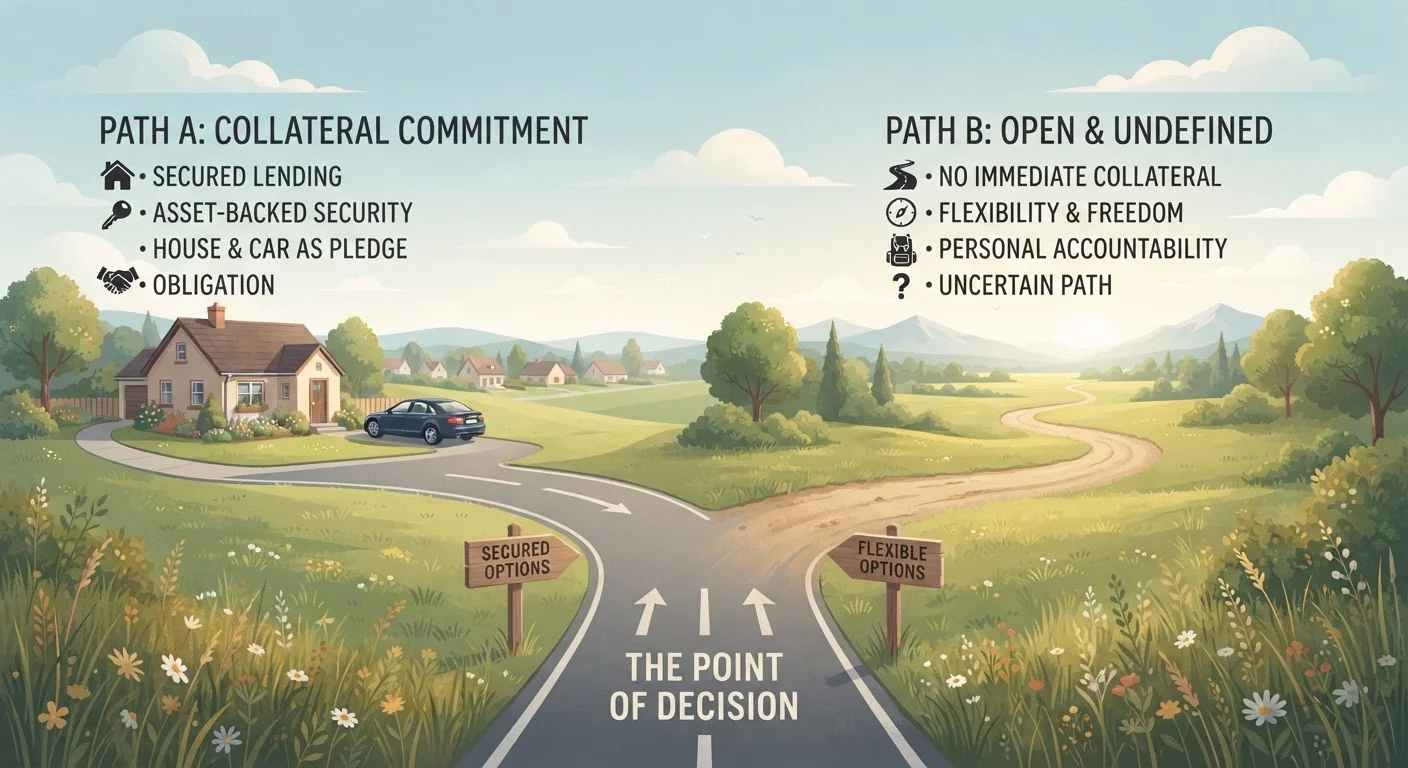
Option A
Secured Debt
The collateral-backed borrowing option with real-asset stakes.
Best for: Families financing large purchases-like a home or vehicle-who want lower interest rates and are comfortable pledging an asset as security.
Option B
Unsecured Debt
The flexible, no-collateral borrowing option with higher rates.
Best for: Families covering everyday expenses, emergencies, or smaller purchases where no asset can or should be pledged as collateral.
The Core Distinction: Collateral or No Collateral
Every loan your family takes on falls into one of two broad categories: secured or unsecured. The difference comes down to one concept-collateral, meaning an asset you pledge to the lender that they can claim if you stop making payments.
With secured debt, a specific asset backs the loan. A mortgage is secured by the home; an auto loan is secured by the vehicle. The lender holds a legal claim-called a lien-on that asset until the debt is repaid. Default, and the lender has grounds to foreclose on the property or repossess the car.
With unsecured debt, no such collateral exists. Credit cards, personal loans, and most medical bills fall into this category. If you don't pay, the lender can't immediately seize property-but they can pursue other consequences, including collections activity, lawsuits, and wage garnishment in some states.
This collateral arrangement directly shapes every other element of the loan: the interest rate, the approval criteria, and what happens when things go wrong. For a fuller picture of how different debt types fit into household finances, see our complete reference on household debt.
| Criterion | Secured Debt | Unsecured Debt |
|---|---|---|
| Collateral required | Yes - specific asset pledged | No asset required |
| Typical interest rate | Lower - lender risk is reduced | Higher - no recovery fallback |
| Common examples | Mortgage, auto loan, HELOC | Credit card, personal loan, medical debt |
| Default consequence | Repossession or foreclosure | Collections, lawsuits, garnishment |
| Approval criteria | Collateral value + creditworthiness | Creditworthiness and income primarily |
| Borrowing limits | Often higher - backed by asset value | Generally lower without collateral |
| Asset risk to family | Direct - home or vehicle at stake | Indirect - earnings or accounts at risk |
Interest Rates and Risk: Why the Gap Exists
Because secured lenders have a fallback-they can recover some losses by selling the collateral-they take on less financial risk. Less risk typically translates to lower interest rates for the borrower. Mortgage rates and auto loan rates are generally far below what you'd see on a personal loan or credit card for the same amount.
Unsecured lenders have no such cushion. If a borrower stops paying, recovery is harder and more expensive. To compensate, they charge higher rates-sometimes significantly so. This is why credit card interest rates are often many times higher than a 30-year fixed mortgage rate.
~20%+
Typical credit card APR range
The Federal Reserve tracks average credit card interest rates, which have historically run far above mortgage rates-often exceeding 20% APR in recent years.
~$12T
US mortgage debt outstanding
The Federal Reserve's consumer credit data consistently shows mortgage debt as the largest single category of household debt in the United States.
7 years
Credit report impact of default
Under the Fair Credit Reporting Act, most negative credit events-including missed payments and collections-can remain on a credit report for up to seven years.
That rate difference compounds quickly. A family carrying a balance on a high-rate unsecured product while also managing a mortgage is effectively paying a premium for the flexibility of not pledging additional collateral. That's not always the wrong trade-off, but families should make it consciously. Our article on how good-faith borrowers end up deep in debt explores how interest dynamics quietly escalate what feels like manageable debt.
What Happens When Payments Stop
The consequences of default differ meaningfully depending on which type of debt is involved-and understanding this before borrowing matters.
With secured debt, lenders move relatively quickly to recover the collateral. Mortgage servicers can initiate foreclosure proceedings after a defined period of missed payments; auto lenders can repossess a vehicle, sometimes without prior notice in certain states. In both cases, you can also lose money already paid-the equity you've built up may be consumed by fees and selling costs.
Unsecured lenders can't immediately take property, but they're not powerless. After failed collection attempts, many sell the debt to collection agencies. Collectors can then pursue legal judgments, which in some states enable wage garnishment or bank levies. Throughout this process, your credit report takes serious damage-typically for up to seven years.
Both paths are disruptive to a family's financial footing. If you're already managing multiple debt obligations, keeping debt from derailing your budget offers practical approaches for staying on track before trouble escalates.
Secured Debt Doesn't Always Mean Lower Total Risk
A lower interest rate on secured debt is genuinely valuable-but it comes paired with direct exposure of a physical asset. A family that defaults on an unsecured credit card faces collection pressure; a family that defaults on a mortgage faces losing their home. Consider both the cost of the debt and the severity of what's at stake before choosing between them. Talking with a licensed financial counselor can help you weigh these trade-offs for your specific situation.
How Both Types Interact with Your Credit
Secured and unsecured debts both appear on your credit report and influence your credit score-but they do so in somewhat different ways. Payment history is the single biggest factor in your score regardless of debt type: consistent on-time payments build your score; missed payments damage it.
The credit utilization ratio-how much of your available revolving credit you're using-applies primarily to unsecured revolving accounts like credit cards. Keeping this ratio low generally helps your score. Secured installment loans (like mortgages and auto loans) don't factor into utilization the same way, but they do contribute to your credit mix, which is another scoring factor.
Families managing both types often ask how to sequence payoff. That decision depends on interest rates, emotional goals, and cash flow. Our comparison of the debt snowball and debt avalanche strategies breaks down how each method applies across mixed debt portfolios. For families thinking about borrowing alongside someone else, co-signing carries full legal responsibility-whether the debt is secured or not.
This article is for general informational and educational purposes only and does not constitute personalized financial, legal, or tax advice. Consult a licensed financial professional for guidance specific to your situation.
The content provided on our blog site traverses numerous categories, offering readers valuable and practical information. Readers can use the editorial team’s research and data to gain more insights into their topics of interest. However, they are requested not to treat the articles as conclusive. The website team cannot be held responsible for differences in data or inaccuracies found across other platforms. Please also note that the site might also miss out on various schemes and offers available that the readers may find more beneficial than the ones we cover.