

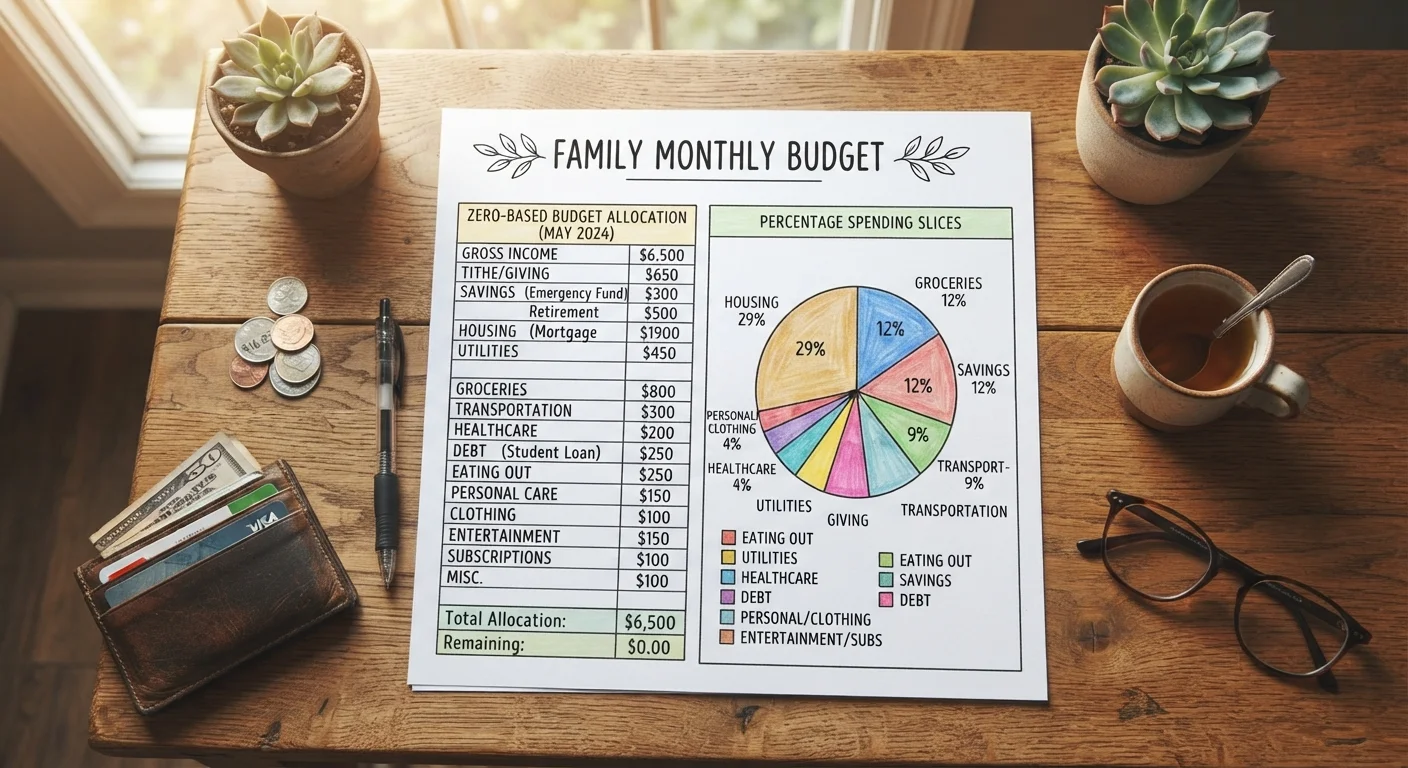
Option A
Zero-Based Budgeting
The meticulous, dollar-by-dollar planner.
Best for: Families who want complete control over where every dollar goes each month.
Option B
Percentage-Based Budgeting
The flexible, rule-of-thumb framework.
Best for: Families seeking a low-maintenance structure that adapts as income changes.
How Each Method Actually Works
Before comparing trade-offs, it helps to understand what each approach asks of you in practice. If you're new to the concept of household budgets altogether, start with the basics first.
Zero-Based Budgeting
Zero-based budgeting (ZBB) starts with your total monthly income and assigns every dollar to a specific category - housing, groceries, utilities, savings, debt payments, fun money - until the remaining balance is exactly zero. That doesn't mean you spend everything; it means every dollar has a designated purpose, including dollars earmarked for savings or an emergency fund.
You rebuild this plan each month, which means irregular expenses like back-to-school supplies or a car registration fee get their own line when relevant. The process typically takes 30-60 minutes per month plus routine check-ins.
Percentage-Based Budgeting
Percentage-based budgeting (PBB) divides your income into broad categories using fixed ratios. The widely referenced 50/30/20 guideline, for example, suggests roughly 50% toward needs, 30% toward wants, and 20% toward savings and debt repayment. Other variations exist, but the principle is the same: categories get a slice of income rather than a specific dollar figure.
Once the ratios are set, the budget largely runs on autopilot. You check periodically whether spending within each category is tracking to its percentage rather than managing individual line items.
| Criterion | Zero-Based Budgeting | Percentage-Based Budgeting |
|---|---|---|
| Core mechanic | Assign every dollar until balance = $0 | Divide income by fixed category ratios |
| Monthly setup time | 30-60 minutes to rebuild each month | Minimal once ratios are established |
| Handles irregular income | Well - rebuilt from actual take-home | Moderately - percentages shift with income |
| Granularity | High - line-item per category | Low - broad buckets only |
| Beginner-friendliness | Moderate - requires spending data | High - ready-made framework |
| Debt payoff support | Strong - dedicated line item | General - falls under savings % |
| Goal tracking | Explicit per-goal allocation | Grouped under savings category |
| Flexibility for lifestyle changes | Rebuilt monthly - fully adaptable | Ratios may need occasional adjustment |
Real-World Trade-Offs for Families
For families managing multiple income streams, childcare costs, or irregular expenses, abstract frameworks hit practical limits fast. Here's where each method earns - and loses - points in day-to-day household life.
Visibility vs. Simplicity
Zero-based budgeting gives you granular visibility. You'll know exactly how much is left for dining out mid-month, which makes saying yes or no to discretionary spending straightforward. The trade-off is time: line-item budgeting requires consistent tracking. Families who skip a few weeks of reconciliation can find the whole system has drifted. For tracking tool options, see approaches to budgeting as a family.
Adaptability to Income Swings
Percentage-based budgeting scales gracefully with income changes - if a freelance month pays less, every category shrinks proportionally without requiring you to rebuild the entire plan. However, fixed percentages don't always map to real life. Families in high-cost-of-living areas often find that housing alone consumes 40-50% of income before any other needs are met, making a 50% needs target aspirational rather than realistic.
The 50/30/20 Rule Is a Starting Point, Not a Prescription
The 50/30/20 guideline is a commonly cited framework for organizing spending, but it was never designed as a one-size-fits-all rule. Families in expensive metro areas, those supporting dependents with special needs, or households with significant medical costs will often find the standard ratios don't fit their reality. Use percentage benchmarks as a rough reference, then adjust categories to reflect your household's actual obligations.
Goal Alignment
Zero-based budgeting integrates naturally with goal-based saving because you can create a dedicated line for each savings target - vacation fund, emergency buffer, home repair reserve - and fund them deliberately. Percentage-based budgeting can support goals too, but the approach is broader: the savings percentage covers everything at once, which can make it harder to see whether specific goals are actually being funded.
78%
Americans living paycheck to paycheck at some point
A widely cited figure from surveys by LendingClub and PYMNTS tracking US consumer financial health; exact rates fluctuate by year and methodology.
~34%
Average share of US household income spent on housing
The U.S. Bureau of Labor Statistics Consumer Expenditure Survey consistently shows housing as the single largest household expense category.
Choosing or Combining Both Methods
The good news: these two methods aren't mutually exclusive. Many families use percentage-based budgeting to set overall category guardrails - for example, committing that no more than 55% of income goes to fixed needs - and then use zero-based logic within discretionary categories to decide exactly how the flexible money is divided each month.
When building your first family budget, a percentage framework is often a reasonable place to start because it requires less data about past spending. Once you've tracked a few months of real expenses, you can introduce zero-based planning for the categories where overspending tends to happen.
Whichever method you choose, the categories you use matter as much as the method itself. Review which budget categories matter most to make sure your structure reflects how your household actually spends.
This article provides general financial information for educational purposes only and does not constitute personalized financial advice. Consult a qualified financial professional regarding decisions specific to your household's circumstances.
The content provided on our blog site traverses numerous categories, offering readers valuable and practical information. Readers can use the editorial team’s research and data to gain more insights into their topics of interest. However, they are requested not to treat the articles as conclusive. The website team cannot be held responsible for differences in data or inaccuracies found across other platforms. Please also note that the site might also miss out on various schemes and offers available that the readers may find more beneficial than the ones we cover.