

The Four Main Soil Types Explained
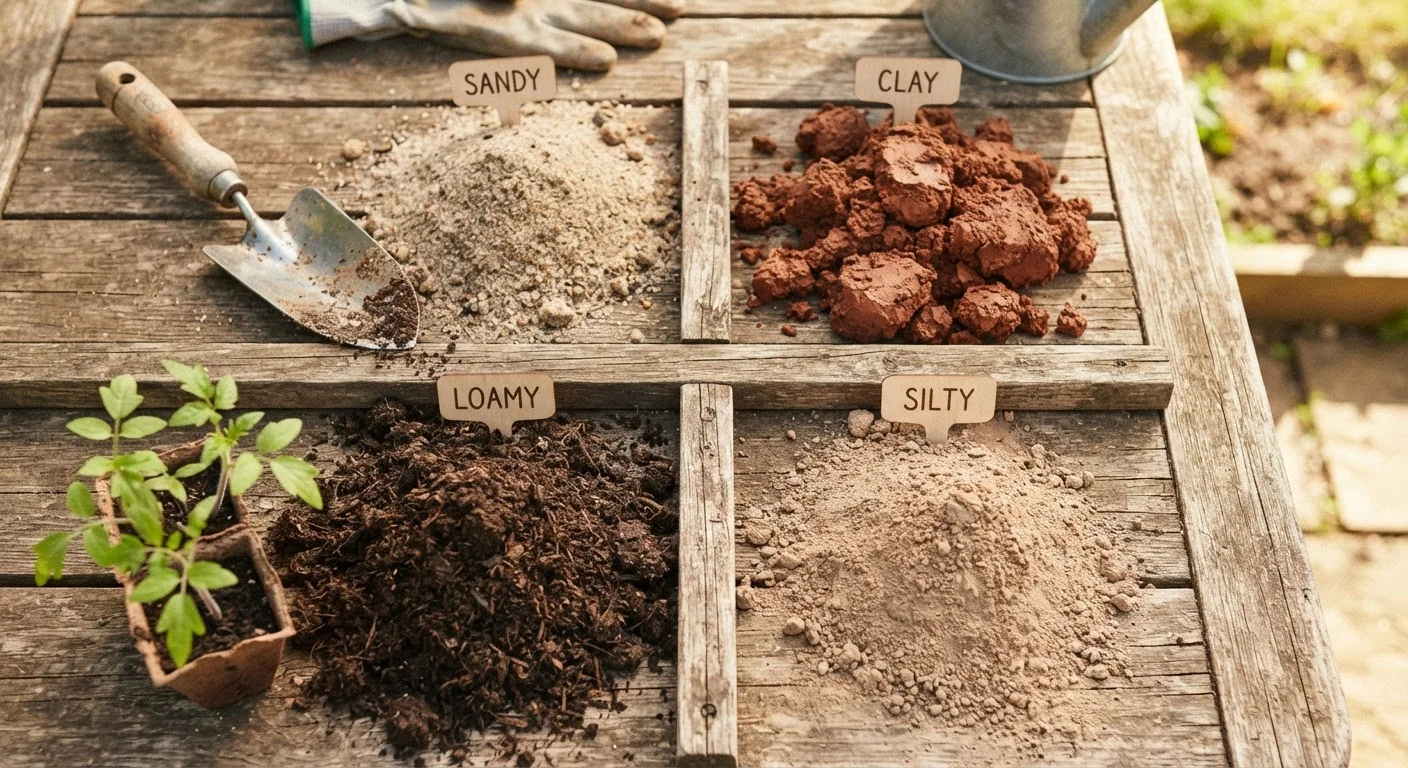
Soil is made up of mineral particles, organic matter, air, and water - and the ratio of particle sizes defines its character. There are four primary types every gardener should recognize:
- Sandy soil has large particles with lots of air space. Water moves through it quickly, which means nutrients leach out fast. It warms up early in spring but dries out rapidly.
- Clay soil has very fine, tightly packed particles. It holds water and nutrients well but drains slowly, compacts under foot traffic, and can become rock-hard when dry.
- Silty soil sits between sand and clay in particle size. It's fertile and moisture-retentive but can compact over time and become slippery when wet.
- Loamy soil is the gardener's ideal - a balanced mixture of sand, silt, and clay that drains well, holds nutrients, and is easy to work with.
Most American yards don't fall neatly into one category. A quick at-home test can reveal where yours lands. Our first-timer's guide to starting a garden walks through this as part of a broader site-assessment process.
Soil Type vs. Soil Quality Are Different Things
Soil type describes its physical texture - the ratio of sand, silt, and clay. Soil quality refers to how well it supports plant life, which also depends on organic matter content, pH, drainage, and microbial activity. A clay soil that's been well-managed with compost for years can outperform a naturally loamy soil that's been compacted or depleted.
How to Test Your Soil at Home
You don't need a laboratory to get useful information about your soil. Two simple methods work well for most home gardeners:
- The ribbon test: Take a moist, golf-ball-sized clump of soil and press it between your thumb and forefinger to form a ribbon. A ribbon longer than 2 inches that feels smooth indicates high clay content. A ribbon that breaks apart quickly or feels gritty suggests more sand.
- The jar test: Fill a clear jar one-third full of soil, top it with water, shake vigorously, and let it sit undisturbed for 24-48 hours. Sand settles to the bottom first, silt in the middle, and clay floats near the top. The relative thickness of each layer tells you your soil's composition.
For pH and nutrient levels, an inexpensive home test kit offers a reliable starting point. Your local cooperative extension service - run through the USDA - often provides low-cost or free soil testing with specific regional recommendations.
Send a Sample to Your Extension Office
Your state's cooperative extension service - affiliated with a land-grant university - often provides soil testing for a modest fee, returning detailed results with region-specific amendment recommendations. This is especially worthwhile before establishing a new garden bed or planting fruit trees, where soil conditions have long-term consequences.
Matching Soil Amendments to What Your Garden Actually Has
Once you know your soil type, targeted amendments make a real difference. Here's how to approach the most common situations:
~95%
Of plant problems linked to soil issues
Cooperative extension educators frequently cite soil health - particularly poor drainage, compaction, or pH imbalance - as the underlying factor in the majority of home garden failures.
6.0-7.0
Ideal pH range for most vegetables
The USDA and most university extension services recommend this slightly acidic to neutral pH window for common food crops including tomatoes, peppers, and leafy greens.
2-3 inches
Compost to add each season
Most soil scientists and extension gardening programs recommend this annual application depth to steadily improve structure, drainage, and organic matter content over multiple growing seasons.
For sandy soil
Work in generous amounts of compost - at least 2-3 inches mixed into the top 8-10 inches of soil. Compost adds organic matter that binds sandy particles together and holds moisture. Mulching the surface also slows evaporation between waterings.
For clay soil
Compost is again your best tool, but avoid adding sand alone - mixing coarse sand into clay can create a concrete-like texture. Organic matter opens up clay structure over time. Raised beds are a practical workaround if your clay is severely compacted.
For pH correction
If your soil tests too acidic (below 6.0 for most vegetables), ground limestone is a common amendment. If it's too alkaline, elemental sulfur or acidic compost can help bring it down. Always follow package guidance and retest after a growing season before adding more.
Our complete vegetable garden guide goes deeper on amendment rates and timing for food crops.
Plants That Prefer Different Soil Conditions
Understanding your soil also helps you choose plants likely to succeed without heavy intervention. Matching plants to conditions is often easier than trying to engineer perfect soil for every species.
Some plants are notably adaptable. Raised bed gardening lets you bring in a custom soil mix when your native soil is a poor fit for what you want to grow - a useful strategy for vegetables, herbs, and shallow-rooted annuals.
One common misconception is that all gardens need the same amendments year after year. This piece on gardening myths beginners believe addresses that and other over-generalizations that can lead to unnecessary expense or plant failure.
The most durable soil improvement strategy for any garden type is a consistent addition of compost. It buffers pH, feeds soil organisms, and gradually shifts almost any soil toward a more workable texture - season by season.
“Feed the soil, not the plant. Healthy, biologically active soil is the foundation of a productive garden - no amount of fertilizer compensates for poor soil structure.”
— USDA Natural Resources Conservation Service, Federal agency focused on soil health and conservation
Frequently Asked Questions
The ribbon test is a quick method: dampen a small handful of soil and try to roll it into a ribbon between your thumb and fingers. Clay-heavy soil forms a long, smooth ribbon; sandy soil falls apart immediately. A jar test - shaking soil in water and letting particles settle in layers - gives a more visual breakdown of your proportions.
Not necessarily. Clay soil retains moisture and nutrients well, which some plants appreciate. The challenge is that it compacts easily and drains slowly. Adding compost and avoiding walking on wet clay beds can dramatically improve its structure over time.
Topsoil is the uppermost layer of earth and varies widely in quality - it may be sandy, compacted, or nutrient-poor. Bagged 'garden soil' products are typically amended blends intended for in-ground use. Neither is a universal fix; what you add should match your existing soil's needs.
Testing every two to three years is a reasonable baseline for most home gardens. Test more frequently if plants are consistently underperforming or if you've recently added large amounts of amendments. Inexpensive test kits are available at garden centers, or you can send a sample to your local cooperative extension office for a detailed analysis.
Yes. Homemade compost from kitchen scraps and yard waste is one of the most effective soil amendments available. Mulching with leaves or grass clippings, practicing no-till methods, and planting cover crops like clover also improve soil health over time with minimal cost.
Significantly. Sandy soil drains fast and dries out quickly, so plants in sandy beds may need more frequent watering. Clay soil holds moisture longer, which can lead to overwatering if you're not careful. Loamy and well-amended soils hold moisture evenly and are more forgiving.
The content provided on our blog site traverses numerous categories, offering readers valuable and practical information. Readers can use the editorial team’s research and data to gain more insights into their topics of interest. However, they are requested not to treat the articles as conclusive. The website team cannot be held responsible for differences in data or inaccuracies found across other platforms. Please also note that the site might also miss out on various schemes and offers available that the readers may find more beneficial than the ones we cover.