

The Simple Science Behind R-Value
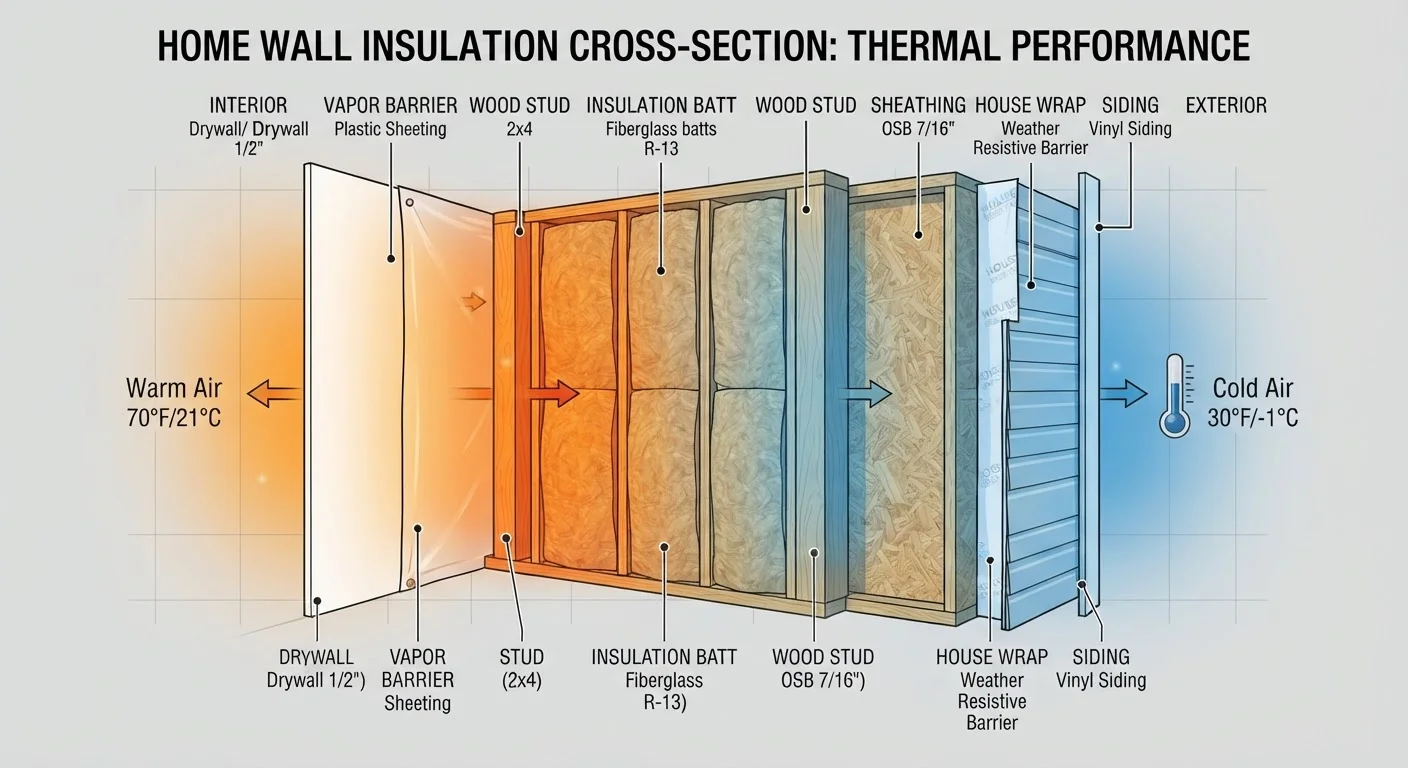
Heat naturally moves from warm areas to cool ones - through your walls, ceiling, floors, and any gap it can find. Insulation slows that movement. R-value (the "R" stands for thermal resistance) is the standardized measure of how effectively a given material slows that heat flow.
A material rated R-15 resists heat transfer roughly twice as well as one rated R-7. The scale is linear and additive: if you install R-19 batts and then add R-11 rigid foam on top, the combined assembly provides R-30.
What the number does not tell you is everything. R-value is measured under controlled lab conditions. Real-world performance depends on correct installation, the absence of gaps, and keeping insulation dry and uncompressed. A perfect R-38 batt installed with even small air gaps can perform significantly below its rated value.
R-Value Measures Conduction, Not Air Leakage
R-value only quantifies resistance to conductive and convective heat transfer through a material - it does not measure how well a product blocks air infiltration. A home can have high R-value insulation and still lose substantial heat through unsealed gaps around outlets, plumbing penetrations, and attic hatches. Air sealing and insulation work best as a system, not as substitutes for each other.
Why Climate Zone Changes the Target Number
Not every home needs the same R-value. The US Department of Energy divides the country into eight climate zones - ranging from hot, humid regions like South Florida (Zone 1) to frigid northern areas like Minnesota and Maine (Zone 7). Each zone has recommended minimum R-values for attics, walls, floors, and crawl spaces.
A home in Phoenix, Arizona may need attic insulation rated at R-30 to R-38. A comparable home in northern Wisconsin may need R-49 to R-60. Installing less than the zone recommendation leaves energy savings on the table; however, dramatically exceeding it in a mild climate offers little additional return.
R-30 to R-60
Recommended attic R-value range by climate zone
According to the US Department of Energy's zone-based insulation recommendations for existing homes.
Up to 15%
Potential heating and cooling cost reduction
The EPA estimates air sealing combined with proper insulation can reduce heating and cooling costs by up to 15% for the average US home.
R-6 to R-7
Highest per-inch R-value among common materials
Closed-cell spray foam achieves the highest thermal resistance per inch of thickness of widely used residential insulation types.
For location-specific targets, the DOE's Zone Map (available at energystar.gov and energy.gov) is the authoritative reference. Your local utility company often provides the same guidance and may offer rebate programs for meeting or exceeding zone minimums.
R-Value by Material: What the Numbers Look Like in Practice
Different insulation materials achieve different R-values per inch of thickness. Understanding this helps when you have limited space - such as a 2×4 wall cavity - and need to maximize performance.
- Fiberglass batts: Approximately R-3.1 to R-3.4 per inch. Common, widely available, and sized for standard stud cavities.
- Mineral wool (rock wool) batts: Around R-3.0 to R-3.3 per inch. Better moisture and fire resistance than fiberglass.
- Blown-in cellulose: Roughly R-3.2 to R-3.8 per inch. Made from recycled paper; good for irregular attic spaces.
- Open-cell spray foam: About R-3.5 to R-3.7 per inch. Seals air gaps well but lower density than closed-cell.
- Closed-cell spray foam: R-6.0 to R-7.0 per inch - the highest per-inch value of common options. Also acts as an air and vapor barrier.
- Rigid foam boards (polyisocyanurate): Up to R-6.5 per inch, useful for adding insulation without building out wall thickness.
When you're weighing where to insulate first, see our comparison of attic vs. wall insulation to understand where heat loss is greatest in most homes.
Match Material to the Space
For open attic floors, blown-in insulation is often easier to install at the right depth than batts. For finished wall cavities, closed-cell spray foam or rigid foam boards can deliver higher R-values in tight spaces. Choose your material based on available depth, accessibility, and moisture exposure - not just per-inch R-value alone.
Common Mistakes That Undercut R-Value Performance
Even correctly specified insulation underperforms when installation goes wrong. Here are the most frequent issues homeowners and contractors encounter:
- Compression: Stuffing a thick batt into a shallow cavity reduces its effective R-value. Always match batt thickness to cavity depth.
- Gaps and voids: Insulation around electrical boxes, pipes, or irregular framing is often cut short. Air moves through gaps freely, bypassing the insulation entirely.
- Moisture intrusion: Wet insulation - from roof leaks, condensation, or flooding - loses effectiveness and can foster mold. Address moisture sources before insulating or re-insulating.
- Ignoring air sealing: R-value measures conductive heat resistance, not air leakage. Sealing gaps with caulk or spray foam before installing insulation is essential for real-world performance.
If you're unsure about your current insulation levels or suspect gaps, a certified home energy auditor can assess your home with blower-door testing and infrared imaging - tools that reveal where heat is actually escaping.
Frequently Asked Questions
A higher R-value does mean more thermal resistance, but there are diminishing returns as you add more. The ideal R-value depends on your climate zone, the part of your home being insulated, and your budget. Over-insulating one area while leaving gaps elsewhere is less effective than balanced coverage.
Some insulation materials, particularly open-cell spray foam and loose-fill cellulose, can lose a small amount of effectiveness if they absorb moisture or settle over time. Rigid foam boards and closed-cell spray foam tend to hold their rated R-value longer when properly installed and kept dry.
Yes, in most cases you can layer new insulation over existing material, and the R-values add together. The exception is if the existing insulation is wet, moldy, or heavily compressed - those issues should be resolved before adding more. An energy auditor can assess your current situation.
The US Department of Energy recommends attic insulation ranging from R-30 in mild southern climates to R-60 in colder northern regions. Your specific climate zone determines the target. Check the DOE's online Zone Map or contact your local utility for guidance tailored to your area.
Yes, compressing fiberglass or mineral wool batts reduces their R-value. Batts are rated at their full, uncompressed thickness. Forcing a thicker batt into a thinner cavity lowers the actual thermal resistance you get, so matching batt thickness to cavity depth matters.
The content provided on our blog site traverses numerous categories, offering readers valuable and practical information. Readers can use the editorial team’s research and data to gain more insights into their topics of interest. However, they are requested not to treat the articles as conclusive. The website team cannot be held responsible for differences in data or inaccuracies found across other platforms. Please also note that the site might also miss out on various schemes and offers available that the readers may find more beneficial than the ones we cover.