

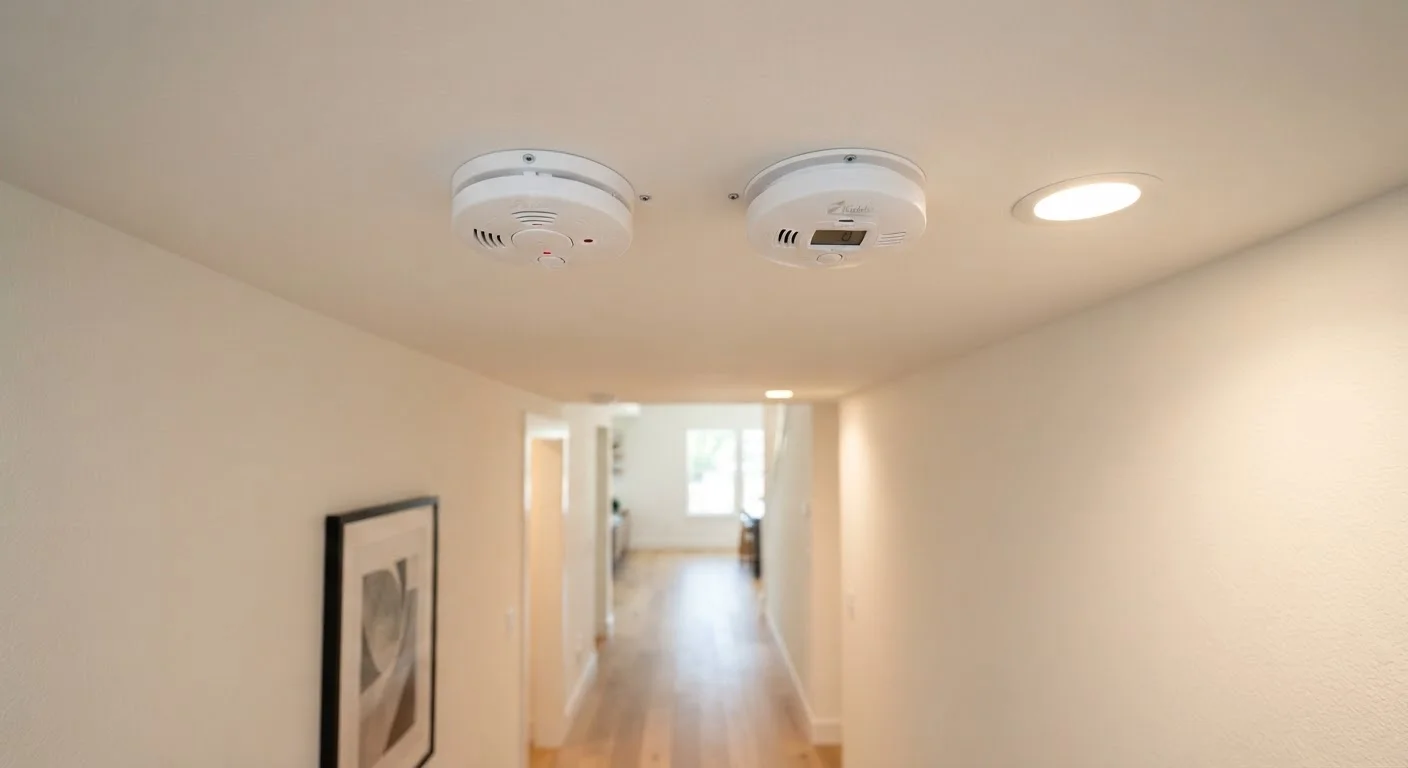
Why Placement Is the Real Safety Variable
Most households own at least one smoke alarm. Fewer have carbon monoxide (CO) detectors, and fewer still have either device in the right location. An alarm that sounds too late - or not at all - because it was mounted in the wrong spot provides almost no protection. Understanding where each detector type belongs, and why, is the first step toward a genuinely safer home.
Smoke and CO detectors are governed by a mix of national model codes and local ordinances. Requirements vary by state and municipality, so verify specifics with your local fire marshal or building department. The guidance below reflects broadly accepted best practices from the National Fire Protection Association (NFPA) and the U.S. Consumer Product Safety Commission (CPSC).
Smoke Alarm Placement: Room by Room
Smoke rises, so alarms belong on ceilings or high on walls - generally within 12 inches of the ceiling per NFPA 72 guidance.
Required Locations
- Inside every sleeping room: Fires often start at night when doors are closed. An alarm inside the bedroom gives occupants the fastest warning.
- Outside each sleeping area: Place one in the hallway immediately adjacent to bedroom doors.
- On every level of the home: Include the basement. Do not skip finished or unfinished lower levels.
Placement Details to Get Right
- Keep alarms at least 10 feet from cooking appliances to reduce nuisance trips from steam or grease.
- In rooms with peaked (cathedral) ceilings, mount the alarm within 3 feet of the peak but not at the very apex, where dead air can delay detection.
- Do not install in bathrooms, garages, or unheated spaces - humidity and temperature extremes cause false alarms and premature sensor failure.
For a broader look at home upkeep tasks that first-time owners often overlook, see our Home Maintenance for First-Time Owners guide.
Carbon Monoxide Detector Placement
CO is odorless, colorless, and roughly the same density as air - meaning it disperses fairly evenly through a room rather than rising or sinking sharply. This changes the placement logic compared to smoke alarms.
Carbon Monoxide (CO)
A colorless, odorless gas produced by incomplete combustion of fuels such as natural gas, propane, oil, or wood. It can accumulate indoors from appliances, fireplaces, or vehicle exhaust and is dangerous at elevated concentrations.
Ionization Smoke Alarm
A type of smoke detector that uses a small amount of radioactive material to ionize air inside a sensing chamber. It typically responds faster to fast-flaming fires than to slow, smoldering ones.
Photoelectric Smoke Alarm
A detector that uses a light beam and sensor to detect smoke particles. It generally responds faster to slow, smoldering fires and is less prone to nuisance alarms from cooking steam.
Combination Detector
A single device that integrates both smoke detection (often dual-sensor ionization and photoelectric) and CO detection. Combination units can simplify installation but must still be placed to satisfy requirements for both device types.
NFPA 72
The National Fire Alarm and Signaling Code published by the National Fire Protection Association. It establishes widely referenced standards for installation, testing, and maintenance of fire and CO detection systems in residential buildings.
Where CO Detectors Belong
- Outside each sleeping area: CO exposure during sleep is particularly dangerous because symptoms (headache, dizziness, confusion) can develop before a person wakes.
- On every level, including the basement: Furnaces, water heaters, and other fuel-burning appliances are common CO sources.
- Near attached garages: Vehicle exhaust is a leading cause of residential CO incidents. Install a detector on the wall separating the garage from the living space.
Mounting Height
Manufacturers typically recommend mounting CO detectors at chest or eye level on a wall, or on a low shelf. Because CO disperses at room air temperature, ceiling mounting is acceptable but not mandatory. Follow the specific instructions included with your unit - they take precedence over general guidance.
Because CO risk is closely tied to home ventilation quality, it's worth reviewing our companion piece on furnace filters, HVAC airflow, and indoor air quality.
Testing, Replacing, and Staying Current
Even correctly placed detectors fail if they aren't maintained. A straightforward schedule prevents most problems.
Combination Units: Convenient but Not Automatic
Combination smoke-and-CO detectors can simplify device counts, but they must still satisfy placement requirements for both alarm types. A combination unit placed only near a bedroom may not adequately cover lower-level CO risks near a furnace room. Review both sets of placement rules before consolidating devices. Always follow the manufacturer's specific installation instructions included with the unit.
Testing
- Press the test button on each alarm once a month. A working alarm will sound briefly. If it doesn't, replace the battery or the unit.
- Test after returning from extended travel - batteries can drain during dormant periods.
Battery Replacement
- Non-sealed units: replace batteries at least once a year, or when the low-battery chirp begins.
- Many current models use sealed, long-life batteries designed to last the life of the unit (typically 10 years) - check the label before assuming the battery is replaceable.
Device Lifespan
- Smoke alarms: Replace the entire unit every 10 years from the manufacture date printed on the back.
- CO detectors: Most units should be replaced every 5 to 7 years. Check the manufacture date on the label; sensor accuracy degrades over time even if the unit still chirps during a test.
When replacing units, record the new manufacture date on a calendar or in a home maintenance log so the next replacement cycle isn't guesswork. Consistent, documented upkeep habits extend to many areas of homeownership - the same discipline that keeps your detectors current helps manage larger property systems reliably.
This article provides general home safety information for educational purposes. Local fire codes, building ordinances, and manufacturer instructions may differ from the guidance above - always consult your local fire marshal, building department, and the product documentation for requirements specific to your home and location.
The content provided on our blog site traverses numerous categories, offering readers valuable and practical information. Readers can use the editorial team’s research and data to gain more insights into their topics of interest. However, they are requested not to treat the articles as conclusive. The website team cannot be held responsible for differences in data or inaccuracies found across other platforms. Please also note that the site might also miss out on various schemes and offers available that the readers may find more beneficial than the ones we cover.