

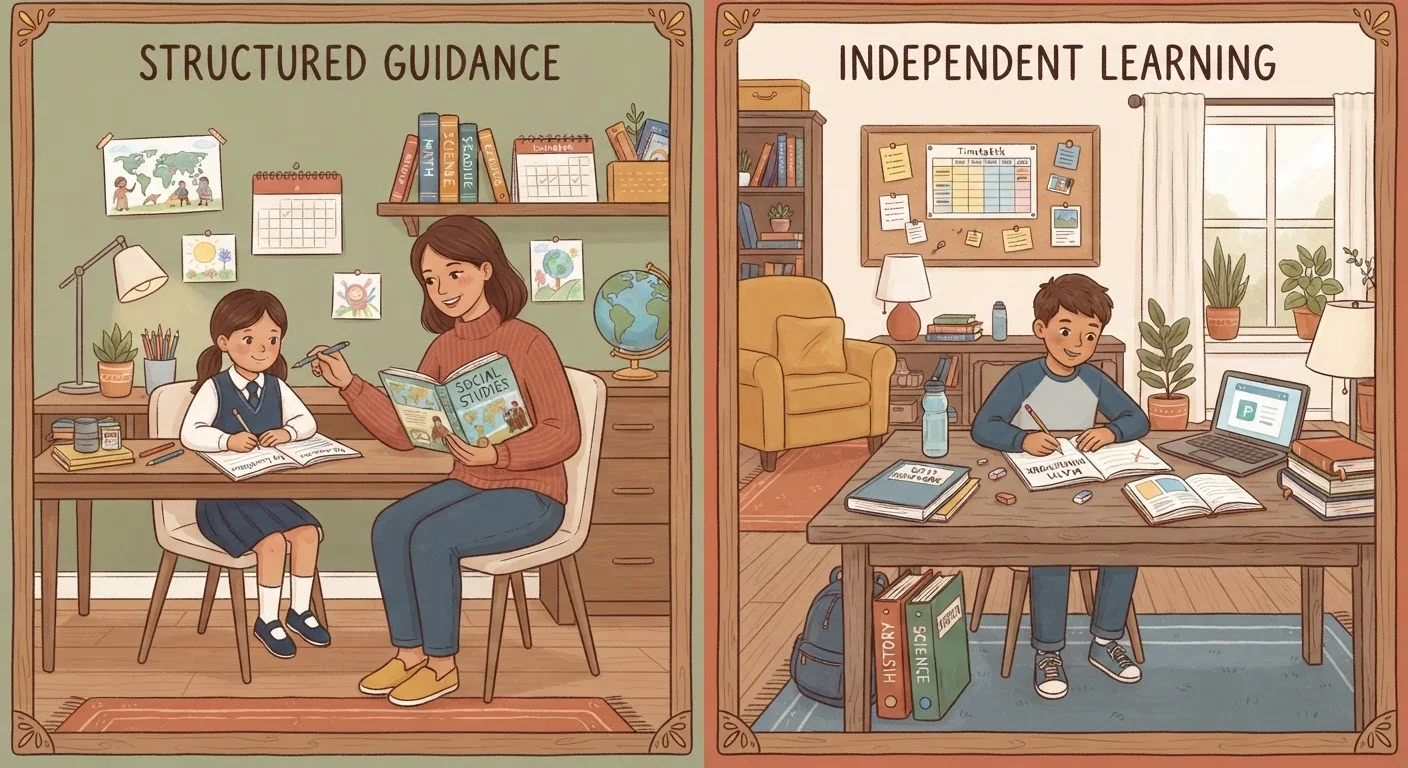
Option A
Full-Time Homeschooling
The complete alternative to traditional schooling.
Best for: Families ready to take on the full responsibility of designing and delivering their child's entire K-12 education.
Option B
Supplemental At-Home Learning
The flexible add-on to an existing school education.
Best for: Parents who want to deepen, extend, or reinforce what their child learns in a traditional school setting without leaving that system.
What Each Path Actually Means
The phrase "learning at home" gets used loosely, which is where confusion starts. Homeschooling and supplemental at-home learning both happen in the house, but they are structurally different in almost every way that matters.
Full-time homeschooling means a family has opted out of the traditional school system entirely. The parent or guardian becomes the primary educator, responsible for planning and delivering instruction across all subjects, tracking academic progress, and complying with their state's legal requirements. For a fuller picture of what that involves day to day, see our overview of homeschooling in the U.S..
Supplemental at-home learning, by contrast, assumes that a child is enrolled in a traditional school and continues to attend. Parents add enrichment, reinforcement, or extension activities at home - reading aloud, working through a math concept, pursuing a passion project - without replacing the school's role. It is additive, not substitutive.
| Criterion | Full-Time Homeschooling | Supplemental At-Home Learning |
|---|---|---|
| Replaces traditional school | Yes - entirely | No - child remains enrolled |
| Legal requirements | Yes - varies by state | None |
| Parent time commitment | High - full-time involvement | Flexible - as little or much as fits |
| Curriculum responsibility | Parent designs or selects all | School handles core curriculum |
| Scheduling flexibility | Full control over daily schedule | Built around school schedule |
| Cost | Variable; curriculum and materials costs | Low to none; uses existing resources |
| Access to school services (IEPs, sports) | Varies by state and district | Fully retained through enrollment |
| Best suited for | Families seeking full customization | Families wanting targeted enrichment |
The Practical Demands: Time, Planning, and Legal Responsibility
One of the clearest lines between these two paths is what they require from parents on a practical level.
Homeschooling carries real legal obligations. All 50 states permit homeschooling, but regulations vary widely - some states require notification, standardized testing, or portfolio reviews, while others impose minimal oversight. Parents must understand and meet the rules in their state before withdrawing a child from school. Beyond legal compliance, they must select or design a curriculum, create a daily structure, and assess whether their child is making adequate progress. This is a significant ongoing commitment, not a one-time decision. Our article on the honest trade-offs of full-time homeschooling explores what families often underestimate going in.
Supplemental learning has no legal requirements and no formal structure. Parents can do as much or as little as fits their family. Even small, consistent habits - 20 minutes of reading, a weekend nature walk paired with journaling - add up meaningfully over a school year. For families unsure where to begin, this starting point for busy parents offers practical, low-pressure ideas.
~3.3M
Homeschooled students in the U.S.
The National Center for Education Statistics estimated approximately 3.3 million homeschooled students in the United States as of its most recent national survey.
50 states
All states permit homeschooling
While homeschooling is legal across all 50 U.S. states, regulations governing notification, testing, and curriculum vary significantly by state.
55%
Parents cite school environment as a factor
According to NCES survey data, concern about the school environment is among the most commonly cited reasons parents choose to homeschool.
Learning Outcomes and Flexibility
Both paths can support strong learning outcomes, but they do so through different mechanisms and with different flexibility trade-offs.
Homeschooling allows families to move at their child's natural pace - accelerating through material a child has mastered, slowing down when a concept needs more time. Families can choose from a wide range of curriculum philosophies, from Charlotte Mason's literature-rich approach to classical education or project-based models. See our guide to major curriculum approaches explained for a comparison of these frameworks. This flexibility is genuinely powerful, but it also means the quality of education is heavily dependent on the parent's capacity and consistency.
Supplemental learning, while narrower in scope, lets parents target specific gaps or strengths. If a child struggles with writing, a parent can spend focused time on that skill at home without needing to restructure their entire education. Families with children who have IEPs or 504 plans should be aware that those supports remain in place through the school - something to factor into the decision. Our article on what IEPs and 504 plans actually do explains how these differ and who they serve.
Project-based learning at home is one enrichment approach that works well in both contexts - it builds critical thinking and curiosity without requiring specialized equipment or a strict curriculum.
Supplemental Learning and School Subjects
Some subjects are harder to support at home than others, regardless of whether you are homeschooling or supplementing. Math, writing, and foreign languages tend to require the most deliberate approach. Our article on subjects families most often struggle to teach at home outlines why these are challenging and what tends to help.
Which Path Fits Your Family?
There is no universal right answer. The better question is: what does your family actually need, and what can you realistically sustain?
Homeschooling is worth exploring seriously if your child has needs the traditional system has consistently failed to meet, if your family values and schedule make it structurally feasible, and if you have the energy and resources to commit long-term. It is a whole-family lifestyle shift, not just an educational choice. The research on common homeschooling myths is worth reading before deciding, especially on questions of socialization and academic outcomes.
Supplemental learning is the right fit for most families who are broadly satisfied with their child's school but want to do more at home. It respects the school's role while giving parents a meaningful way to stay involved. For a sense of how that involvement can evolve as children age, this parent road map from kindergarten to 12th grade offers a useful framework.
Both paths share the same underlying goal: a child who is curious, capable, and supported. The route you choose should match your family's real capacity - not an idealized version of it.
The content provided on our blog site traverses numerous categories, offering readers valuable and practical information. Readers can use the editorial team’s research and data to gain more insights into their topics of interest. However, they are requested not to treat the articles as conclusive. The website team cannot be held responsible for differences in data or inaccuracies found across other platforms. Please also note that the site might also miss out on various schemes and offers available that the readers may find more beneficial than the ones we cover.