

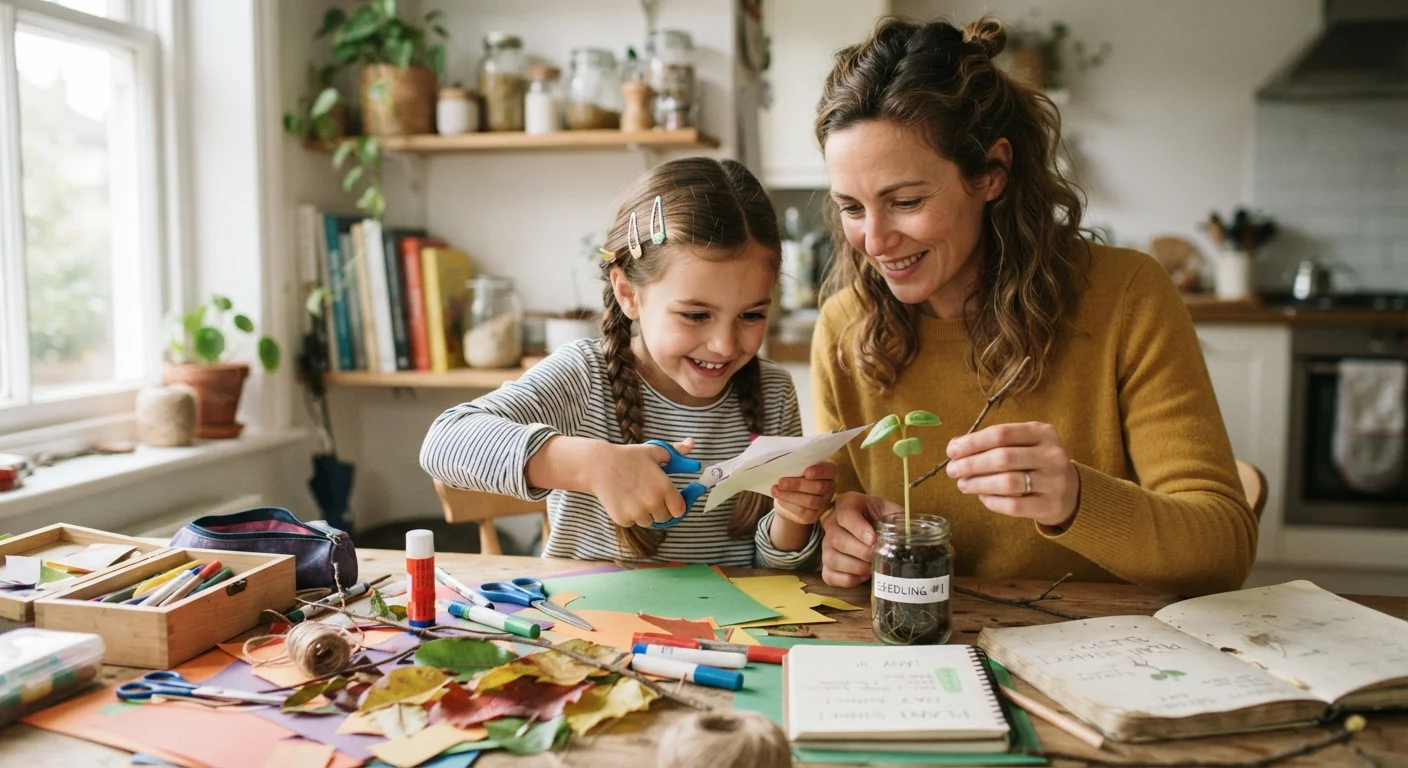
Why Projects Beat Worksheets for Deeper Learning
Worksheets have their place - they can reinforce a specific skill or fact efficiently. But they rarely ask children to do anything with knowledge beyond recall. Project-based learning (PBL) is a structured approach in which students investigate a meaningful question over time and produce something that demonstrates their understanding. Research in educational psychology consistently links this kind of active, applied learning to stronger retention and transferable skills.
For families, the appeal is practical: PBL doesn't require a lab, a budget, or a teaching credential. It requires a curious child, a good question, and a parent willing to step back. It pairs naturally with classroom learning - a child studying ecosystems at school, for example, might investigate the specific ecosystem in your backyard. For more context on how at-home enrichment relates to what happens in school, see the key differences between homeschooling and supplemental learning.
PBL also builds the habits that critical thinking researchers identify as foundational: asking precise questions, evaluating evidence, tolerating ambiguity, and revising conclusions when new information arrives. These are habits formed over many projects, not a single lesson.
PBL Supplements School - It Doesn't Replace It
Project-based learning at home works best as enrichment alongside classroom instruction, not as a substitute for it. If you are considering a more structured approach to home education, the differences between supplemental learning and full-time homeschooling are worth understanding before you commit significant time and resources.
What You Need Before You Start
The barrier to entry for home PBL is lower than most parents assume. No specialist curriculum or expensive kit is required. The essentials are listed below, followed by a few optional tools that can make the process smoother.
What you will need
Notebook or project journal
Gives the child a dedicated space to record questions, findings, and reflections throughout the project.
Library card or internet access
Enables research into the driving question using books, articles, or reputable websites.
Index cards
Useful for organising ideas, creating timelines, or building simple visual displays.
Basic craft supplies (scissors, glue, markers)
Support the creation of a tangible final product such as a poster, model, or booklet.
If you are new to enriching learning at home and want a broader starting point before diving into projects, this practical overview for busy parents covers a range of low-pressure approaches alongside PBL.
Running Your First Home Project: Step by Step
The five steps below follow a widely used PBL framework adapted for home use. Each session can be as short as 20 minutes, making this approach workable even during a busy school week. For ideas on fitting structured learning into your family's routine, this guide to designing a home learning schedule offers flexible models.
Identify a genuine driving question
The foundation of any PBL project is a question that is open-ended, meaningful to the child, and impossible to answer with a single Google search. Ask your child what they genuinely wonder about - a natural phenomenon, a community problem, a historical mystery, or a skill they want to develop. Shape their interest into a driving question using the frame "How might we…" or "Why does…" Avoid questions with a single right answer.
Build a simple project plan together
Co-create a one-page plan that lists the driving question, what the child already knows, what they need to find out, and what the final product might look like (a model, a presentation, a written report, a video, an experiment). Agree on a realistic timeline - even a single week of 20-minute sessions works well. Writing the plan down transforms the project from an idea into a commitment.
Investigate using multiple sources
Encourage the child to gather information from at least two different types of sources - for example, a library book and an interview with a knowledgeable adult, or a reputable website and a documentary. Teach them to note where each fact came from. This builds source-evaluation habits that transfer directly to classroom research skills and aligns with what educators call information literacy.
Create a tangible final product
The product is what makes PBL distinct from a reading assignment. It should demonstrate understanding rather than simply summarise facts. Options include: a poster explaining findings, a short video or podcast, a working model, a persuasive letter to a local official, a recipe developed through experimentation, or a storybook for a younger sibling. The format matters less than the requirement to organise and communicate ideas to an audience beyond just the parent.
Reflect and document what was learned
Reserve the final session for structured reflection. Ask three simple questions: What did you discover that surprised you? What would you do differently? What new question do you have now? Have the child write or dictate answers in their project journal. This metacognitive step - thinking about their own thinking - is where much of the long-term learning value is consolidated, according to educational research on self-regulated learning.
Keep the Focus on Process, Not Perfection
The goal of PBL is the thinking that happens during investigation, not a polished end product. Resist the urge to correct your child's work heavily or take over when the project stalls. Struggle and revision are where the deepest learning occurs. Praise effort and curiosity over accuracy and neatness.
Once your child completes a first project, the process becomes easier to repeat. Many families find that children begin proposing their own project ideas unprompted - which is exactly the outcome PBL is designed to produce. For a complementary strategy that strengthens memory between projects, retrieval practice is worth exploring as an everyday study habit.
Avoid Turning Projects Into Assignments
One of the most common pitfalls is gradually converting a project into a parent-directed task - choosing the topic, structuring every session, and grading the output. When children lose ownership, motivation drops sharply. Your role is to ask good questions and provide resources, not to manage the outcome.
The content provided on our blog site traverses numerous categories, offering readers valuable and practical information. Readers can use the editorial team’s research and data to gain more insights into their topics of interest. However, they are requested not to treat the articles as conclusive. The website team cannot be held responsible for differences in data or inaccuracies found across other platforms. Please also note that the site might also miss out on various schemes and offers available that the readers may find more beneficial than the ones we cover.