

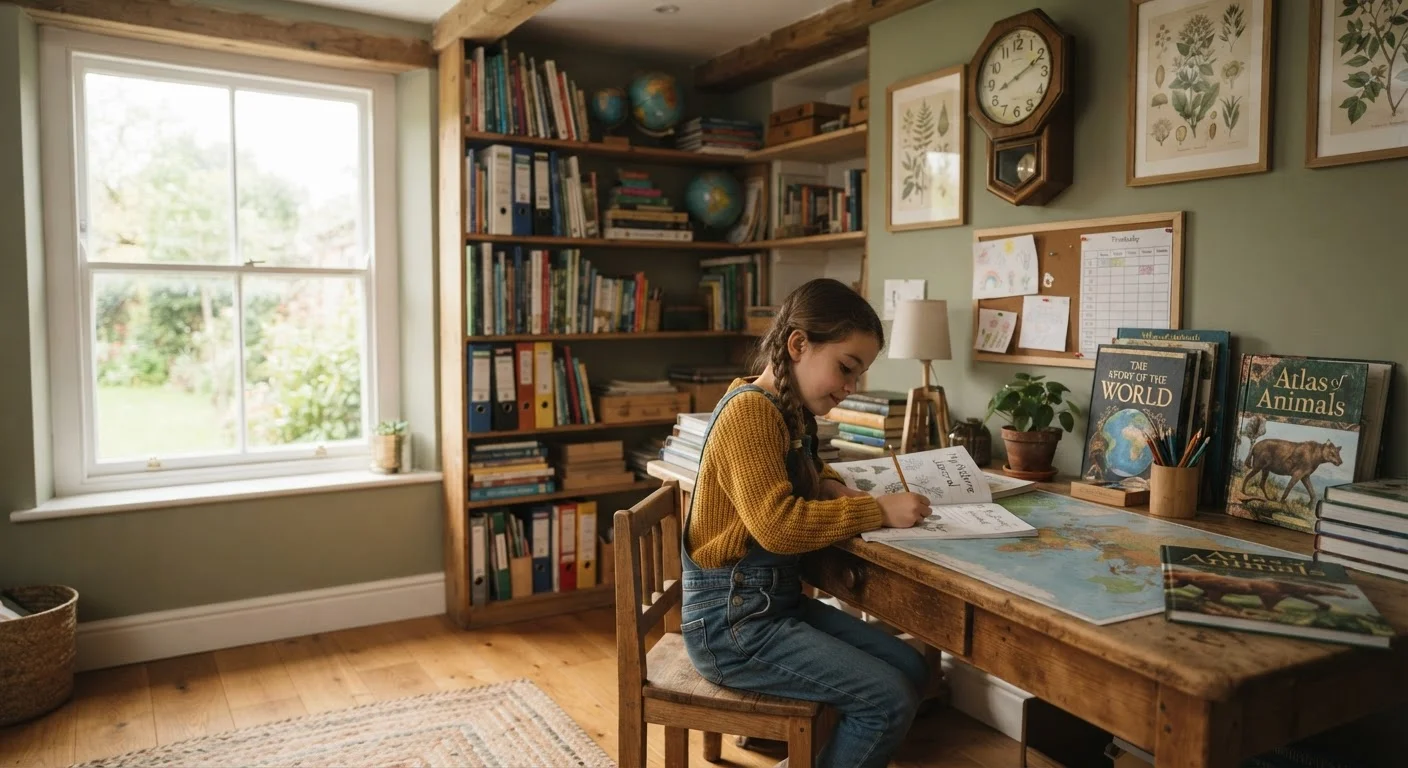
Why Structure Matters - Without Becoming Rigid
Children thrive on predictability. Research in developmental psychology consistently shows that routines reduce anxiety and free up cognitive resources that would otherwise go toward wondering what comes next. A structured learning day doesn't mean every minute is scripted - it means the shape of the day is familiar enough that your child can relax into it.
This is especially relevant for families who supplement classroom education at home. As explored in Homeschooling vs. Supplemental At-Home Learning, the goals of at-home enrichment are different from full-time homeschooling - and so the structure should be proportionally lighter and more flexible. The aim isn't to recreate school; it's to add value to what school already provides.
Structure Should Serve the Child, Not the Parent
A learning day that works is one your child can actually sustain - not one that looks impressive on paper. If your child is consistently stressed, resistant, or exhausted, that's a signal the structure needs adjusting, not more enforcement. Build in flexibility from the start rather than treating it as a failure of the plan.
If you're just beginning this process, Enriching Your Child's Education at Home offers a useful starting point for families who aren't yet sure what at-home learning should look like in practice.
What You'll Need Before You Begin
What you will need
Visual schedule or printed timetable
Gives children a clear, concrete view of the day's rhythm so transitions feel predictable rather than abrupt.
Timer (digital or analog)
Helps enforce focused work blocks and break periods without constant parental intervention.
Notebook or learning journal
Provides a dedicated place for notes, questions, and reflections that children can review over time.
Whiteboard or chalkboard
Useful for working through problems visually and keeping daily goals visible throughout the session.
How to Build the Learning Day Step by Step
Avoid Replicating a Full School Day at Home
Home learning does not need to mirror a six-hour school schedule. Research on cognitive load suggests that children learn more efficiently in shorter, focused sessions than in prolonged, classroom-length blocks. Trying to replicate the full school day at home often leads to frustration and disengagement on both sides.
Map out your family's fixed commitments
Before building any learning structure, list every non-negotiable in your day: school drop-off and pickup times, meals, extracurricular activities, and caregiving responsibilities. These form the immovable boundaries your schedule must work around. Identifying them first prevents you from designing a plan that collapses the moment real life intervenes.
Identify your child's daily energy peaks
Children's attention and cognitive performance fluctuate throughout the day. Many younger children focus best in mid-morning, while some older students hit a second peak in late afternoon. Observe your child over several days without intervention: when are they naturally alert and engaged, and when do they tend to lag? Schedule demanding subjects - math, writing, reading comprehension - during their peak window, and save lighter tasks or creative work for lower-energy periods.
Design learning blocks with built-in breaks
Structure learning in focused blocks followed by deliberate rest. For children aged 6-8, blocks of 15-20 minutes work well; ages 9-12 can often sustain 25-30 minutes; teenagers may manage 40-45 minutes before needing a reset. After each block, schedule a break of roughly 5-10 minutes - movement, a snack, or unstructured time. This pattern, sometimes called distributed practice, is supported by memory and learning research as more effective than long, unbroken study sessions.
Choose two or three learning priorities per session
Trying to cover every subject every day overwhelms both children and parents. Instead, identify two or three focused priorities for each session - one core skill like reading or math, and one enrichment area such as science curiosity, creative writing, or a subject your child loves. Rotate priorities across the week so broader coverage happens over time rather than in a single sitting. If your child's school already assigns homework, that homework counts as a learning priority; you don't need to layer additional content on top of it every day.
Build in a consistent start and end signal
Transitions are often the hardest part of a home learning day. A predictable ritual that marks the beginning - sharpening pencils, reviewing the day's plan together, or a brief breathing exercise - and a clear end signal help children mentally shift in and out of learning mode. Consistency matters more than what the ritual is. Over time, these cues become anchors that reduce the negotiation and resistance that often precede learning sessions.
Review and adjust the schedule weekly
No learning schedule survives first contact with a real week unchanged. Set aside 10 minutes each Sunday - or whatever transition day works for your family - to review what worked and what didn't. Ask your child directly: Was any part too long? Too rushed? Were there days when they felt ready to learn but had no structure, or days when structure felt forced? Treat the schedule as a living document that evolves as your child grows and as family demands shift.
Keeping the Day Sustainable for Everyone
A learning schedule only works if both the child and the adults supporting them can maintain it without resentment or exhaustion. A few principles help keep the day sustainable over weeks and months rather than just the first enthusiastic week.
Let Your Child Help Design the Schedule
Children who have a say in when and how they learn show greater ownership over their work. Sit down together and ask which subjects they prefer tackling early versus later, and where they'd like breaks. Even young children can make simple choices that meaningfully shape the rhythm of the day.
Watch for disengagement signals early. Persistent resistance, tears before sessions begin, or a child who seems to be going through the motions without absorbing anything are signs worth taking seriously. When Home Learning Stops Working outlines what to look for and how to course-correct before small problems compound.
Connect the day's end to a calming wind-down. Learning sessions that bleed into the evening with no clear close can make it harder for children to decompress before bed. A consistent transition into evening - one that doesn't involve screens immediately after cognitive work - supports both rest and next-day readiness. See Creating a Wind-Down Routine for practical evening strategies.
Finally, remember that variety in how children learn matters as much as the schedule itself. Project-based learning is one approach that builds engagement by connecting skills to real-world inquiry - and it fits naturally into a structured day without adding significant planning burden.
The content provided on our blog site traverses numerous categories, offering readers valuable and practical information. Readers can use the editorial team’s research and data to gain more insights into their topics of interest. However, they are requested not to treat the articles as conclusive. The website team cannot be held responsible for differences in data or inaccuracies found across other platforms. Please also note that the site might also miss out on various schemes and offers available that the readers may find more beneficial than the ones we cover.