

Why Method Matters as Much as Effort
Most students take notes. Fewer students take notes in a way that actually helps them learn. The difference often comes down to method - not intelligence or effort. A note-taking system shapes how information is organized on the page, which in turn shapes how easily it can be retrieved during review or a test.
The six methods below represent the most well-established approaches used in classrooms from middle school through college. None is universally superior; each fits certain subjects, learning styles, and class formats better than others. A student who uses the Cornell Method for a history lecture but switches to a mind map for brainstorming an essay isn't being inconsistent - they're being strategic.
If you're new to structured studying, our starter guide for new students covers the broader habits and mindsets that make note-taking systems actually stick.
Review Notes Within 24 Hours
Regardless of which method a student uses, reviewing notes within 24 hours of class is one of the highest-impact habits research supports. A brief 10-minute re-read - during which students add clarifying details or generate questions - dramatically reduces forgetting before the next class. Pair this habit with a consistent study routine: see Building a Study Routine That Works Across Grade Levels for practical scheduling guidance.
The Cornell Method
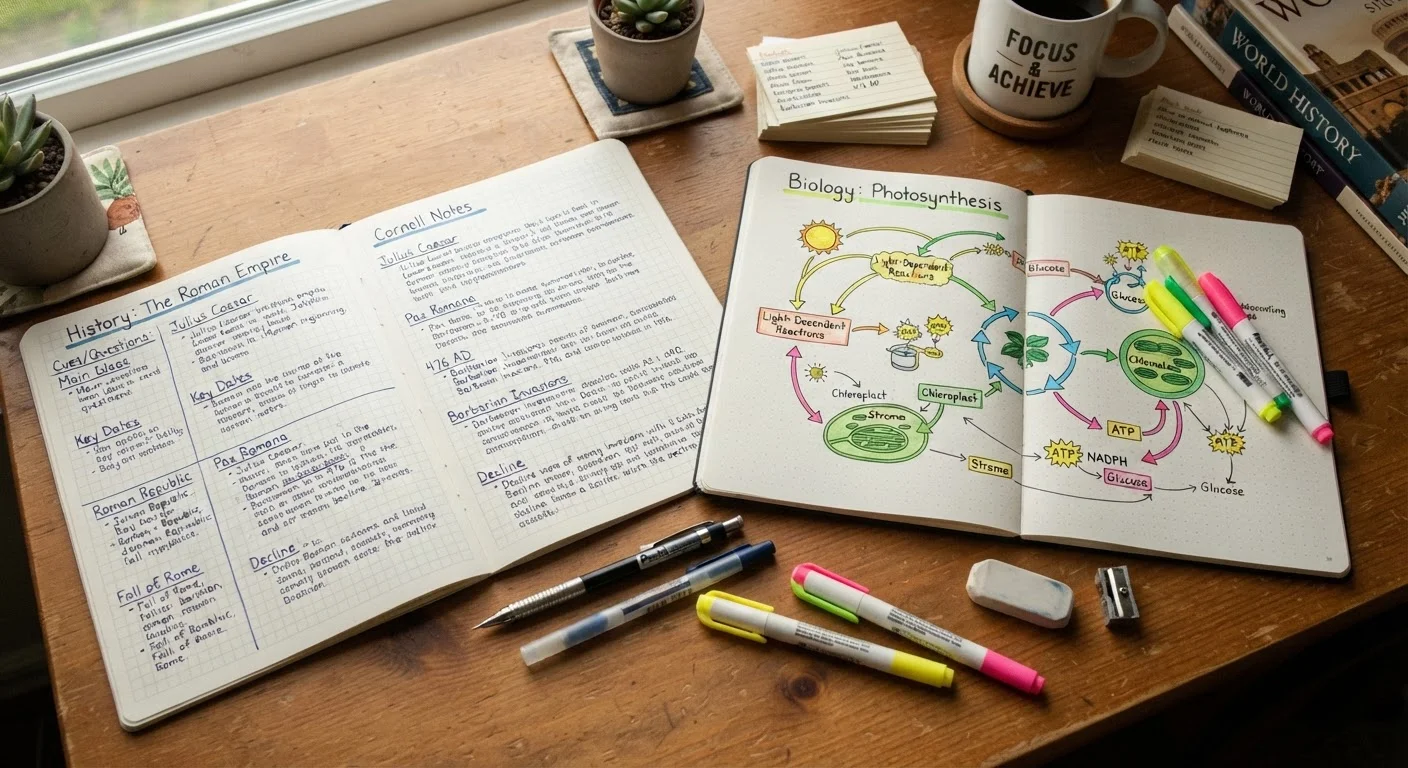
Developed at Cornell University in the 1950s, this system divides a standard page into three zones: a narrow left column for cue words or questions, a wide right column for main notes taken during class, and a summary box written at the bottom after the session ends.
What makes it powerful is built-in retrieval practice. After class, students cover the main notes and use their cue column to self-quiz - a technique cognitive science consistently links to stronger long-term memory. The summary forces synthesis rather than passive copying.
Best fit: Lecture-based classes in middle school, high school, and college; any subject where understanding relationships between ideas matters.
Covering the main notes and self-quizzing from cue words is built-in retrieval practice.
The Outline Method
Outlining uses indentation to reflect a topic's hierarchy: main ideas at the left margin, supporting details indented one level in, and specific examples or facts indented further. It mirrors how most textbooks and many lectures are structured, making it intuitive to use in real time.
The outline method works well when information is delivered in a logical, sequential order - history lectures, science unit introductions, or structured class discussions. It's less useful when a teacher jumps between topics or when a subject is conceptually web-like rather than linear.
Best fit: History, science lectures, English literature analysis, and any class with a predictable, layered structure.
Outlining mirrors the hierarchy of most lectures, making it easy to use in real time.
Mind Mapping
A mind map starts with a central concept written in the middle of a blank page. Related ideas branch outward as labeled lines, and sub-ideas branch from those. Color coding, simple icons, and varied branch thickness help distinguish levels of importance.
Research on visual learning suggests that spatially organizing information helps some students see connections they might miss in a linear list. Mind maps are particularly useful during brainstorming, essay planning, and exam review. They're less suited to fast-paced dictation-style lectures.
For a deeper look at when to choose this approach versus a linear format, see Linear Notes vs. Mind Maps.
Best fit: Biology, social studies, creative writing, and any subject where seeing the big picture matters.
Mind maps help students see connections between ideas that a linear list might hide.
The Charting Method
Charting organizes information into a table with labeled columns. For a history class comparing three civilizations, columns might be labeled Geography, Economy, Government, and Culture - with each civilization occupying its own row. Notes are condensed into cells as class proceeds.
This method shines when a lesson involves comparing multiple subjects across consistent categories. The comparison is already built in, reducing the work needed at review time. The main limitation is that it requires anticipating the structure before class begins, which takes some preparation.
Best fit: History, biology (comparing organisms or systems), economics, and any unit built around structured comparison.
Charting works best when you can anticipate the comparison categories before class begins.
The Sentence Method
Each new thought, fact, or idea gets its own numbered sentence on a new line. There's no hierarchy, no columns - just a running, numbered list of complete statements. It's fast and flexible, making it practical when information arrives quickly and unpredictably.
The downside is that reviewing sentence-method notes requires more active effort to identify themes and relationships. Students who use this method benefit from a post-class processing step: re-reading and underlining key terms, then adding margin annotations or converting the notes into a mind map or outline.
Best fit: Fast-moving discussions, guest speakers, seminars, and situations where lecture structure is unclear until after class.
Sentence-method notes almost always need a post-class processing step to become truly useful.
The Boxing Method
Rather than a continuous page of text, the boxing method groups related notes into labeled boxes drawn around clusters of content. Each box represents a distinct topic or subtopic, making the page look somewhat like a newspaper layout. Some students draw boxes in real time; others sketch rough brackets and formalize them during review.
This approach works especially well for students who find dense pages of prose overwhelming and need visual separation to make sense of material. It pairs naturally with color coding and is well-suited to tablet and stylus note-taking apps.
Best fit: Students who are visual organizers; subjects with clear but loosely connected sub-topics such as anatomy or geography.
Visual separation between topics makes boxing-method notes much easier to scan during review.
Choosing Your System - and Giving It a Fair Trial
The most common mistake students make is switching methods every week before any single approach has had a fair trial. Give a new system at least two to three weeks across multiple subjects. Signs it's working: you can answer practice questions without re-reading everything, your review sessions feel faster, and exam prep feels less like starting from scratch.
Digital vs. Paper: What Does Research Say?
Studies - including frequently cited work by Mueller and Oppenheimer published in 2014 - suggest that handwriting notes tends to promote deeper processing than typing verbatim transcription. However, digital tools can be equally effective when students engage actively rather than transcribing passively. The key variable is how students interact with their notes, not the medium itself. Encourage students to experiment and observe which approach leads to better retention at review time.
Note-taking doesn't exist in isolation. How you prepare before class and how you structure time around study sessions matters just as much as which columns you draw. Our pre-session readiness checklist can help students build intentional habits around the moment they open their notebooks. For a fuller picture of how note-taking fits into broader exam preparation strategy, see Mastering the Art of Exam Preparation.
The content provided on our blog site traverses numerous categories, offering readers valuable and practical information. Readers can use the editorial team’s research and data to gain more insights into their topics of interest. However, they are requested not to treat the articles as conclusive. The website team cannot be held responsible for differences in data or inaccuracies found across other platforms. Please also note that the site might also miss out on various schemes and offers available that the readers may find more beneficial than the ones we cover.