

Start here
Why Study Skills Matter from Day One
Next
Setting Up Your Study Environment
Then
Core Study Strategies That Actually Work
Apply it
Building Consistency: Habits Over Heroics
Stay balanced
Mindset, Wellbeing, and Knowing When to Pause
Why Study Skills Matter from Day One
Many students - and parents - assume that academic success comes down to intelligence or natural ability. Research in educational psychology suggests otherwise. Study skills are learned behaviors, and students who acquire them early tend to carry significant advantages across every grade level and into adult learning.
The difference between a student who struggles and one who thrives is often not how smart they are, but how strategically they approach their work. Skills like planning, self-testing, and managing distractions can be taught, practiced, and improved - just like any other skill.
This guide introduces the foundational ideas every new student needs. Whether you're a parent helping a child in elementary school or a student entering high school or college, these principles scale to any level. For a deeper look at vocabulary around these concepts, the Study Skill Terms Glossary is a helpful companion resource.
Active Recall
Retrieving information from memory without looking at your notes, rather than simply re-reading. This strengthens memory more effectively than passive review.
Spaced Practice
Spreading study sessions across multiple days or weeks instead of cramming everything the night before. The gaps between sessions help lock information into long-term memory.
Metacognition
Thinking about your own thinking - being aware of how you learn, what you understand, and what still needs work. Students with strong metacognitive habits can self-correct more effectively.
Interleaving
Mixing different subjects or problem types within a single study session, rather than focusing on one topic at a time. It feels harder but often leads to deeper understanding.
Study Fatigue
A state of mental exhaustion that reduces a student's ability to concentrate or retain new information, caused by prolonged or poorly managed study effort.
Setting Up Your Study Environment
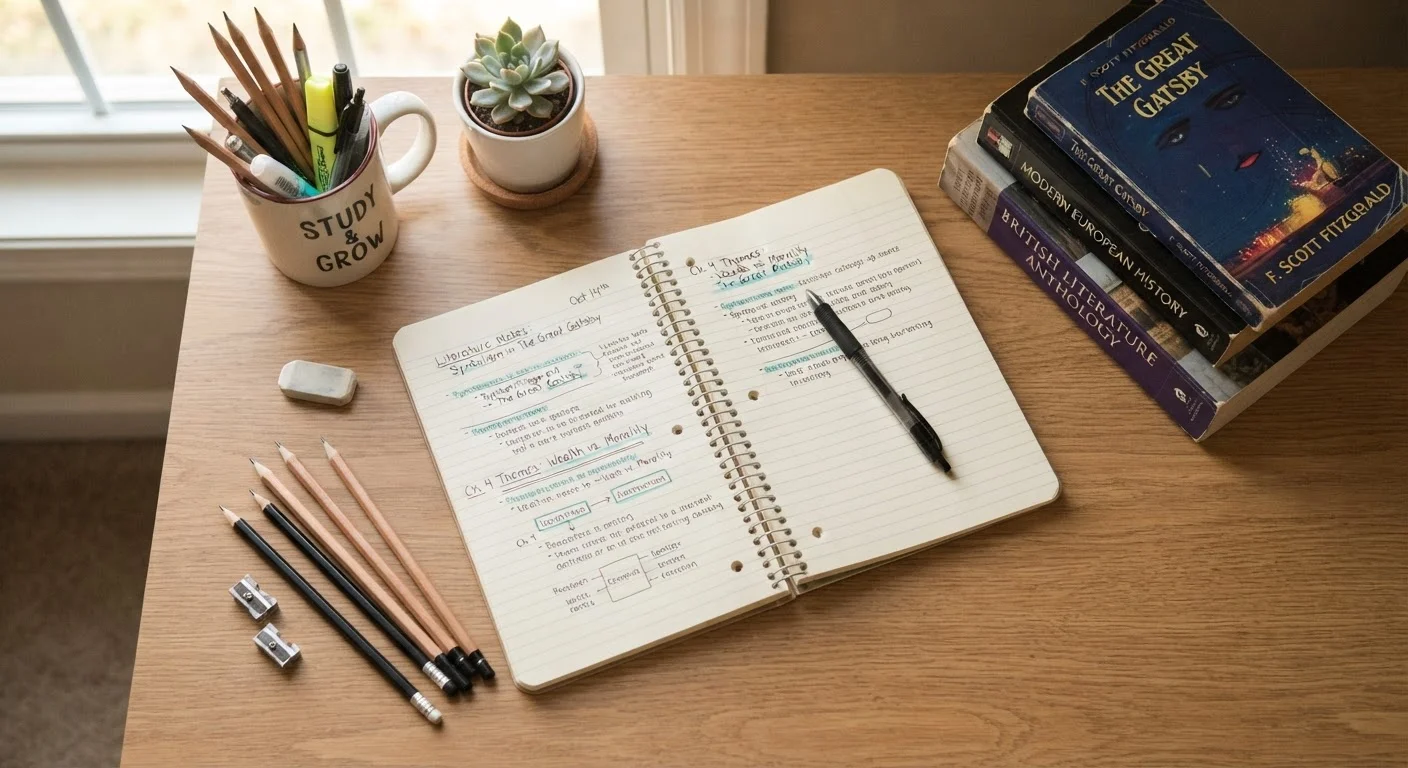
Where you study shapes how well you study. A dedicated, organized space signals to the brain that it's time to focus - and removes the mental friction of getting started. You don't need a perfect home office; a consistent corner of a table works fine.
- Minimize distractions: Silence non-essential notifications. If a phone is needed, place it face-down and out of easy reach.
- Gather materials first: Having everything on hand before starting reduces interruptions. Our pre-session readiness checklist covers this in structured detail.
- Use good lighting: Natural light or a well-positioned lamp reduces eye strain during longer sessions.
- Keep the space tidy: Clutter competes for attention. A clear desk makes it easier to stay on task.
The environment doesn't have to be silent - but it should be predictable. If background noise works for a student, research on multitasking and studying can help them choose wisely.
Use the Same Spot Every Time
Consistency of location helps condition your brain into a study mindset more quickly. Even if the space isn't perfect, using it reliably builds a mental association between that spot and focused work. Over time, sitting down there can itself become a cue to concentrate.
Core Study Strategies That Actually Work
Not all study methods are equally effective. Highlighting and re-reading feel productive but produce weak long-term retention. The following strategies are grounded in cognitive science and consistently show stronger results.
Active Recall
Instead of reviewing notes passively, close them and try to retrieve the information from memory. This act of retrieval strengthens the memory trace far more than re-reading the same page. Flashcards, practice tests, and self-quizzing are all forms of active recall. For a thorough breakdown, see Active Recall: The Science Behind Studying That Actually Sticks.
Spaced Practice
Spreading study sessions over time - rather than cramming the night before - dramatically improves retention. Revisiting material after a gap forces the brain to reconstruct it, which strengthens learning.
Effective Note-Taking
Good notes are a learning tool, not a transcript. Structured methods like Cornell notes or mind maps help students process information as they record it. The Note-Taking Methods guide walks through the most practical options.
Notes Are a Tool, Not a Record
The goal of taking notes is to help you think and remember - not to capture everything the teacher says. Selective, organized notes that reflect your understanding of the material are more useful than dense transcriptions. Reviewing and reorganizing notes shortly after class is one of the most underused study habits.
Building Consistency: Habits Over Heroics
A reliable study routine matters more than occasional bursts of intense effort. Students who study for 30 focused minutes each day generally retain more than those who spend three hours the night before an exam. Consistency reduces anxiety and builds genuine confidence over time.
Start by anchoring study time to an existing habit - after dinner, right after school, or before a regular activity. Keeping the schedule predictable makes it easier to maintain. For guidance on building a routine that scales as a student grows, Building a Study Routine That Works Across Grade Levels is a natural next step from this guide.
One useful structure is to alternate between subjects in a single session - a technique called interleaving. While it feels harder than focusing on one topic at a stretch (called blocked practice), research suggests it builds more flexible understanding. Interleaving vs. Blocked Practice explores the trade-offs clearly.
Mindset, Wellbeing, and Knowing When to Pause
Sustainable studying requires more than technique - it requires a healthy relationship with effort and rest. Students who push through exhaustion rarely absorb what they're reviewing. Recognizing the signs of study fatigue early is a genuine skill. Managing Study Fatigue offers practical guidance on identifying and responding to overload.
Equally important is approaching mistakes as information rather than failure. A student who reviews what went wrong on a quiz and adjusts is doing exactly what skilled learners do. For families navigating the emotional side of school pressure, our Exam Preparation reference guide includes a section on recovering after poor results.
If a student is feeling persistently overwhelmed beyond normal study stress, that's worth addressing separately. Mental Wellness for Beginners is a helpful starting point for families noticing signs of broader emotional strain.
Cramming Has Real Costs
Last-minute study sessions may help a student get through a single exam, but the information rarely sticks beyond the next day. Relying on cramming also increases stress and reduces sleep - both of which impair performance. Building regular habits early avoids this cycle entirely.
Frequently Asked Questions
Study skills are strategies and habits that help students learn, retain, and apply information more effectively. They matter because raw effort alone doesn't guarantee understanding - knowing how to study makes the same amount of time significantly more productive. Research consistently shows that students who learn explicit study strategies outperform those who rely on repetition or re-reading alone.
Begin with small, consistent sessions rather than long marathon efforts. Pick a regular time and place dedicated to studying, set a specific goal for each session, and start with just 20-30 minutes of focused work. Building the habit matters more than the length of the session at first.
Active recall - testing yourself on material rather than passively re-reading - is one of the most well-supported methods for beginners and experienced students alike. Flashcards, practice questions, or simply closing your notes and writing down what you remember are good starting points.
For most beginning students, sessions of 25-45 minutes with a short break tend to be more effective than hours of unbroken work. Attention and retention decline with extended, uninterrupted effort. Building up session length gradually as focus improves is a sound approach.
Parents can help by creating a consistent, low-distraction study space, setting a regular homework time, and asking their child to explain what they learned rather than just checking that work is done. See our guide on <a href="/learning-school/learning-at-home/enriching-your-childs-education-at-home-a-starting-point-for-busy-parents">supporting learning at home</a> for practical, low-pressure ideas.
It depends on the task and the individual, but cognitive research generally suggests that lyrical music or unpredictable noise disrupts reading comprehension and complex problem-solving. Some students find low, steady ambient sound helpful for routine tasks. Our article on <a href="/learning-school/study-skills/the-myths-around-multitasking-and-studying">study and multitasking myths</a> explores the evidence in more depth.
The content provided on our blog site traverses numerous categories, offering readers valuable and practical information. Readers can use the editorial team’s research and data to gain more insights into their topics of interest. However, they are requested not to treat the articles as conclusive. The website team cannot be held responsible for differences in data or inaccuracies found across other platforms. Please also note that the site might also miss out on various schemes and offers available that the readers may find more beneficial than the ones we cover.