

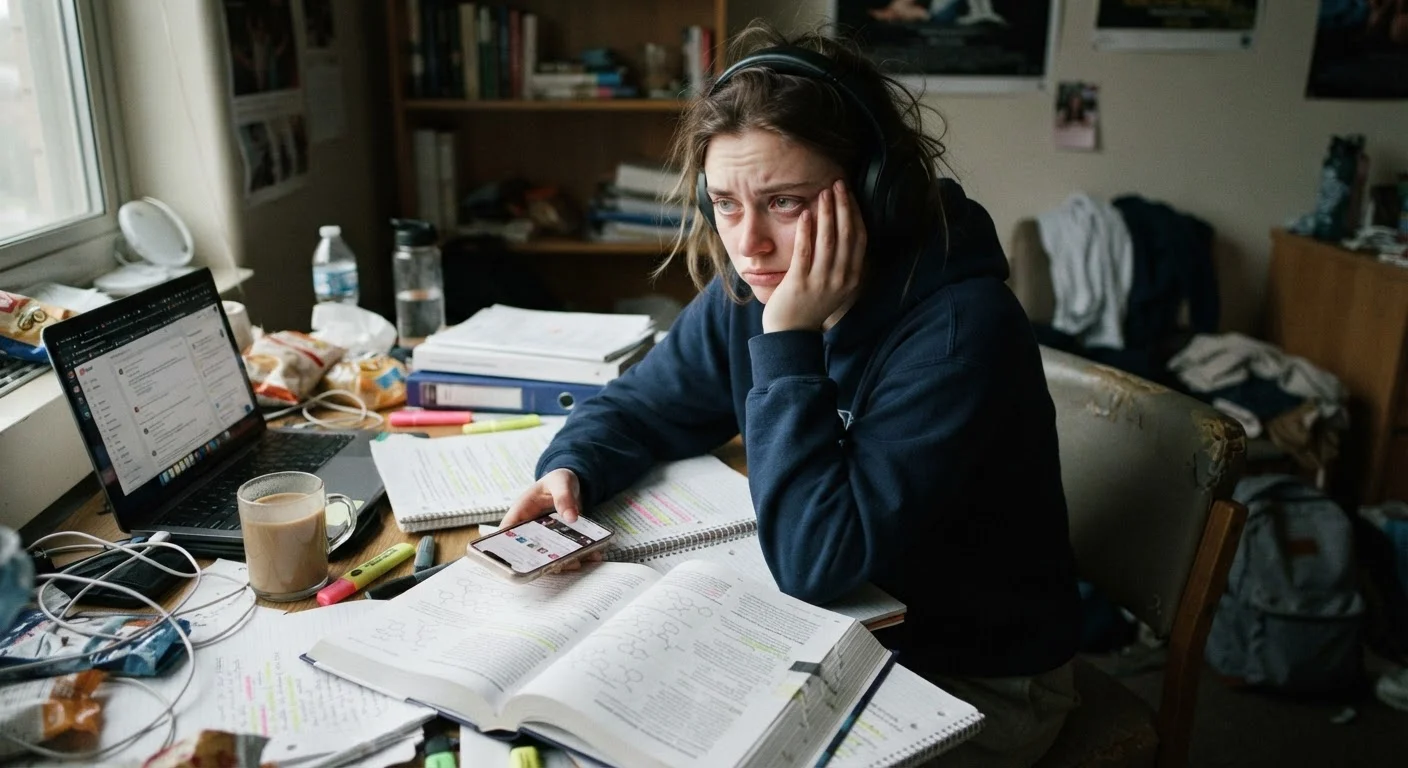
Why Multitasking and Studying Feel So Compatible
It makes intuitive sense: studying is time-consuming, and other tasks - texting, watching a show, listening to music - feel light enough to run in the background. For many students, studying without a screen or soundtrack feels oddly uncomfortable. That discomfort has a name. Researchers call it the preference for keeping multiple streams of stimulation active, and it is especially common among adolescents who have grown up with media-rich environments.
But feeling comfortable multitasking and performing well while doing it are two very different things. Understanding why requires a look at how attention actually works - and what happens when we ask it to do more than one demanding job at once. For a deeper dive into the underlying science, see what cognitive load theory means for how students study.
Myth
Multitasking lets you get more done in less time.
Fact
Multitasking almost always slows you down and reduces the quality of both tasks.
What feels like doing two things at once is actually rapid back-and-forth switching between tasks. Each switch carries a cognitive cost - researchers call it a "switching penalty" - that adds up quickly. Studies show that people who multitask frequently often take longer to complete tasks and make more errors than those who focus on one thing at a time.
Myth
Background music helps you concentrate while studying.
Fact
Music without lyrics can be neutral or mildly helpful for some tasks, but lyric-based music reliably impairs reading and writing.
The effect of music depends heavily on the task. Instrumental, low-tempo music may mask distracting environmental noise without competing for language-processing resources. However, any music containing lyrics uses the same cognitive channels needed for reading, writing, and verbal reasoning - meaning comprehension and recall tend to suffer. Students who feel they study better with music playing may be experiencing a preference, not a performance boost.
Myth
You can study effectively with the TV on in the background.
Fact
Television - even as background noise - meaningfully reduces comprehension and memory consolidation.
Unlike simple ambient noise, TV combines rapidly changing audio and visual content designed to capture attention. Even when a student isn't actively watching, the brain registers scene changes and voices and allocates cognitive resources toward them. Research on media multitasking in academic settings consistently finds lower retention among students studying with TV present compared to those in quieter environments.
Myth
High multitaskers are better at filtering distractions.
Fact
Research suggests heavy multitaskers are actually worse at ignoring irrelevant information, not better.
A widely cited study from Stanford University found that people who regularly engage in heavy media multitasking performed worse on tasks requiring them to filter out irrelevant stimuli - not better. The researchers concluded that frequent multitaskers may have trained themselves to remain open to new inputs, which becomes a liability when sustained, selective focus is required, as it is in most studying contexts.
Myth
If you feel productive while multitasking, you probably are.
Fact
The sense of productivity during multitasking is a well-documented cognitive illusion.
Subjective feelings of productivity and actual output are poorly correlated during multitasking. People tend to overestimate how much they have learned or accomplished when stimulation is high. This illusion can persist even after a task is complete - students may feel confident about material they have processed poorly. Testing yourself on the content after studying (rather than rereading) is a far more reliable indicator of what has actually been retained.
What the Research Actually Shows
Studies in cognitive psychology consistently find that dividing attention across two cognitively demanding tasks - such as reading for meaning while following a conversation on TV - reduces performance on both. A landmark line of research by David Meyer and colleagues established that task-switching, even when it feels seamless, carries a measurable time cost called the "switching penalty." Each switch requires the brain to reload the rules and context of the new task, which burns time and mental energy.
20+ min
Average time to restore full focus after an interruption
Widely cited in attention research, including work by Gloria Mark at UC Irvine studying workplace and study interruptions.
40%
Productivity loss from task-switching
Research by the American Psychological Association suggests switching between tasks can cost as much as 40% of productive time.
This has direct implications for homework sessions. A student who glances at a phone notification mid-paragraph doesn't just lose the two seconds of reading time - research suggests it can take more than 20 minutes on average to fully restore deep focus after an interruption. Over a two-hour study session, repeated interruptions can dramatically compress effective learning time. If this kind of fatigue accumulates across study sessions, it may start showing up as study fatigue - a pattern worth recognising early.
Phone Nearby = Attention Divided
Research published in the Journal of the Association for Consumer Research found that the mere presence of a smartphone on a desk - even face-down and silent - reduced available cognitive capacity compared to leaving it in another room. Students don't need to be actively using their phone for it to cost them focus. Physically separating the device during study blocks is one of the highest-impact changes a student can make.
Putting Accurate Strategies Into Practice
Replacing multitasking habits requires deliberate structure. A single-task session - even 25 to 30 focused minutes - paired with a genuine break tends to produce better retention than an hour of fractured attention. This is the core insight behind focused study methods, though how well any particular approach fits a student depends on age, subject, and personal learning style. For a balanced look at one popular method, see the Pomodoro Technique in academic settings.
For families helping students build these habits from scratch, starting with environment matters most: a designated study space with phone out of reach, notifications silenced, and a clear end time reduces the temptation to task-switch before it arises. Students who want to build these habits systematically will find a practical starting point in our guide to building a study routine across grade levels. The goal isn't perfection - it's gradually shifting the default from divided attention to focused effort, one session at a time.
The content provided on our blog site traverses numerous categories, offering readers valuable and practical information. Readers can use the editorial team’s research and data to gain more insights into their topics of interest. However, they are requested not to treat the articles as conclusive. The website team cannot be held responsible for differences in data or inaccuracies found across other platforms. Please also note that the site might also miss out on various schemes and offers available that the readers may find more beneficial than the ones we cover.