

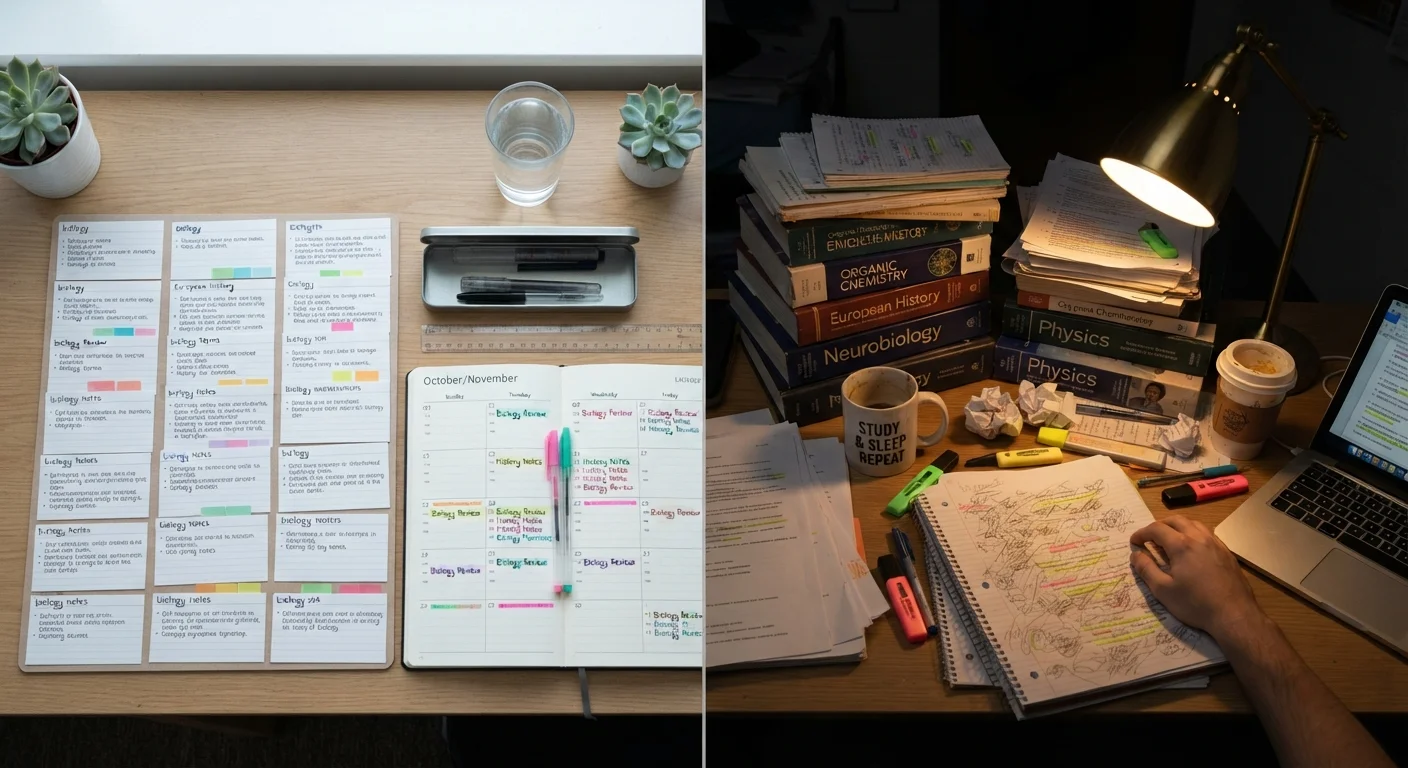
Option A
Spaced Repetition
The evidence-backed method for long-term retention.
Best for: Students who want material to stick beyond the next exam - from vocabulary building to mastering complex concepts over weeks or months.
Option B
Cramming
The familiar last-minute push before a test.
Best for: Students facing imminent deadlines who need a short-term memory boost, accepting that much of the material will fade quickly afterward.
The Science Behind Each Approach
The distinction between spaced repetition and cramming comes down to one variable: time distribution. Cramming - formally called massed practice - concentrates all study into one long block, typically close to a deadline. Spaced repetition - also called distributed practice - spreads review across multiple shorter sessions with deliberate gaps in between.
The psychological principle underpinning spaced repetition is the spacing effect, first documented by Hermann Ebbinghaus in the late 19th century and replicated extensively since. When the brain retrieves information after a period of forgetting has begun, the memory trace is re-encoded more strongly than if it had been reviewed immediately. This slightly effortful retrieval is what drives durable learning.
Cramming exploits a different mechanism: short-term working memory. A concentrated session can flood the brain with recently encountered information, making it temporarily accessible. The problem is Ebbinghaus's other famous finding - the forgetting curve. Without spaced review, roughly half of new information is lost within a day, and the decline continues steeply from there.
| Criterion | Spaced Repetition | Cramming |
|---|---|---|
| Study distribution | Multiple sessions spread over days or weeks | One long session close to the deadline |
| Short-term recall | Strong | Strong (immediately after) |
| Long-term retention | Strong - information persists weeks or months | Weak - rapid forgetting within days |
| Planning required | High - must start well ahead of deadline | Low - can begin the night before |
| Cognitive load per session | Lower - shorter, focused reviews | Higher - sustained concentration required |
| Research support | Extensive and consistent across studies | Limited for anything beyond next-day recall |
| Best suited for | Cumulative subjects, language learning, exam prep | One-off tests with no follow-on requirement |
For a broader look at how these principles fit into a complete study plan, see our complete exam preparation reference.
What the Research Actually Shows
The evidence favouring spaced repetition is among the most replicated findings in cognitive psychology. A landmark review by Cepeda and colleagues, published in Psychological Bulletin, analysed over 250 studies and found that spaced practice consistently outperformed massed practice across age groups, subject types, and retention intervals. The advantage was especially pronounced when the gap between final study and testing was long - exactly the real-world scenario students face when knowledge must carry forward into future coursework.
200+
Studies confirming the spacing effect
A review in Psychological Bulletin by Cepeda et al. synthesised over 250 studies consistently showing spaced practice outperforms massed practice.
~50%
Information lost within 24 hours without review
Ebbinghaus's forgetting curve research suggests roughly half of newly learned material is forgotten within a day absent any reinforcement.
10-30%
Typical retention advantage for spaced practice
Across delayed retention tests, distributed practice groups commonly outperform massed practice groups by 10-30 percentage points, per meta-analytic findings.
Cramming's weaknesses are just as well-documented. Studies using delayed post-tests - assessing recall a week or more after studying - regularly show that students who crammed perform significantly worse than those who used distributed practice, even when both groups scored similarly on an immediate test. This is sometimes called the illusion of knowing: the material feels familiar during a cram session because it was just reviewed, not because it has been durably encoded.
Spaced repetition also pairs powerfully with retrieval practice - testing yourself rather than re-reading. Retrieval practice at home and in the classroom strengthens the same memory pathways that spacing targets, making the combination particularly effective. Similarly, active recall techniques amplify the gains from spaced sessions beyond what either method achieves alone.
Practical Trade-offs: When Each Method Gets Used
Despite the research consensus, cramming persists for understandable reasons. Life is unpredictable - assignments pile up, illness disrupts schedules, and sometimes a test arrives before a student has managed consistent review. In those situations, a structured cram session is better than no preparation at all. The key is to cram strategically: focus on high-priority concepts, use active methods like self-quizzing rather than passive re-reading (see why re-reading rarely works), and get adequate sleep, which is critical for memory consolidation.
Spaced repetition, by contrast, requires one resource cramming cannot provide: time. It demands that students start early and return to material repeatedly. Even a simple schedule - first review the day after learning, second review after three to five days, third after two weeks - outperforms a single massed session of equivalent total study time. Building this kind of rhythm is exactly what a sustainable study routine is designed to support.
Students who want to move beyond both passive re-reading and late-night cramming should also explore interleaving vs. blocked practice, a complementary strategy that further disrupts the illusion of mastery.
A Note on Digital Spaced Repetition Tools
Various apps and software platforms use algorithms to schedule review sessions based on how well a student recalls each item - automatically widening gaps for well-known material and shortening them for weaker items. These tools can make the scheduling side of spaced repetition much easier to manage. That said, the core principle works just as well with paper flashcards or a simple calendar-based review schedule. The method matters more than the medium.
The content provided on our blog site traverses numerous categories, offering readers valuable and practical information. Readers can use the editorial team’s research and data to gain more insights into their topics of interest. However, they are requested not to treat the articles as conclusive. The website team cannot be held responsible for differences in data or inaccuracies found across other platforms. Please also note that the site might also miss out on various schemes and offers available that the readers may find more beneficial than the ones we cover.