

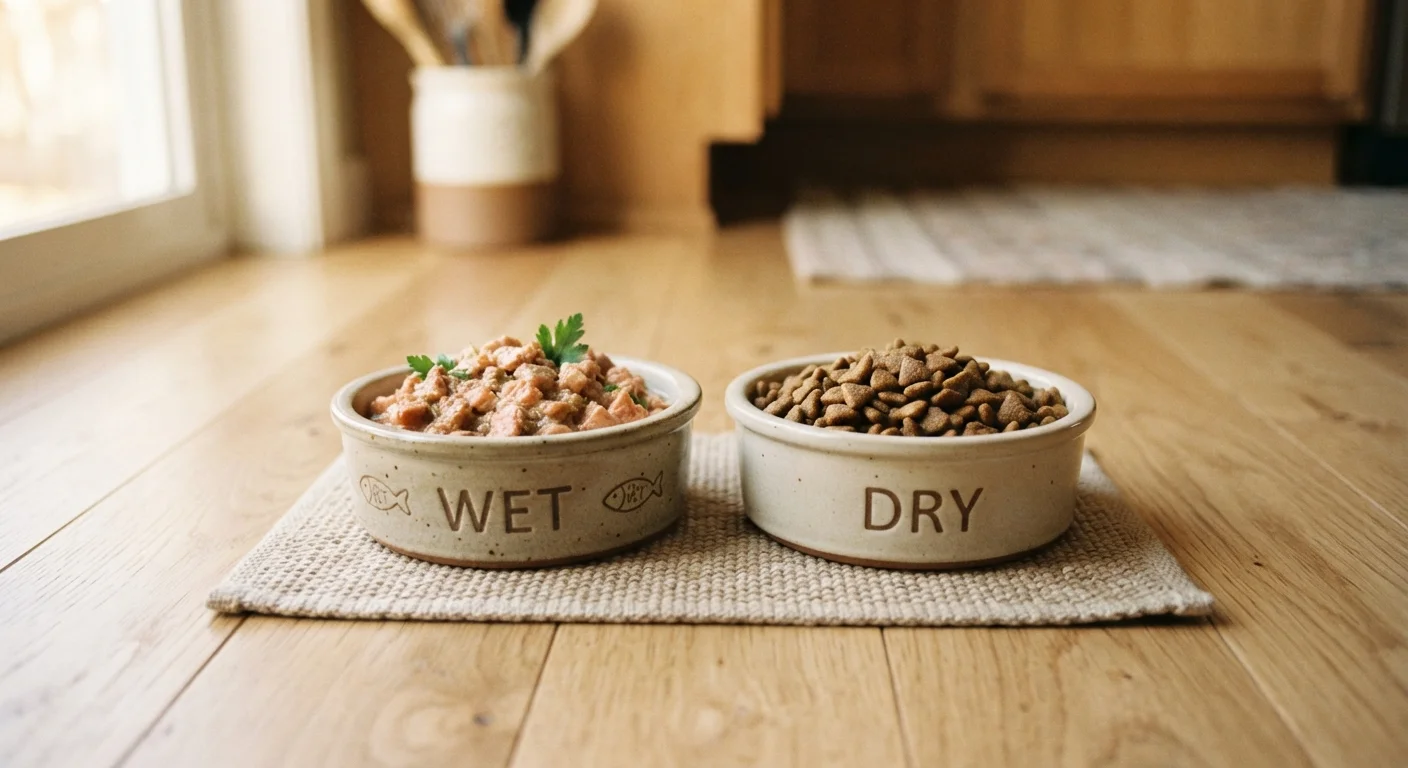
Option A
Wet Cat Food
The high-moisture, protein-rich option closest to a cat's natural prey diet.
Best for: Cats needing extra hydration, seniors, urinary health concerns, or picky eaters.
Option B
Dry Cat Food
The convenient, shelf-stable option suited to free-feeding and multi-cat households.
Best for: Owners needing flexibility, cats who self-regulate portions, or households on a tighter food budget.
What Each Format Actually Contains
The most fundamental difference between wet and dry cat food isn't flavor or texture - it's water content. Wet food is typically 70-80% moisture, while dry kibble contains only 6-10%. This gap has real consequences for feline health, since cats evolved as desert animals with a naturally low thirst drive. They're biologically adapted to obtain most of their hydration through food rather than a water bowl.
Beyond moisture, wet food tends to be higher in animal protein and fat, and lower in carbohydrates. Dry food, by contrast, relies on starches to maintain its structure during manufacturing, resulting in a higher carbohydrate profile. Cats are obligate carnivores - they have limited ability to use carbohydrates as an energy source and require specific nutrients like taurine, arachidonic acid, and preformed vitamin A that only come from animal tissue. Both wet and dry formulas can meet these requirements when properly formulated, but the macronutrient ratios differ noticeably.
For a detailed breakdown of how these nutritional needs shift over time, see what cats need from their diet at every life stage.
| Criterion | Wet Cat Food | Dry Cat Food |
|---|---|---|
| Moisture content | 70-80% | 6-10% |
| Protein profile | Generally higher animal protein | Variable; often lower relative protein |
| Carbohydrate content | Lower | Higher (needed for structure) |
| Caloric density | Lower per gram | Higher per gram |
| Shelf life after opening | 24-48 hours refrigerated | Weeks in sealed container |
| Cost per serving | Generally higher | Generally lower |
| Palatability | High; appeals to finicky cats | Variable; some cats prefer crunch |
| Urinary health support | Strong (via hydration) | Weaker without high water intake |
Health Implications Worth Knowing
Hydration is where wet food has its clearest advantage. Chronic low-level dehydration is associated with feline lower urinary tract disease (FLUTD) and contributes to kidney strain over time. Cats on exclusively dry diets who don't drink enough water face a measurably higher risk of urinary crystal formation and kidney issues. Wet food can act as a passive hydration vehicle - cats consuming it ingest substantially more fluid than kibble-fed cats typically drink voluntarily.
Dental health is an area where dry food is sometimes credited with benefit, though the evidence is more nuanced. Some kibble formulations are designed with a texture that provides mild mechanical abrasion as cats chew. However, many cats swallow kibble whole, negating any cleaning effect. Dental-specific diets carry a different formulation altogether. The broader consensus among veterinary dental specialists is that no food format replaces active dental care. For a full picture, cat dental health: what owners often overlook covers what actually prevents periodontal disease in cats.
Weight management is more nuanced than format alone. Wet food's lower caloric density can support portion control, but free-feeding dry food without measured portions is a common driver of feline obesity. The issue isn't the format - it's how feeding is managed.
70-80%
Moisture in wet cat food
Compared to roughly 6-10% in dry kibble - a difference that significantly affects daily fluid intake for cats.
~50%
Estimated US cats classified overweight or obese
According to veterinary survey data, obesity is one of the most common preventable health issues in domestic cats, often linked to unmanaged free-feeding.
7-10 days
Recommended food transition period
Veterinary guidelines generally advise gradually mixing new food with old over one to two weeks to minimize digestive upset.
Practical Tradeoffs at Home
From a daily-use standpoint, dry food wins on convenience. It doesn't spoil quickly after being placed in a bowl, it's easier to store, and it tends to cost less per calorie. For households managing tight schedules or traveling with cats, these qualities matter. Wet food, once opened, must be refrigerated and used within 24-48 hours. Uneaten portions left at room temperature spoil within a few hours, which can be both wasteful and a food safety concern for your cat.
Smell and palatability often favor wet food from the cat's perspective. The stronger aroma and softer texture are particularly appealing to finicky eaters, cats recovering from illness, or seniors with reduced appetite. Conversely, some cats develop strong preferences for kibble's crunch and resist switching - a behavioral tendency that can make dietary transitions challenging if health conditions later require a change.
A mixed feeding approach - offering measured wet food at scheduled mealtimes alongside available dry food - is a practical middle ground many owners and veterinarians find useful. It ensures moisture intake while preserving some of the convenience and dental exposure that dry food offers.
A Note on Reading Cat Food Labels
Ingredient lists on cat food are ordered by weight before cooking, which means moisture-heavy ingredients like chicken breast can rank first even if protein content isn't dominant after processing. The more reliable metric is the guaranteed analysis panel, which shows minimum protein and fat percentages and maximum moisture and fiber. For a true comparison between wet and dry foods, nutritionists often convert values to a dry-matter basis - a calculation your veterinarian or a board-certified veterinary nutritionist can walk you through.
Making the Right Call for Your Cat
There's no single correct answer that applies to every cat. Life stage, health history, activity level, and individual preference all factor into what constitutes an appropriate diet. A young, healthy indoor cat may thrive on a well-formulated dry food with adequate water availability. A senior cat with early-stage kidney disease will likely do better on wet food specifically selected to support renal function - ideally under veterinary supervision.
The most reliable approach is to treat food format as one variable among several, and to revisit feeding decisions with your veterinarian as your cat's needs evolve. A cat's nutritional needs at two years old are not the same as at twelve. Understanding how feline dietary requirements shift across life stages can help you ask better questions at your next vet visit.
Gradual transitions between food types - mixing increasing proportions of the new food over 7-10 days - reduce the risk of gastrointestinal upset and help confirm whether your cat tolerates and accepts the change.
This article is intended as general educational information about cat nutrition and is not a substitute for individualized veterinary advice. Always consult a licensed veterinarian before making significant changes to your cat's diet, particularly if your cat has an existing health condition.
The content provided on our blog site traverses numerous categories, offering readers valuable and practical information. Readers can use the editorial team’s research and data to gain more insights into their topics of interest. However, they are requested not to treat the articles as conclusive. The website team cannot be held responsible for differences in data or inaccuracies found across other platforms. Please also note that the site might also miss out on various schemes and offers available that the readers may find more beneficial than the ones we cover.