

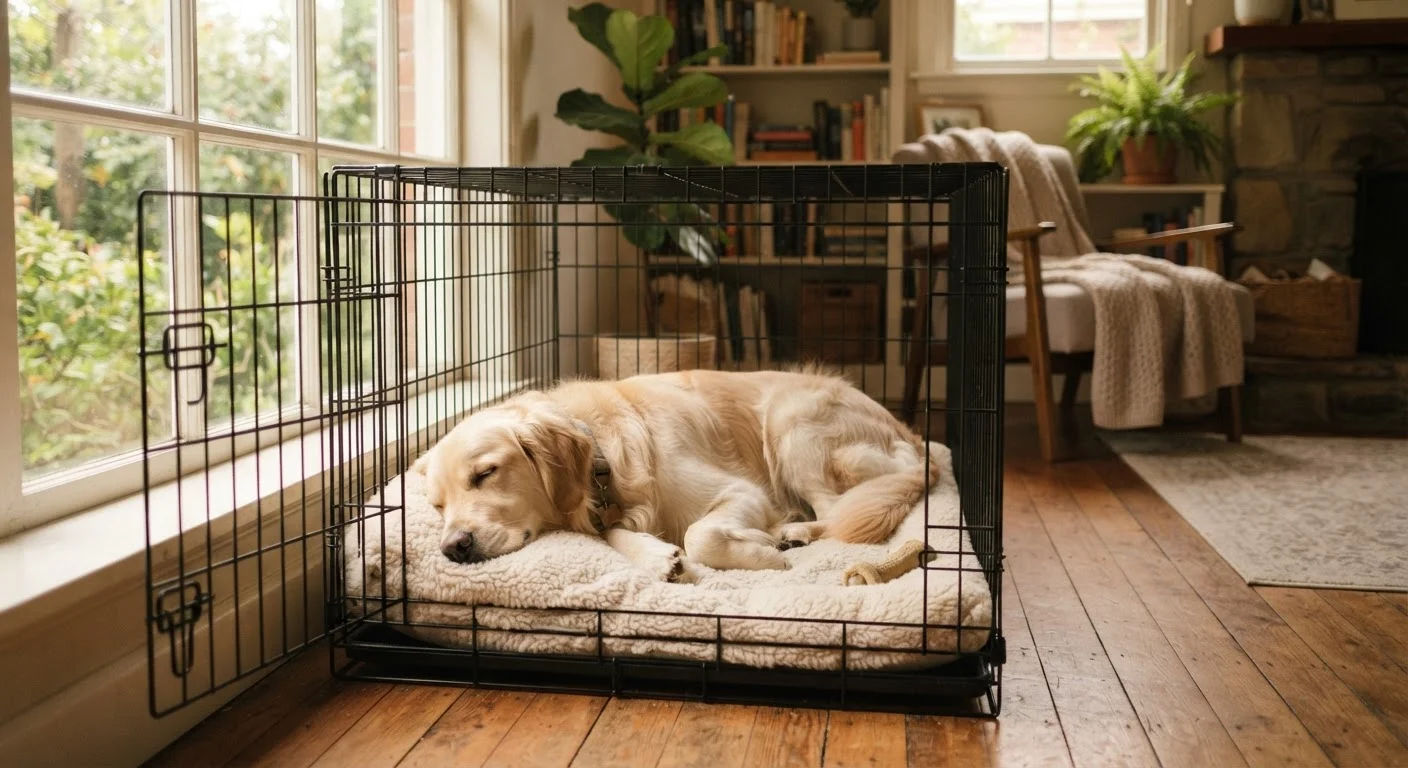
Why Crate Associations Matter More Than the Crate Itself
A crate is a neutral object. What determines whether your dog treats it as a den or a detention cell is entirely the emotional history you build around it. Dogs learn through association, so every interaction with the crate - even incidental ones - shapes how they feel about being inside it.
The most common mistake owners make is introducing the crate reactively: the dog chews something, gets into the trash, or becomes too boisterous, and the crate becomes the consequence. Even if the dog isn't scolded as they're put inside, the pattern registers. Over time, crate placement becomes a predictor of something unpleasant, and resistance follows.
Contrast that with a dog who has spent weeks associating the crate with meals, chew toys, and undisturbed naps. That dog will often choose the crate voluntarily - exactly the outcome good crate training aims for. If you're setting up your home for a new arrival, our puppy-proofing guide covers how to establish safe spaces before day one.
What you will need
Tools That Set You Up for Success
Getting the physical setup right before training begins removes friction from every step. Crate size is critical: too large and the space loses its den-like quality; too small and it becomes genuinely uncomfortable. Your dog should be able to stand without crouching, turn a full circle, and lie stretched out.
Wire or plastic dog crate
Provides the enclosed space your dog will learn to associate with rest and safety.
Soft crate mat or blanket
Makes the crate interior comfortable and helps signal 'rest time' to your dog.
High-value treats
Used to reward voluntary entry and calm behavior during every training phase.
Food-stuffed chew toy (e.g., rubber puzzle toy)
Gives your dog a positive, long-lasting activity that builds a pleasant crate association.
Crate cover or blanket
Reduces visual stimulation and creates a more den-like environment for anxious dogs.
Wire crates offer better ventilation and visibility, which suits social dogs who like to keep an eye on household activity. Plastic travel crates feel more enclosed and tend to work well for dogs who seem to prefer darker, quieter spaces. If you're unsure which suits your dog better, observe where they naturally choose to rest - that preference is informative.
Step-by-Step: Building a Positive Crate Routine
Follow these steps in order and at your dog's pace. There is no fixed timeline - some dogs progress through the full sequence in a few days; others take several weeks. Both are normal. The goal is consistent positive associations, not speed.
Position the crate in the right spot
Place the crate in a room where your family spends time - a living room or bedroom works well. Avoid isolating it in a basement or utility room, which can make it feel like a exile zone from the start. Leave the door open and let your dog explore at their own pace before any formal training begins.
Build curiosity with treats near the crate
Drop a few treats near the crate entrance - not inside yet. Let your dog approach, sniff, and eat at their own comfort level. Repeat this several times over a day or two. The only goal here is to connect the crate's presence with something good.
Move treats just inside the crate entrance
Once your dog approaches the crate without hesitation, begin placing treats just inside the threshold. Over multiple short sessions, gradually move the treats further back until your dog is stepping fully inside to retrieve them. Praise calmly each time they enter voluntarily.
Feed meals inside the crate with the door open
Start feeding your dog their regular meals just inside the crate door, then gradually move the bowl toward the back over several meals. Keep the door open throughout. Meal-feeding inside the crate is one of the fastest ways to build a strong positive association.
Close the door briefly - then open it immediately
Once your dog enters the crate comfortably to eat, close the door for just a few seconds while they finish, then open it before they show any sign of stress. Over several sessions, extend the closed-door time by small increments - 30 seconds, then a minute, then a few minutes - always ending before your dog becomes anxious.
Practice short absences, then build duration gradually
Crate your dog for short periods while you remain home - step into another room, then return before they become distressed. Once they settle reliably for 30 minutes with you nearby, begin leaving the house for brief stretches. Build duration slowly over days and weeks, not hours.
Never Use the Crate as Punishment
Sending your dog to the crate after scolding them - even once - can permanently undermine its positive association. The crate should only ever be used as a calm, rewarding place. If you need a management tool during a stressful moment, redirect your dog to a mat or another quiet space instead.
Crate Training Rescue Dogs and Anxious Dogs
Dogs adopted from shelters often arrive with unknown crate histories. Some may have been crated inappropriately - for too long, as punishment, or in stressful conditions - and will need extra patience at each stage. Start from step one regardless of the dog's age or what a shelter has told you about prior crate experience.
For dogs with broader anxiety around confinement or separation, crate training alone is unlikely to resolve the underlying issue. Our article on separation anxiety versus normal boredom can help you identify what you're dealing with before investing weeks in a training approach that may not fit. For rescue dogs in particular, the adjustment period can be longer than most owners expect - our guide to the first 90 days with a rescue dog gives a realistic picture of what that looks like.
Watch for Signs of Genuine Distress
Whining for a minute during early sessions is normal; sustained howling, frantic scratching, drooling, or attempts to escape are not. These may indicate a deeper anxiety issue that benefits from professional guidance. See a certified dog trainer or veterinary behaviorist before continuing if your dog shows these signs consistently.
Crate Training Is Not a Shortcut to Housetraining
A crate supports housetraining by limiting unsupervised roaming, but it does not replace consistent outdoor toilet schedules. Confining a dog for longer than they can hold their bladder will cause accidents inside the crate, which erodes its comfort value and can cause frustration for both dog and owner. Pair crate use with regular, predictable outdoor trips.
The content provided on our blog site traverses numerous categories, offering readers valuable and practical information. Readers can use the editorial team’s research and data to gain more insights into their topics of interest. However, they are requested not to treat the articles as conclusive. The website team cannot be held responsible for differences in data or inaccuracies found across other platforms. Please also note that the site might also miss out on various schemes and offers available that the readers may find more beneficial than the ones we cover.