

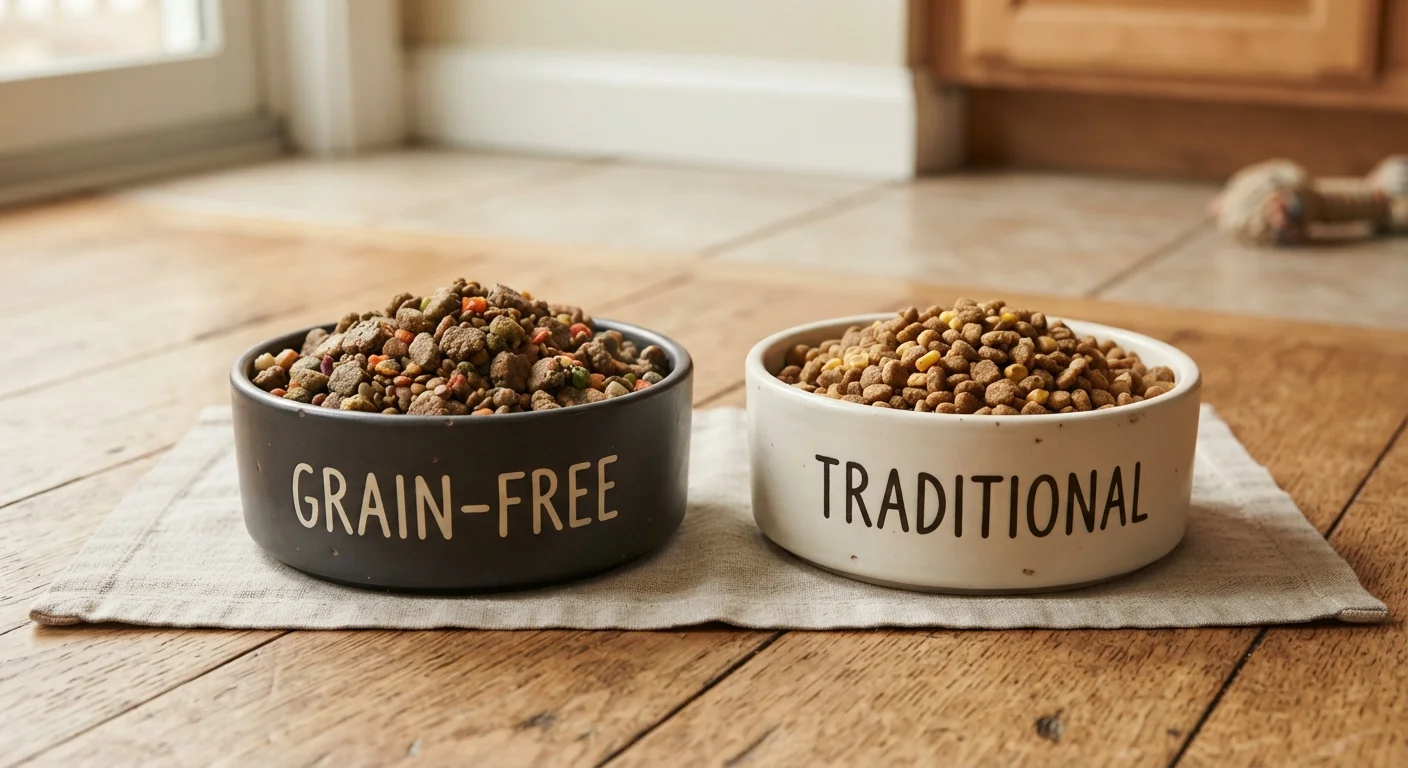
Option A
Grain-Free Dog Food
The newer, protein-forward alternative with ongoing scrutiny.
Best for: Dogs with confirmed grain allergies or specific dietary sensitivities diagnosed by a veterinarian.
Option B
Traditional Dog Food
The established, research-backed standard in canine nutrition.
Best for: Most healthy adult dogs seeking balanced, complete nutrition supported by decades of feeding trials.
The Rise of Grain-Free Diets and Why It Matters
Over the past decade, grain-free dog food moved from niche health store shelves to mainstream pet retail, driven largely by the assumption that dogs thrive on diets mirroring ancestral wolf eating patterns. The appeal is intuitive: fewer carbohydrates, more protein, no wheat or corn fillers. But the science behind this shift is more complicated than marketing suggests.
Most grain-free formulas replace grains with alternative carbohydrate sources - legumes like peas and lentils, potatoes, or tapioca. These substitutions are not neutral; they alter the food's amino acid availability, fiber profile, and digestibility in ways researchers are still working to understand. For families comparing their options, understanding what the evidence actually shows - rather than what the packaging implies - is the most useful starting point. See also our guide on feeding a dog at every life stage for context on how nutritional needs shift over time.
The DCM Investigation: What the FDA Found
In 2018, the U.S. Food and Drug Administration (FDA) launched an investigation into a potential association between grain-free diets and dilated cardiomyopathy (DCM) - a serious heart condition in which the heart muscle weakens and enlarges, reducing its ability to pump blood effectively. DCM cases were being reported in dog breeds not historically predisposed to the condition, and a dietary pattern kept emerging: grain-free foods, often rich in legumes.
560+
DCM cases reported to the FDA
Between January 2014 and April 2019, the FDA received over 560 reports of DCM in dogs, many involving grain-free diets.
~1-2%
Dogs with confirmed food allergies
Veterinary estimates suggest true food allergies affect a small minority of dogs, with grains rarely identified as the primary trigger.
90%+
DCM reports involving grain-free foods
The FDA noted that the majority of DCM case reports submitted during the investigation involved dogs eating grain-free diets.
By 2019, the FDA had received hundreds of DCM reports, with a significant portion involving grain-free diets. Critically, the investigation has not established a definitive causal link - correlation was observed, but the mechanism remains unclear. Researchers have hypothesized that high legume content may interfere with taurine synthesis or absorption, an amino acid essential to cardiac function. However, not all affected dogs had low taurine levels, suggesting the relationship is more complex.
The investigation remains open. Veterinary cardiologists and nutritionists continue to study the question, and the scientific consensus has not yet arrived at a firm conclusion either way.
| Criterion | Grain-Free Dog Food | Traditional Dog Food |
|---|---|---|
| Primary carbohydrate source | Legumes, potatoes, tapioca | Rice, oats, barley, corn |
| Long-term safety data | Limited; under FDA scrutiny | Extensive feeding trial history |
| DCM risk association | Investigated; link not confirmed | No current investigation |
| Appropriate for grain allergy | Yes, if vet-diagnosed | Not suitable |
| AAFCO-compliant options | Available, but fewer trials | Widely available with trials |
| Typical protein emphasis | Higher protein, lower carb | Balanced macro profile |
What Grains Actually Do for Dogs
A persistent misconception is that grains are purely filler ingredients with no nutritional value. In reality, whole grains used in quality traditional dog foods - such as brown rice, oats, and barley - contribute digestible carbohydrates, dietary fiber, B vitamins, and minerals. Dogs, unlike obligate carnivores such as cats, have evolved amylase activity that allows them to digest starch efficiently.
True grain allergies in dogs are also far less common than many owners assume. Veterinary dermatologists note that the most frequent dietary allergens in dogs are animal proteins - beef, chicken, dairy - rather than grains. If a dog shows signs of food sensitivity, a proper elimination diet trial guided by a veterinarian is the appropriate diagnostic step, not preemptively switching to grain-free food.
If you're curious how similar questions play out in feline nutrition, our wet food vs. dry food comparison for cats explores comparable ingredient tradeoffs.
Making a Feeding Decision With Your Veterinarian
For the vast majority of healthy dogs, a complete and balanced traditional dog food - one that meets AAFCO (Association of American Feed Control Officials) nutritional standards and has undergone feeding trials - remains the evidence-supported default. Dogs with specific, diagnosed conditions may benefit from tailored diets, but that determination belongs with a veterinarian, not a product label.
If you currently feed a grain-free diet, there is no need for alarm - but it is worth raising the topic at your next veterinary appointment, particularly if your dog is a large breed or shows any signs of reduced energy or exercise tolerance. Your vet may recommend monitoring or a dietary transition.
AAFCO Standards: A Baseline Worth Checking
When evaluating any dog food, look for a statement indicating the formula meets AAFCO nutritional profiles or has completed AAFCO feeding trials. Feeding trials provide stronger evidence of real-world nutritional adequacy than formulation alone. This applies equally to grain-free and traditional options. Your veterinarian can help interpret these labels in the context of your dog's specific needs.
Nutrition science for dogs is an active field. What's known today may be refined by tomorrow's research. Staying connected with your veterinarian and consulting resources like the American College of Veterinary Nutrition (ACVN) ensures your feeding decisions are grounded in current, credible guidance rather than trends.
This article provides general educational information about dog nutrition and is not a substitute for personalized veterinary advice. Always consult a licensed veterinarian before making significant changes to your dog's diet.
The content provided on our blog site traverses numerous categories, offering readers valuable and practical information. Readers can use the editorial team’s research and data to gain more insights into their topics of interest. However, they are requested not to treat the articles as conclusive. The website team cannot be held responsible for differences in data or inaccuracies found across other platforms. Please also note that the site might also miss out on various schemes and offers available that the readers may find more beneficial than the ones we cover.