

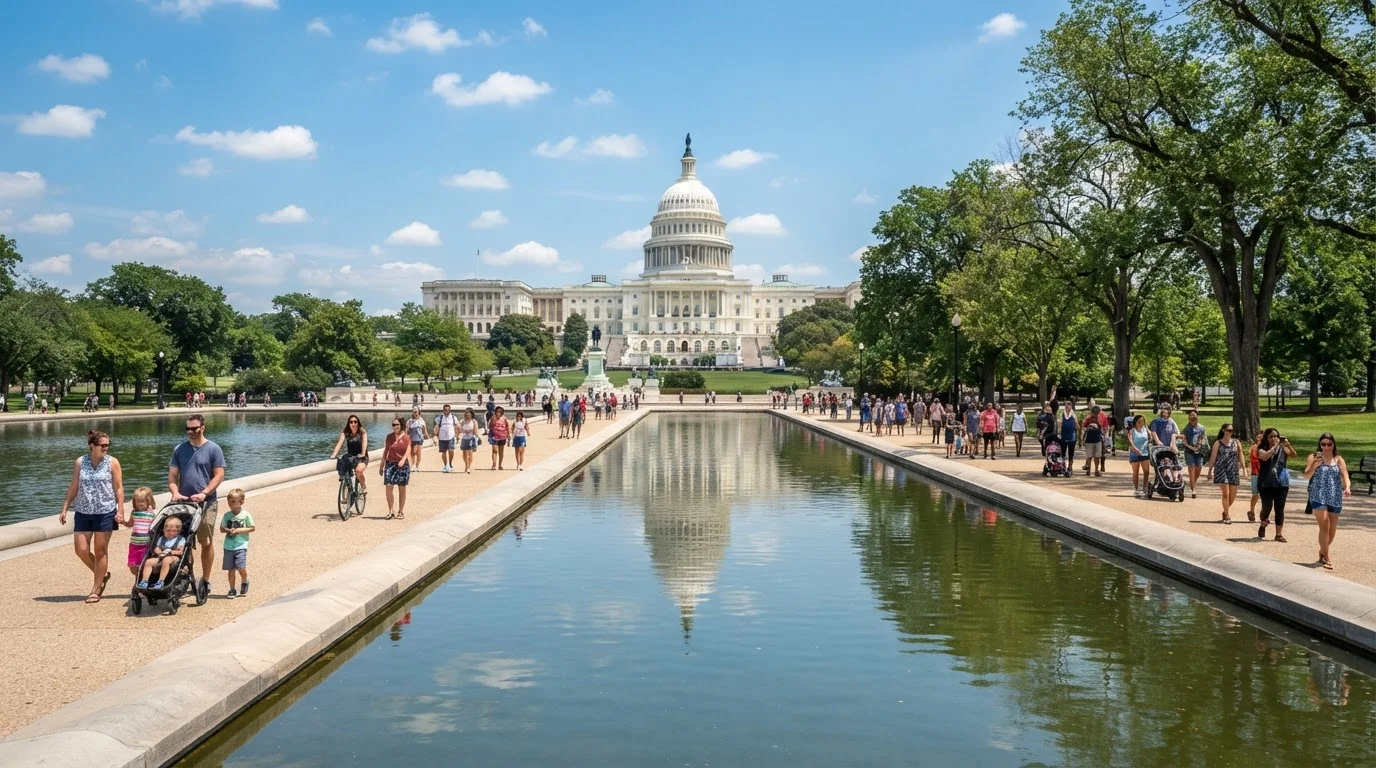
Why D.C. Works So Well for Families
Washington D.C. has a quiet superpower that most family destinations lack: a staggering amount of genuinely excellent, completely free content. The 19 Smithsonian museums, most monuments, and a number of outdoor spaces cost nothing to enter. For families tracking a travel budget, that changes the entire trip equation. See our guide to free attractions in major U.S. cities for a broader look at how D.C. compares to other destinations.
The city is also remarkably walkable in its core areas, Metro-connected throughout, and kid-tolerant in ways that denser urban destinations sometimes aren't. Strollers are common, green space is abundant, and the sheer scale of the monuments gives kids a physical sense of history that no textbook replicates.
19
Free Smithsonian museums in D.C.
All 19 Smithsonian Institution museums in the Washington D.C. area are free to enter, according to the Smithsonian Institution's official site.
~25M
Annual visitors to the National Mall area
The National Mall and Memorial Parks unit of the National Park Service is among the most visited NPS sites in the country, drawing tens of millions of visitors annually.
4-6 miles
Walkable distance across the core Mall
A full end-to-end walk of the National Mall from the Lincoln Memorial to the Capitol building covers roughly 4-6 miles round trip, depending on route.
Beyond the Mall: Neighborhoods Worth Exploring
Families who spend every hour on the National Mall miss a more relaxed, local side of the city. Georgetown offers a cobblestoned waterfront, accessible C&O Canal towpath walks, and ice cream stops that feel genuinely unhurried. The Eastern Market neighborhood on Capitol Hill draws weekend farmers market crowds and has the kind of community energy that helps kids connect with a city as a real place, not just a backdrop for monuments.
Navy Yard, transformed in recent years, has a waterfront park, easy Nationals baseball access, and restaurants geared toward casual family dining rather than expense-account crowds. For kids who need to run and decompress mid-trip, these neighborhoods deliver what the Mall cannot: space, shade, and a slower pace.
Plan Neighborhood Time Intentionally
Don't leave Georgetown or Eastern Market as an afterthought. Scheduling a neighborhood half-day gives kids a chance to experience D.C. as a living city rather than just a landmark checklist. It also gives parents a much-needed break from monument-to-monument logistics.
If you're arriving by car as part of a longer journey, see our family road trip planning framework for help building D.C. into a broader route.
The Museums: What Kids Actually Enjoy
Not every Smithsonian lands equally with children. The National Museum of Natural History consistently earns the loudest reactions - the dinosaur hall, the Hope Diamond, and the live insect zoo hit across nearly every age group. The National Air and Space Museum (both the Mall location and the larger Udvar-Hazy Center near Dulles) tends to captivate kids who are even mildly curious about flight or space exploration.
The National Zoo, also free and part of the Smithsonian, is a half-day commitment that gives younger children a meaningful break from monument fatigue. The American History Museum resonates more strongly with older kids who have some school-level U.S. history context.
Arrive at the most popular museums - Natural History, Air and Space - within 30 minutes of opening. Lines and interior crowds thin noticeably before 10 a.m.
Museum crowd patterns consistently peak mid-morning through early afternoon; arriving at opening is one of the most effective tactics families can use to reduce wait stress.
Build in a genuine rest window after lunch each day, even if it's just 45 minutes on the Mall lawn or back at your accommodation. Over-scheduling is the most common D.C. family trip mistake.
Children's stamina drops significantly in the afternoon, especially in warm weather. Families who pace themselves tend to enjoy evenings and subsequent days far more than those who push through exhaustion.
“The best thing about the Smithsonian is that it lets you follow curiosity without watching the clock or the budget. A family can spend twenty minutes in one gallery and two hours in the next, and nobody's wasted anything.”
— Amy Graff, Family travel journalist and parent travel writer
D.C. contrasts interestingly with other major family destinations. Unlike the sensory overload that defines a trip to New York City with kids, D.C.'s pace is more manageable, and the free-entry model removes a constant source of parental stress.
Logistics, Crowds, and Honest Warnings
Summer in D.C. is brutally hot and genuinely crowded. Families visiting between late June and August should plan for long security lines at popular museums, waits for timed-entry passes (which some museums now require - always check official museum sites before visiting), and midday temperatures that make outdoor monument walks exhausting for younger children.
Summer Visits Require Extra Preparation
July and August in D.C. bring high humidity, peak-season crowds, and frequent afternoon thunderstorms. Families should pack water, plan indoor museum time for midday hours, and check museum reservation requirements well before arrival. Some of the most in-demand museums have limited same-day availability during peak season.
The Metro is the most family-friendly way to move around the city, but elevator access at some stations is limited or unreliable - worth checking via the WMATA official site if stroller or accessibility needs are a factor. Driving and parking near the Mall is not recommended; most families find parking peripheral and using Metro far less stressful.
If your family finds the density of D.C.'s urban core tiring, combining the trip with a visit to nearby national parkland can reset the energy. Our national parks family strategy guide covers what to expect from park-centered travel near major corridors.
Making the Most of Your D.C. Days
Most families find three to four full days is enough to hit meaningful highlights without hitting a wall. A rough structure that works: dedicate the first day to the Mall monuments (early morning, before crowds peak), use the second and third days for two to three focused museum visits each, and save a half-day for a neighborhood like Georgetown or Eastern Market where the goal is just to wander.
Timed-entry reservations, where required, should be secured well in advance - particularly for the National Museum of African American History and Culture, which books out weeks or months ahead. Always check the official Smithsonian and National Park Service websites for current entry requirements, hours, and any temporary closures before finalizing plans.
Entry Requirements Change - Always Verify
Timed-entry passes, reservation systems, and temporary closures shift regularly across D.C.'s major museums and monuments. Before your trip, confirm current requirements directly through official Smithsonian Institution and National Park Service websites. Third-party listings are not always current.
D.C. also makes an interesting comparison point for families weighing city destinations: the free-access model and civic scale give it a different character than, say, San Francisco with children, where costs and topography shape the experience quite differently. Wherever you're headed next, exploring the family road trips hub can help you think through the broader journey.
The content provided on our blog site traverses numerous categories, offering readers valuable and practical information. Readers can use the editorial team’s research and data to gain more insights into their topics of interest. However, they are requested not to treat the articles as conclusive. The website team cannot be held responsible for differences in data or inaccuracies found across other platforms. Please also note that the site might also miss out on various schemes and offers available that the readers may find more beneficial than the ones we cover.