

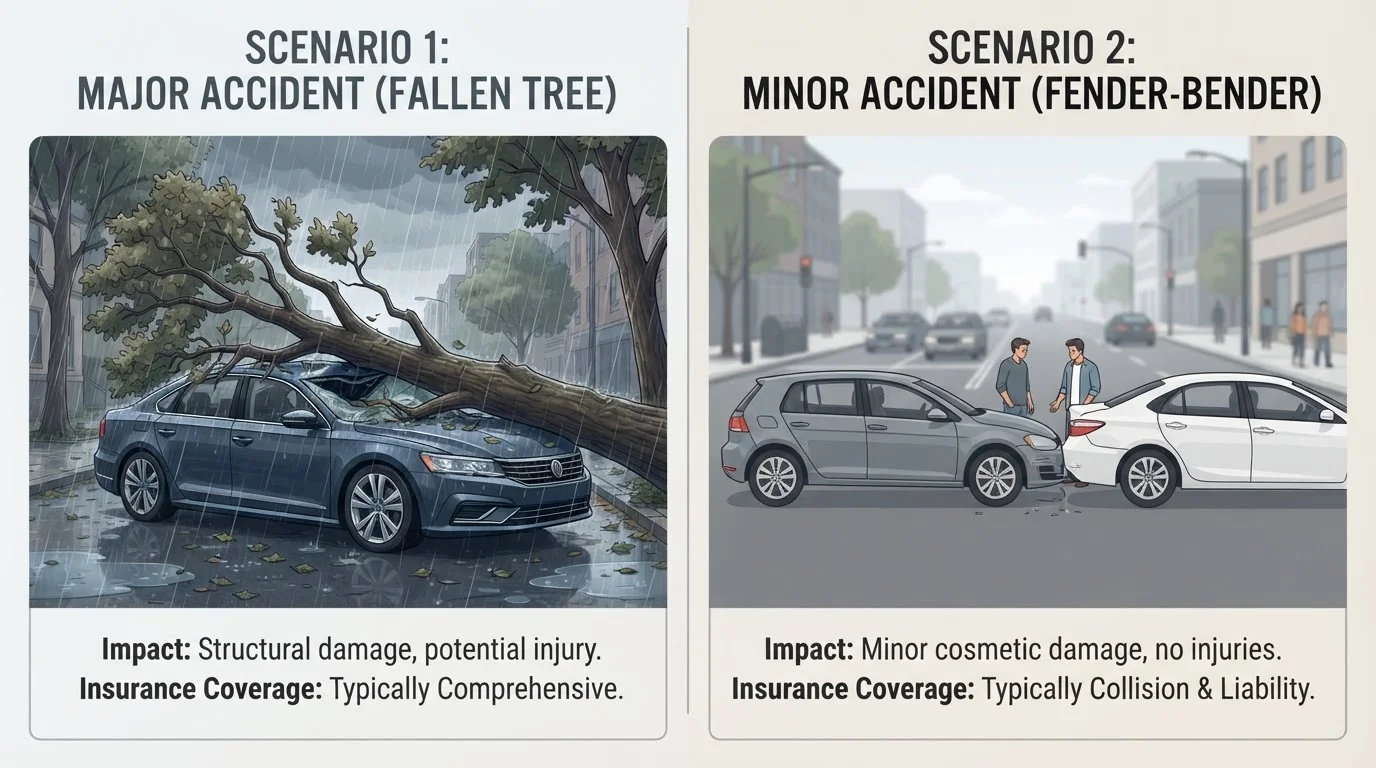
Option A
Comprehensive Coverage
Protection against events outside your control.
Best for: Drivers who want coverage for theft, weather damage, falling objects, and other non-collision incidents.
Option B
Collision Coverage
Protection when your vehicle hits - or is hit by - something.
Best for: Drivers who want repair or replacement coverage after their car strikes another vehicle or a physical object.
What Each Coverage Actually Protects
Comprehensive coverage pays to repair or replace your vehicle when it's damaged by something other than a collision. Common covered events include theft, vandalism, fire, flooding, hail, falling objects (such as tree branches), and animal strikes - for example, hitting a deer. Because most of these events happen regardless of driver behavior, comprehensive is sometimes described as covering acts of nature or circumstances beyond your control.
Collision coverage pays for damage to your vehicle when it physically strikes - or is struck by - another vehicle or object. That includes rear-end accidents, hitting a guardrail, or rolling into a parking lot barrier. Importantly, collision coverage applies regardless of who was at fault. If another driver hits you and they're uninsured or underinsured, your collision coverage can still step in to cover your vehicle's damage.
Neither coverage addresses injuries to you or other people - that's the role of medical payments coverage or personal injury protection. Neither pays for damage to the other driver's vehicle; that falls under liability coverage.
| Criterion | Comprehensive Coverage | Collision Coverage |
|---|---|---|
| What triggers a claim | Non-collision events (theft, weather, animals, fire) | Vehicle strikes object or another car |
| Fault requirement | Not applicable | Pays regardless of fault |
| Typical deductible | $100-$1,000 | $250-$1,500 |
| Required by lenders | Yes, on financed/leased vehicles | Yes, on financed/leased vehicles |
| Covers theft | Yes | No |
| Covers hitting a guardrail | No | Yes |
| Covers flood damage | Yes | No |
| Covers uninsured driver hitting you | No | Yes (for your vehicle damage) |
When Each Coverage Triggers - Real Scenarios
Understanding the coverage boundary in practice helps avoid surprises at claims time.
- Hailstorm dents your parked car: Comprehensive. No collision occurred.
- You back into a fire hydrant: Collision. You struck a stationary object.
- Your car is stolen from your driveway: Comprehensive. Theft is explicitly a comprehensive event.
- A deer runs into the side of your moving vehicle: Comprehensive. Animal strikes fall under this coverage even when your car is moving.
- You swerve to avoid a deer and hit a fence: Collision. Once you strike a physical structure, collision applies - not comprehensive.
- A tree limb falls and cracks your windshield: Comprehensive. Falling objects are covered.
The deer-fence scenario above is one of the most common points of confusion. The event that triggers the claim is what matters: contact with a structure or vehicle means collision; everything else generally means comprehensive.
If you're ever uncertain after an incident, knowing what to do right after an accident can help you document damage properly before filing.
~77%
Insured drivers carrying comprehensive
According to the Insurance Information Institute, roughly three-quarters of insured US drivers carry comprehensive coverage.
~74%
Insured drivers carrying collision
The Insurance Information Institute also reports that collision coverage is held by about 74% of insured drivers in the US.
$3,600+
Average comprehensive claim (hail/weather)
Industry data from the Insurance Information Institute suggests major weather events regularly push comprehensive claims well above $3,000.
Deductibles, Costs, and When It May Be Worth Dropping Coverage
Each coverage carries its own deductible - the amount you pay out of pocket before your insurer pays the remainder. Common deductible amounts range from $250 to $1,500. A higher deductible lowers your premium but increases what you owe after a claim.
A straightforward way to evaluate whether keeping coverage makes financial sense: compare the coverage's annual premium plus your deductible against your vehicle's current market value. If those costs approach or exceed what the car is worth, you may be paying for coverage whose payout couldn't justify the expense. Resources like Kelley Blue Book or NADA Guides can help you estimate your vehicle's current value.
For financed or leased vehicles, this calculation is largely moot - lenders require both coverages, and dropping them would violate your loan or lease agreement. If a total loss occurs and you owe more than the vehicle's value, gap insurance may cover the remaining balance.
What Neither Coverage Includes
Comprehensive and collision only cover your own vehicle's physical damage. They do not pay for injuries, cover damage to other vehicles, or replace personal belongings stolen from inside your car (that may fall under renters or homeowners insurance). Always review your full policy - not just these two coverages - to understand where gaps exist.
Managing insurance premiums is part of overall household budget planning. Revisiting your coverage levels annually - especially after paying off a vehicle - can prevent you from carrying unnecessary expense.
The content provided on our blog site traverses numerous categories, offering readers valuable and practical information. Readers can use the editorial team’s research and data to gain more insights into their topics of interest. However, they are requested not to treat the articles as conclusive. The website team cannot be held responsible for differences in data or inaccuracies found across other platforms. Please also note that the site might also miss out on various schemes and offers available that the readers may find more beneficial than the ones we cover.