

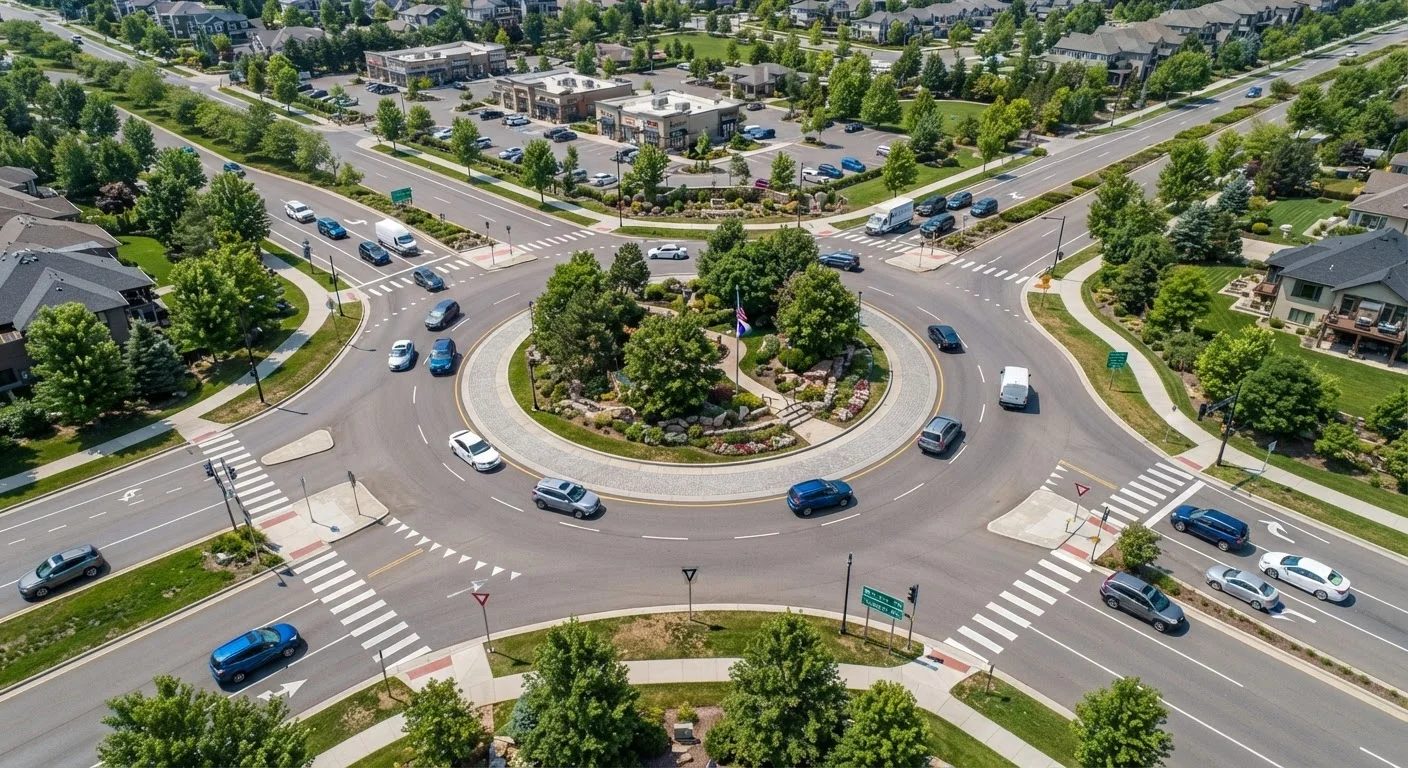
The Basic Logic of a Roundabout
A roundabout replaces the crossing paths of a traditional intersection with a single, continuous loop. Instead of two streams of traffic intersecting at a right angle - one of the most dangerous crash configurations on the road - all vehicles travel the same direction around a central island and peel off at their chosen exit.
The key rule is simple: yield before you enter. Drivers approaching the circle must pause at the yield line and wait for a safe gap in the circulating traffic. Once inside, they have priority over entering vehicles. This principle eliminates the ambiguity that often causes crashes at four-way stops or intersections where signal timing is misread.
Speed is deliberately managed by the roundabout's geometry. The curved entry forces drivers to decelerate - typically to 15-20 mph - before reaching the yield line. That built-in speed reduction is a primary reason serious crashes are far less common at roundabouts than at comparable signalized intersections.
78%
Reduction in fatal crashes at roundabouts
The Federal Highway Administration reports roundabouts reduce fatal crashes by approximately 78% compared to conventional intersections with stop signs or signals.
~15 mph
Typical design speed through a roundabout
Modern roundabout geometry is engineered to guide vehicles through at 15-20 mph, significantly reducing the kinetic energy involved in any collision.
~8,000
Roundabouts operating in the US
The number of roundabouts in the United States has grown substantially over the past two decades as transportation agencies have prioritized them at high-crash intersections.
Why Drivers Get Confused - and What Goes Wrong
Confusion at roundabouts almost always comes down to three issues: not knowing when to yield, not choosing a lane early enough, and misjudging speed on approach.
Failure to yield: Many drivers treat the yield sign like a stop sign and wait even when the circle is empty - causing backups - or, worse, they roll in without yielding at all, assuming oncoming traffic will slow for them. Neither is correct. Yield means give way to circulating traffic; it does not mean stop unconditionally.
Late lane selection: In a two-lane roundabout, attempting to pick a lane after the entry point creates dangerous weaving inside the circle. Signage and lane markings at the approach tell drivers exactly which lane corresponds to which exits. Reading those signs before you reach the yield line is the single most effective habit you can build.
Excessive speed on entry: Drivers accustomed to flowing through green lights often approach roundabouts without slowing adequately. The deflected entry geometry makes it physically awkward to enter at highway speeds, but drivers who fight that geometry by straightening out their line create sideswipe risk with circulating vehicles.
Practice the Approach Before the Yield Line
Begin decelerating well before the yield sign - not at it. Giving yourself a longer, slower approach lets you read circulating traffic, confirm your lane, and enter smoothly rather than braking sharply at the last moment. A consistent, moderate speed on entry is easier to manage than a last-second stop-and-go.
Practicing the yield-and-merge mindset in roundabouts directly reinforces the same skill used in highway on-ramp merging. If your family is working on overall driving confidence, the principles of defensive driving cover this broader situational awareness in depth.
Navigating Pedestrians, Cyclists, and Special Vehicles
Roundabouts include crosswalks, but they are positioned one or two car lengths back from the yield line - not at the curb of the circle itself. This placement gives pedestrians a safe crossing zone while allowing drivers to focus on circulating traffic when entering or exiting. Always look for pedestrians at these crossings before accelerating away from your exit.
Cyclists can legally travel through the circulatory lane like any other vehicle, or use a separate shared-use path if one is present. Drivers should treat a cyclist in the lane the same as any other vehicle - do not try to squeeze past them inside the circle.
If an emergency vehicle with lights and sirens activated approaches while you are already inside the roundabout, exit at the nearest safe opportunity and then pull over. Do not stop inside the circulatory roadway.
Roundabouts vs. Traffic Circles: Not the Same Thing
Older traffic circles and rotaries - still found in some northeastern cities - operate differently from modern roundabouts. They are often larger, may have circulating traffic yielding to entering traffic, and typically have higher speed limits. The rules described in this article apply to modern roundabouts with yield-on-entry design. Always observe posted signs at any circular intersection you haven't driven before.
If you're reinforcing safe driving habits with a new driver in your household, roundabouts are worth practicing explicitly. Teen drivers face elevated crash risk at unfamiliar intersection types - adding deliberate roundabout practice during supervised driving hours builds real-world confidence before they encounter one alone.
Making Roundabouts Second Nature
Roundabouts reward drivers who slow down, read their surroundings, and yield with confidence rather than hesitation. With repetition, the sequence - slow, check, yield, enter, exit - becomes as automatic as any other driving maneuver.
The broader habit that makes roundabouts easier is the same one that improves all complex driving situations: scanning ahead and preparing early rather than reacting at the last moment. That principle is central to building safer driving habits that actually stick, and roundabouts are a practical proving ground for it.
Families who drive together can reinforce roundabout skills by narrating the steps aloud when approaching one as a passenger - naming the lane, confirming the yield, and calling out the exit. This verbal rehearsal is a low-effort, high-value habit for newer drivers and confident ones alike.
Frequently Asked Questions
Vehicles already inside the roundabout always have the right of way. Drivers approaching on the entry road must yield at the dashed yield line before merging into the circle. Never assume a gap will remain open - always check before entering.
As a general rule, use the right lane to turn right or go straight, and the left lane to go straight or turn left. Always check posted signage and pavement markings at the specific roundabout, as layouts can vary. Choose your lane before entering - do not switch lanes once you're in the circle.
No. Stopping inside a roundabout - unless forced to by an emergency - disrupts traffic flow and increases collision risk. If you miss your exit, continue around the circle and take it on the next pass.
Research from the Federal Highway Administration (FHWA) indicates that roundabouts reduce fatal and injury crashes significantly compared to conventional signalized and stop-controlled intersections. The primary reason is that roundabouts eliminate high-speed right-angle and head-on conflicts, replacing them with lower-speed, glancing-angle interactions.
Many roundabouts include a raised, mountable apron around the central island to accommodate trucks and large vehicles that need extra turning radius. Emergency vehicles should be given the right of way; pull to the right and stop before the yield line, or exit the roundabout if you are already inside before stopping safely.
The content provided on our blog site traverses numerous categories, offering readers valuable and practical information. Readers can use the editorial team’s research and data to gain more insights into their topics of interest. However, they are requested not to treat the articles as conclusive. The website team cannot be held responsible for differences in data or inaccuracies found across other platforms. Please also note that the site might also miss out on various schemes and offers available that the readers may find more beneficial than the ones we cover.