

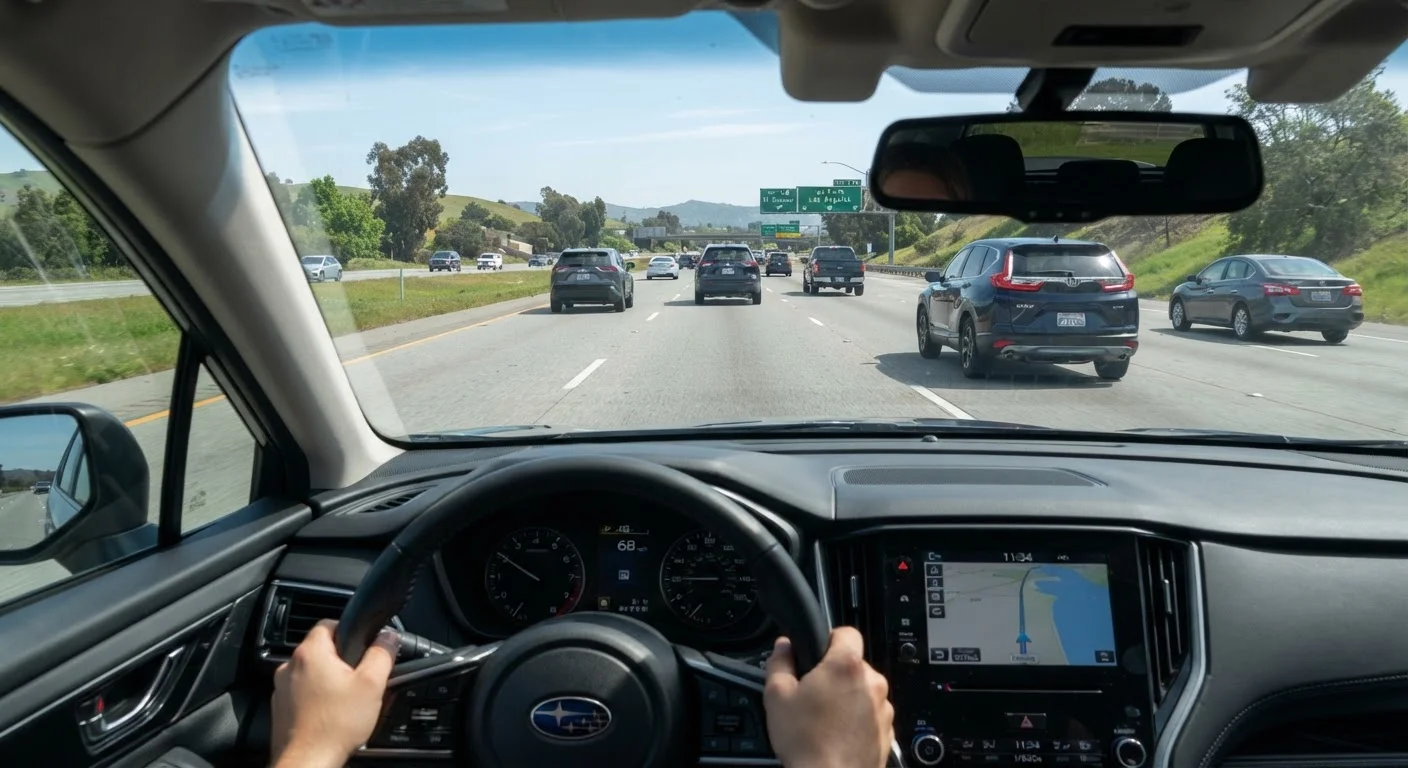
How the Two-Second Rule Actually Works
The mechanics are simple. As the vehicle ahead of you passes a fixed roadside point - a sign, a lane marking, a bridge shadow - begin counting: one-one-thousand, two-one-thousand. If your front bumper reaches that same point before you finish the count, you are following too closely.
At 30 mph, two seconds equals roughly 88 feet. At 60 mph, that gap stretches to approximately 176 feet - about the length of six car lengths. The rule scales with speed automatically, which is precisely its value as a practical tool. You don't need to estimate feet or calculate anything; the count does the work.
What the rule does not do is account for everything that can go wrong. It assumes your vehicle's brakes are in good condition, your tires have adequate tread and grip, the road is dry, and you are fully alert. Remove any one of those factors and two seconds may be insufficient.
Practice the Count Out Loud
When teaching the two-second rule - especially to new drivers - have them count aloud rather than mentally. Saying 'one-one-thousand, two-one-thousand' at a natural pace prevents rushing the count, which is the most common way drivers convince themselves their gap is adequate when it isn't.
Why Most Drivers Underestimate Their Following Distance
Research consistently shows that drivers are poor judges of their own following distance, particularly at speed. The visual system compresses apparent spacing at higher velocities, and highway driving in particular creates a kind of perceptual habituation - gaps that feel normal are often dangerously short.
~1 second
Typical real-world following gap on highways
Traffic safety research has found that many drivers on busy highways maintain following gaps well under two seconds, often closer to one second or less.
240 ft
Approximate stopping distance at 60 mph
NHTSA estimates that a typical passenger vehicle traveling at 60 mph requires approximately 240 feet to stop when accounting for perception-reaction time and braking distance.
40%
Of crashes involve rear-end collisions
According to NHTSA crash data, rear-end collisions account for approximately 40 percent of all reported crashes in the United States annually.
Tailgating is also normalized in dense traffic. When surrounding vehicles follow closely, drivers unconsciously mirror that behavior, treating it as the situational standard. This social calibration can override learned safety habits, even among experienced drivers.
For new and teen drivers, the problem is compounded by limited experience reading traffic dynamics. Teen drivers face outsized crash risk in part because they haven't yet developed the anticipatory skills that help experienced drivers recognize when a gap is truly adequate.
When Two Seconds Isn't Enough
The two-second rule was designed for ideal conditions. Extend your following distance in any of these situations:
- Rain, ice, or snow: Wet pavement can double stopping distances; ice can multiply them further. Four seconds is a reasonable minimum on slick roads.
- Reduced visibility: Fog, glare, and nighttime driving require more reaction time because hazards appear with less warning. For a deeper look at why darkness changes the risk equation, see our guide on nighttime driving risks.
- Following large vehicles: Trucks, RVs, and vehicles towing trailers take longer to stop and can obstruct your view of the road ahead.
- High speed: At 70 mph, stopping distances under emergency braking can exceed 300 feet. A two-second gap may barely cover that distance, leaving no margin for reaction.
Speed is the underlying multiplier in nearly every following-distance scenario. Understanding how speed limits differ from truly safe speeds helps put appropriate following distance into broader context.
The Four-Second Rule for Adverse Conditions
Many driver education programs now teach a four-second rule as the default for anything other than ideal dry-road conditions. This provides a more comfortable buffer for reaction time and braking on compromised surfaces and accounts for the fact that most drivers' self-assessed reaction time is faster than their actual measured response.
Building the Habit Consistently
The two-second rule is most valuable when it becomes automatic rather than deliberate. That means practicing it consciously until it stops requiring active thought - the same way checking mirrors eventually becomes routine.
One practical approach: run a quick self-check every time you enter a new driving environment - city to highway, dry to wet, day to night. Reset your following distance expectation each time conditions change rather than carrying the same gap through every situation.
For families with teen drivers, introducing the two-second rule early and reinforcing it across different road conditions is one of the most concrete safety skills that can be taught and observed. Ask a new driver to demonstrate it on a practice drive: pick a landmark, count it out, and adjust. Seeing the gap visually - and hearing the count - makes the concept concrete in a way that verbal instruction alone does not.
Frequently Asked Questions
Pick a stationary roadside marker - a sign, bridge, or shadow. When the vehicle ahead passes it, count 'one-one-thousand, two-one-thousand.' If you reach the marker before finishing the count, you're too close. The count should feel unhurried, not rushed.
Two seconds is considered a minimum under dry, clear conditions. At 65 mph, two seconds translates to roughly 190 feet. Many safety experts recommend three to four seconds on highways, especially in heavy traffic or when following large trucks.
Increase to four seconds or more in rain, snow, fog, or reduced visibility. Also allow more space when following motorcycles, large trucks, or vehicles towing trailers, when you're fatigued, or when road conditions are unpredictable.
Yes, though in stop-and-go traffic the practical application shifts to maintaining a visible gap - you should be able to see the rear tires of the vehicle ahead touching the road. This provides reaction room without blocking intersections.
Speed perception is unreliable at close distances, and highway driving can compress our sense of space. Studies suggest drivers routinely underestimate how fast they're traveling relative to the car ahead, leading to habitual following distances well under one second.
The content provided on our blog site traverses numerous categories, offering readers valuable and practical information. Readers can use the editorial team’s research and data to gain more insights into their topics of interest. However, they are requested not to treat the articles as conclusive. The website team cannot be held responsible for differences in data or inaccuracies found across other platforms. Please also note that the site might also miss out on various schemes and offers available that the readers may find more beneficial than the ones we cover.