

Option A
Posted Speed Limit
The legal maximum set by traffic engineers and lawmakers.
Best for: Defining the upper boundary of lawful speed under ideal road, weather, and traffic conditions.
Option B
Safe Speed
The driver-determined speed appropriate for actual conditions.
Best for: Protecting everyone in the vehicle and on the road when real-world conditions differ from ideal.
What the Posted Limit Actually Means
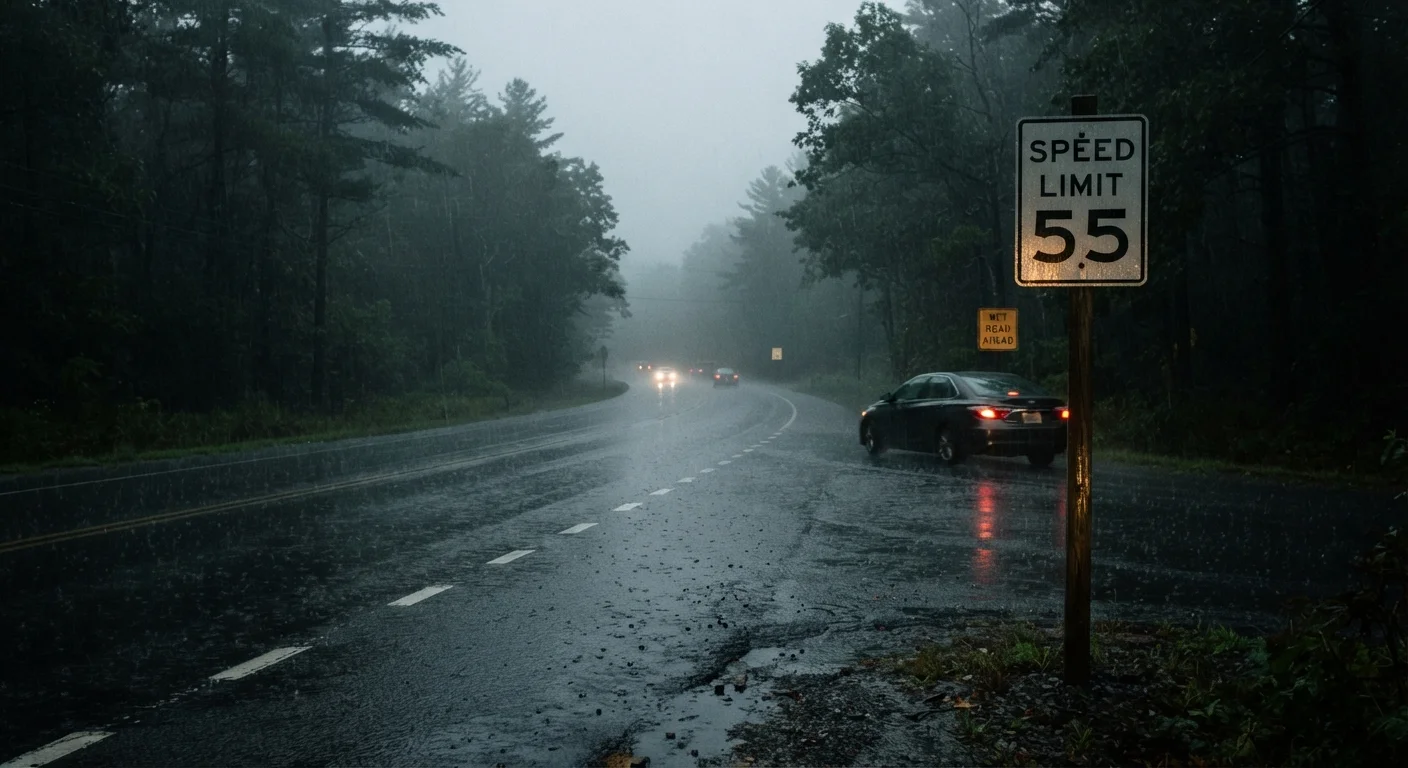
Speed limit signs communicate the maximum lawful speed under ideal conditions - not a target speed, not a guarantee of safety, and not a blanket permission to drive that fast regardless of what's happening on the road. Limits are set through a process that considers road geometry, surrounding land use, and typical traffic flow. They assume dry pavement, adequate visibility, and predictable conditions.
That context matters enormously. A 55 mph limit on an interstate was calculated for a clear, uncongested afternoon - not for a January ice storm or a construction zone with workers present. When conditions change, the posted number becomes less relevant to your actual decision-making.
| Criterion | Posted Speed Limit | Safe Speed |
|---|---|---|
| Set by | Traffic engineers and state/local law | The driver, based on real-time conditions |
| Assumes | Ideal road, weather, and traffic conditions | Actual conditions at the moment of driving |
| Legal status | Maximum lawful speed under ideal conditions | Required by basic speed laws in all US states |
| Changes with weather | No - the sign stays the same | Yes - must decrease as conditions worsen |
| Changes with traffic | No | Yes - dense traffic requires lower speeds |
| Requires driver judgment | Minimal - read the sign | High - continuous active assessment |
| Can exceed the other? | May exceed safe speed in poor conditions | Never lawfully exceeds the posted limit |
The Legal Obligation to Drive at a Safe Speed
Every US state includes some version of a basic speed law in its traffic code. The language varies, but the principle is consistent: drivers must operate at a speed that is reasonable and prudent given the conditions at the time. This means that driving at the posted limit can still be an illegal act if conditions make that speed dangerous.
Common triggering conditions include:
- Reduced visibility - fog, heavy rain, glare, or nighttime driving without adequate lighting
- Slippery surfaces - rain, ice, snow, gravel, or wet leaves
- Heavy or stop-and-go traffic - where reaction time becomes the limiting factor
- Road hazards - potholes, debris, narrow lanes, or construction activity
- Pedestrian and cyclist presence - especially near schools, parks, and intersections
Defensive driving treats speed as a variable to be adjusted continuously, not a fixed setting chosen once at the start of a trip.
~33%
Fatal crashes involving excessive speed
According to NHTSA data, speeding is consistently a factor in roughly one-third of all US traffic fatalities each year.
4x
Braking distance increase when speed doubles
Because kinetic energy scales with the square of velocity, doubling speed approximately quadruples the distance needed to stop on dry pavement.
160-250 ft
Typical headlight illumination range
Standard low-beam headlights illuminate roughly 160 to 250 feet ahead - well short of stopping distance at highway speeds.
The Physics Behind Why Speed Matters So Much
Speed and stopping distance don't scale in a straight line - they scale with the square of your speed. Doubling your speed roughly quadruples your braking distance on dry pavement. On wet or icy roads, that relationship becomes even more punishing.
At 30 mph on dry pavement, the average stopping distance (reaction time plus braking) is roughly 75 feet. At 60 mph, it's closer to 240 feet - not twice as long, but three times. Add rain or worn tires, and those numbers grow further still.
This is why the two-second following distance rule must be extended in poor conditions - your car simply cannot stop in the same distance. Speed governs everything downstream: how much time you have to react, how far you travel before braking takes effect, and how severe a collision will be if one occurs.
Night driving makes this especially critical. Headlights typically illuminate only 160-250 feet ahead, meaning a driver traveling at 60 mph is outrunning their own ability to stop before reaching whatever their headlights reveal.
How to Judge Your Safe Speed in Practice
Determining a safe speed is an active, ongoing judgment - not a one-time decision. A useful starting framework involves three questions:
- Can I stop in the distance I can see? If visibility is limited by weather, curves, or darkness, your speed must match your sight lines.
- What's the traffic doing around me? Matching the flow of traffic generally reduces conflict - but if the flow itself is too fast for conditions, independence of judgment is required.
- What hazards am I approaching? Intersections, school zones, cyclists, merging traffic - each demands a speed reduction. See highway merging guidance for specific speed considerations at highway on-ramps.
Building this kind of real-time awareness is part of what building safer driving habits actually looks like in practice - small, consistent decisions rather than occasional heroics.
Speed Limits Can Also Set a Minimum Expectation
While this article focuses on when to drive below the limit, it's worth noting that driving significantly below posted speeds on highways can also create hazards by disrupting traffic flow. Most states have minimum speed provisions for limited-access highways. The goal is always a speed appropriate to conditions - not simply the lowest speed possible.
The content provided on our blog site traverses numerous categories, offering readers valuable and practical information. Readers can use the editorial team’s research and data to gain more insights into their topics of interest. However, they are requested not to treat the articles as conclusive. The website team cannot be held responsible for differences in data or inaccuracies found across other platforms. Please also note that the site might also miss out on various schemes and offers available that the readers may find more beneficial than the ones we cover.