

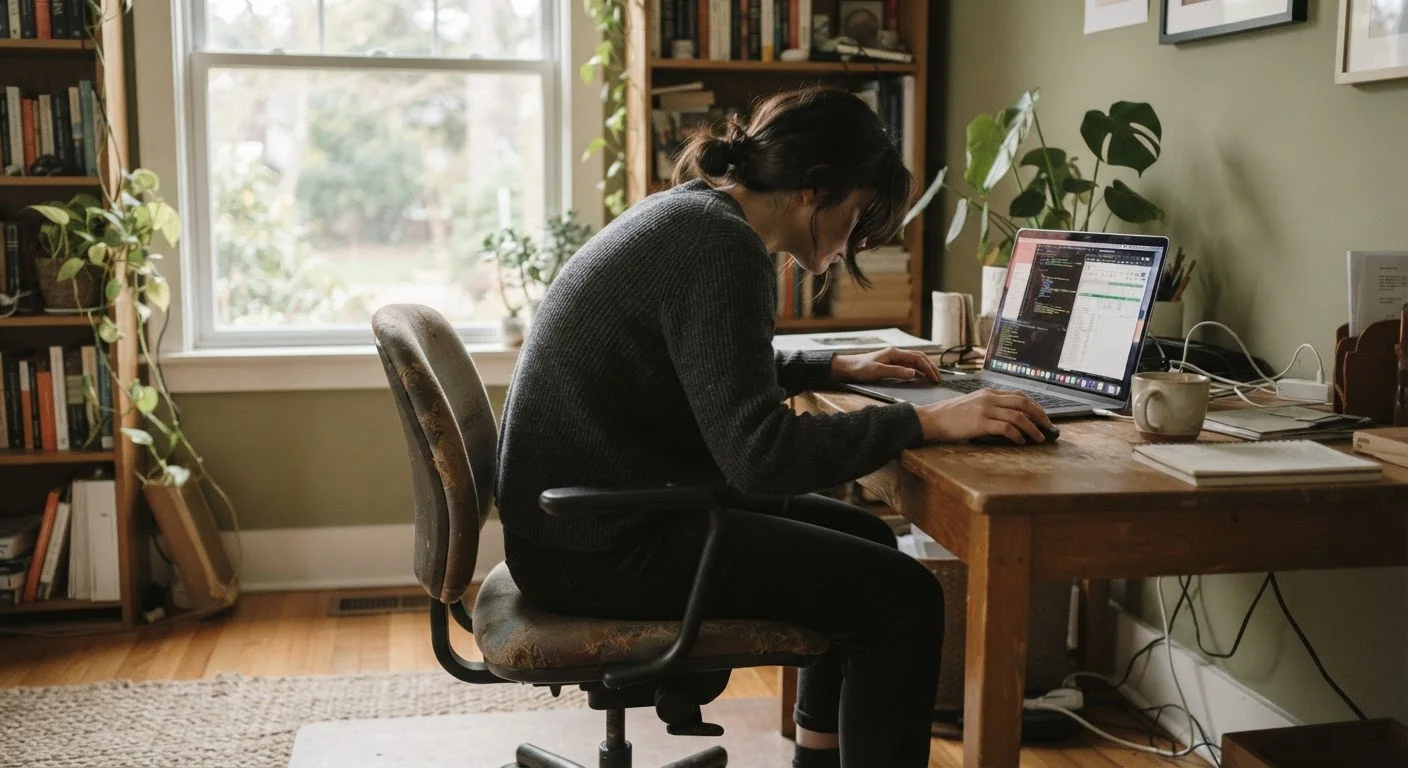
Why Sitting All Day Is More Than Just Inactivity
Most people understand that exercise is good for health. Fewer realize that sitting - even for someone who works out regularly - creates its own category of physiological stress. Occupational and public health researchers distinguish between physical inactivity (insufficient exercise) and sedentary behavior (prolonged sitting), treating them as separate, compounding risks.
When the body remains still for extended periods, a cascade of subtle changes occurs. Muscles responsible for circulation, particularly in the legs, become largely inactive. Enzymes involved in processing blood fats slow down. Blood sugar regulation becomes less efficient. These are not dramatic events, but repeated daily over months and years they accumulate into measurable health burden.
6-8 hrs
Average daily sitting time for US adults
Multiple national health surveys, including data from the CDC and NHANES, consistently estimate that most American adults sit between six and eight hours per day on average.
~30%
US workers in sedentary occupations
Bureau of Labor Statistics occupational data indicates that roughly a third of US workers hold jobs classified as primarily sedentary, including office, managerial, and professional roles.
3x
Increase in desk-based work since 1960s
Research published in PLOS ONE estimated that the proportion of US jobs requiring primarily sedentary activity has tripled since the 1960s, reflecting broad economic shifts toward knowledge work.
For families where one or more adults hold desk-based jobs - and where children spend hours in school chairs followed by screen time at home - sedentary time is a household-wide phenomenon, not just an individual one.
What Happens Inside the Body During Prolonged Sitting
The effects of extended sitting touch multiple body systems simultaneously.
Metabolic Effects
Research published in major public health journals has linked high daily sitting time to reduced insulin sensitivity and less favorable blood lipid profiles. The muscles of the lower body, when inactive for hours, contribute far less to the uptake of glucose from the bloodstream than they do during even light movement. Over time, this pattern is associated with elevated risk for metabolic conditions - though individual risk depends on many factors, including genetics, diet, and overall activity.
Cardiovascular and Circulatory Effects
Blood pools more easily in the lower limbs during long sitting periods, reducing the mechanical demands that normally help maintain healthy blood pressure and vascular tone. Large prospective studies have found associations between high sedentary time and cardiovascular health markers, independent of leisure-time exercise levels.
Musculoskeletal Effects
Prolonged sitting shortens hip flexor muscles and places sustained load on the lumbar spine, often contributing to the lower back pain that is one of the most common complaints among desk workers. Neck and shoulder tension frequently accompany screens-forward postures. These discomforts affect not just workplace productivity but willingness to move during off-hours.
“Sitting is the new smoking is probably an overstatement, but the evidence that prolonged sedentary time is an independent risk factor - separate from physical inactivity - is now quite solid. We need to think about both.”
— Dr. Neville Owen, Professor and behavioral epidemiologist, Baker Heart and Diabetes Institute
Children, Older Adults, and the Full-Family Picture
Adults in sedentary jobs typically receive most of the attention in this conversation, but they are rarely sitting alone. School-age children may accumulate six or more hours of seated time on a school day before adding homework and leisure screen time. Research from pediatric health fields consistently links high childhood sedentary time to lower cardiovascular fitness, disrupted sleep, and in some studies, impacts on attention and mood regulation.
For adults over 60, the picture shifts again. Reduced muscle mass and changes in balance make the consequences of inactivity more acute, while opportunities for incidental movement often decline with retirement or reduced mobility. Our article on staying active after 60 explores how movement needs and capacities evolve with age.
Special Considerations for Older Adults
For adults over 60 or anyone with a chronic health condition, changes to activity levels should be discussed with a healthcare provider before implementation. Falls risk, joint health, and cardiovascular conditions all influence what types and amounts of movement are appropriate. General information here is not a substitute for personalized medical guidance.
Understanding that sedentary behavior is a family issue - affecting everyone under the roof in age-specific ways - is one of the most useful reframes a household can make.
Practical Counterstrategies That Actually Work
The evidence consistently points to one finding that many people find surprising: breaking up sitting time with frequent short bursts of movement matters, and may matter as much as or more than a single long exercise session. This is encouraging news for families, because it shifts the goal from finding a 60-minute workout window to building movement into the texture of the day.
Try the 30-Minute Rule as a Family
Encourage every household member - adults and children alike - to stand, stretch, or walk briefly at least once every 30 to 60 minutes. A shared phone alarm or visual timer on the fridge can make this a household habit rather than an individual discipline. Even two minutes of light movement counts.
Practical strategies that fit family schedules include standing or walking during phone calls, parking farther away, replacing one seated family evening per week with a short walk, and encouraging children to help with physically active household tasks. Our piece on movement snacks for busy families offers concrete ideas for weaving activity into school runs, work breaks, and evenings.
For families ready to build something more structured, getting the whole family moving provides a grounded starting point that accommodates different ages and ability levels. And if weather or space is a concern, outdoor vs. indoor exercise options covers both approaches honestly. For those seeking gentler entry points, low-impact exercise options describes activities well-suited to a wide range of fitness levels and physical conditions.
The goal is not perfection - it is consistent, sustainable interruption of prolonged stillness across every member of the family.
This article provides general health information and education only. It is not a substitute for advice from a qualified healthcare professional. If you have concerns about sedentary behavior and your health, please consult your doctor or a licensed health provider.
Frequently Asked Questions
Research suggests that prolonged, unbroken sitting carries health risks that are partly independent of your overall exercise level. A single gym session may not fully cancel out eight or more hours of continuous sitting. Breaking up sedentary time throughout the day appears to matter alongside regular exercise.
There is no universally agreed threshold, but many researchers recommend breaking up sitting every 30 to 60 minutes with light movement. Even brief walks or standing periods appear to benefit metabolic markers. Consult a healthcare professional for guidance tailored to your situation.
Prolonged sitting is associated with changes in blood sugar regulation, blood pressure, blood lipid levels, and musculoskeletal discomfort, particularly in the lower back, hips, and neck. Longer-term associations with cardiovascular and metabolic conditions have been observed in large population studies.
Children accumulating high screen and sitting time may experience disrupted sleep, reduced cardiovascular fitness, and impacts on attention and mood. Developing movement habits early is considered especially important since physical activity patterns tend to persist into adulthood.
Setting a recurring timer to stand and move briefly every 45-60 minutes is a low-barrier starting point. Walking during phone calls, using breaks to stretch, and involving family members in after-dinner walks are practical strategies many households find sustainable.
The content provided on our blog site traverses numerous categories, offering readers valuable and practical information. Readers can use the editorial team’s research and data to gain more insights into their topics of interest. However, they are requested not to treat the articles as conclusive. The website team cannot be held responsible for differences in data or inaccuracies found across other platforms. Please also note that the site might also miss out on various schemes and offers available that the readers may find more beneficial than the ones we cover.