

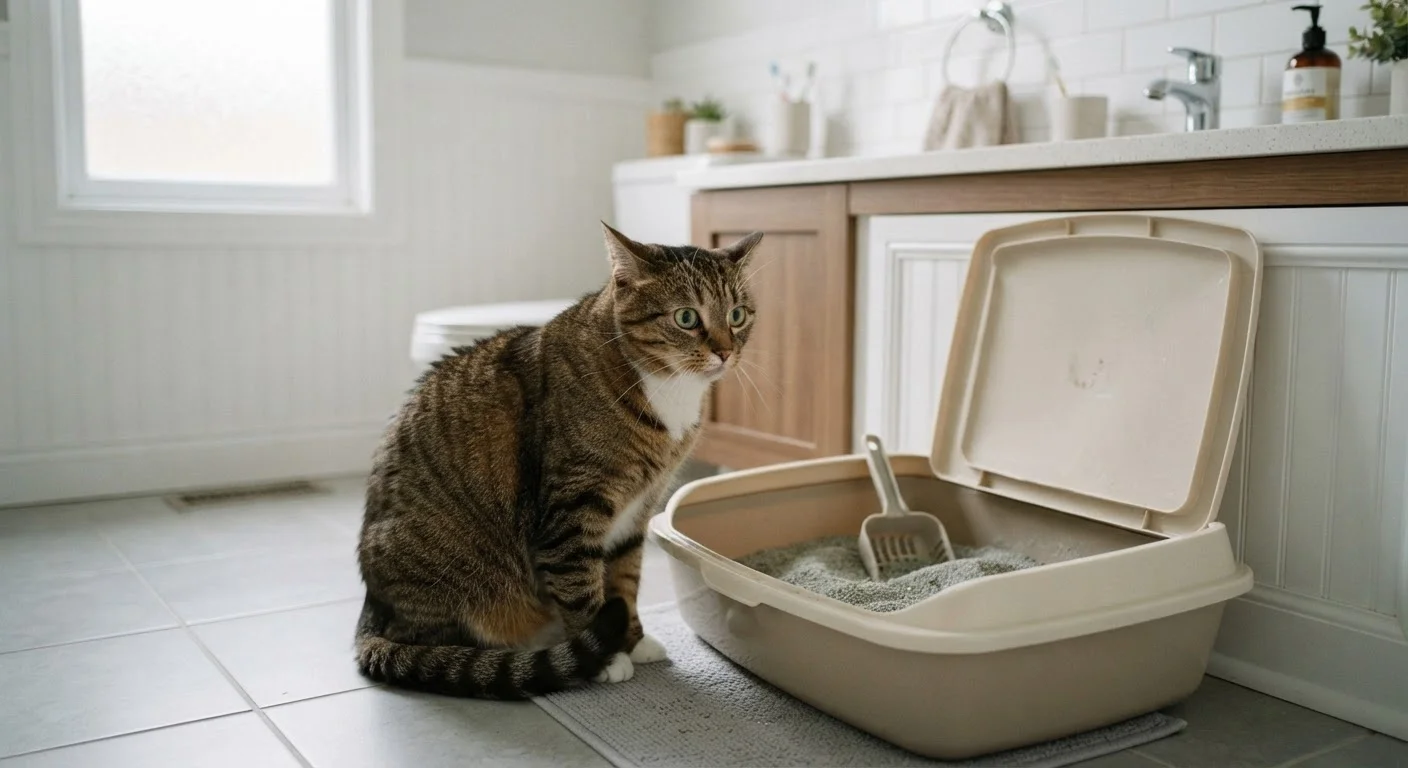
Why Litter Box Signals Get Misread
Litter box problems rank among the most common reasons cat owners seek behavioral advice - and among the most frequently misdiagnosed at home. The core misread is simple: owners tend to frame elimination issues as attitude problems rather than communication. Cats cannot verbalize discomfort, stress, or physical pain. Changes in where, when, and how they use (or avoid) the litter box are often the clearest signal they can send.
Understanding what a cat's litter box behavior is actually saying requires separating medical causes from environmental ones - and knowing that both can be present at the same time. A urinary tract infection may trigger avoidance; a poorly placed box may sustain it long after the infection is treated. For a broader look at how cats signal distress, the practical guide to feline body language offers useful context.
Avoidance Can Signal a Medical Emergency
A cat straining in the litter box without producing urine - especially a male cat - may be experiencing a urinary blockage, which is life-threatening. Do not wait to see if the behavior resolves on its own. Contact a veterinarian immediately if your cat visits the box repeatedly but produces little or no urine.
Common Mistakes Cat Owners Make
The following mistakes represent the most frequent - and most consequential - errors owners make when interpreting or managing litter box problems. Each one can be corrected once identified.
Assuming avoidance is purely behavioral without ruling out medical causes first.
Why it happens: Owners often interpret box avoidance as stubbornness or dissatisfaction with the setup, and focus on adjusting the environment before considering health.
Keeping too few litter boxes in a multi-cat household.
Why it happens: Many owners assume one shared box is sufficient, particularly if the cats appear to get along.
Using a box that is too small for the cat's body size.
Why it happens: Owners often purchase boxes sized for kittens and never upgrade as the cat grows, or choose compact boxes to save space.
Placing the box in a location the cat finds stressful or inconvenient.
Why it happens: Owners prioritize hiding the box out of sight - inside cabinets, near appliances, or in isolated basements - without considering the cat's perspective.
Not scooping frequently enough, then blaming the cat for going elsewhere.
Why it happens: Owners underestimate how sensitive cats are to odor and waste accumulation, since the human nose adapts to household smells.
Interpreting increased litter box visits as normal or healthy without tracking the pattern.
Why it happens: Owners sometimes assume frequent box use means a cat is more comfortable or regular, rather than recognizing it as a potential distress signal.
Never Punish Litter Box Accidents
Scolding, confining near the box, or rubbing a cat's nose in an accident does not teach the desired behavior. It increases stress, which can make elimination problems significantly worse. Cats do not connect after-the-fact punishment with their earlier actions - a finding consistently supported by veterinary behaviorists.
It's also worth noting that some behaviors owners attribute to litter box preferences, like scratching or spraying near the box area, may reflect territorial communication rather than elimination issues. The article on common feline myths addresses several misconceptions that overlap with litter box misreads.
When to Call the Vet
Not every litter box adjustment requires professional input, but several situations demand prompt veterinary attention rather than trial-and-error at home:
- Any straining without output, particularly in male cats, is a potential emergency.
- Blood visible in urine or stool should be evaluated promptly.
- Sudden changes in a previously reliable cat with no environmental change are often medical in origin.
- Vocalization while using the box suggests pain and warrants examination.
Cats instinctively mask discomfort, so visible signs are often late-stage. Our guide to recognizing pain in cats explains why these signals are so easy to miss and what to look for. When litter box behavior shifts, the safest assumption is that something has changed for your cat - and it's worth finding out what.
~10%
Cats affected by elimination problems
Veterinary behaviorists estimate roughly 10% of cats will develop a house soiling or litter box problem at some point in their lives.
Top reason
Cats surrendered to shelters
Litter box problems are consistently cited among the leading behavioral reasons cats are relinquished to shelters, according to animal welfare researchers.
This article is for general informational purposes only and is not a substitute for professional veterinary advice. Always consult a licensed veterinarian for concerns about your cat's health or behavior.
The content provided on our blog site traverses numerous categories, offering readers valuable and practical information. Readers can use the editorial team’s research and data to gain more insights into their topics of interest. However, they are requested not to treat the articles as conclusive. The website team cannot be held responsible for differences in data or inaccuracies found across other platforms. Please also note that the site might also miss out on various schemes and offers available that the readers may find more beneficial than the ones we cover.