

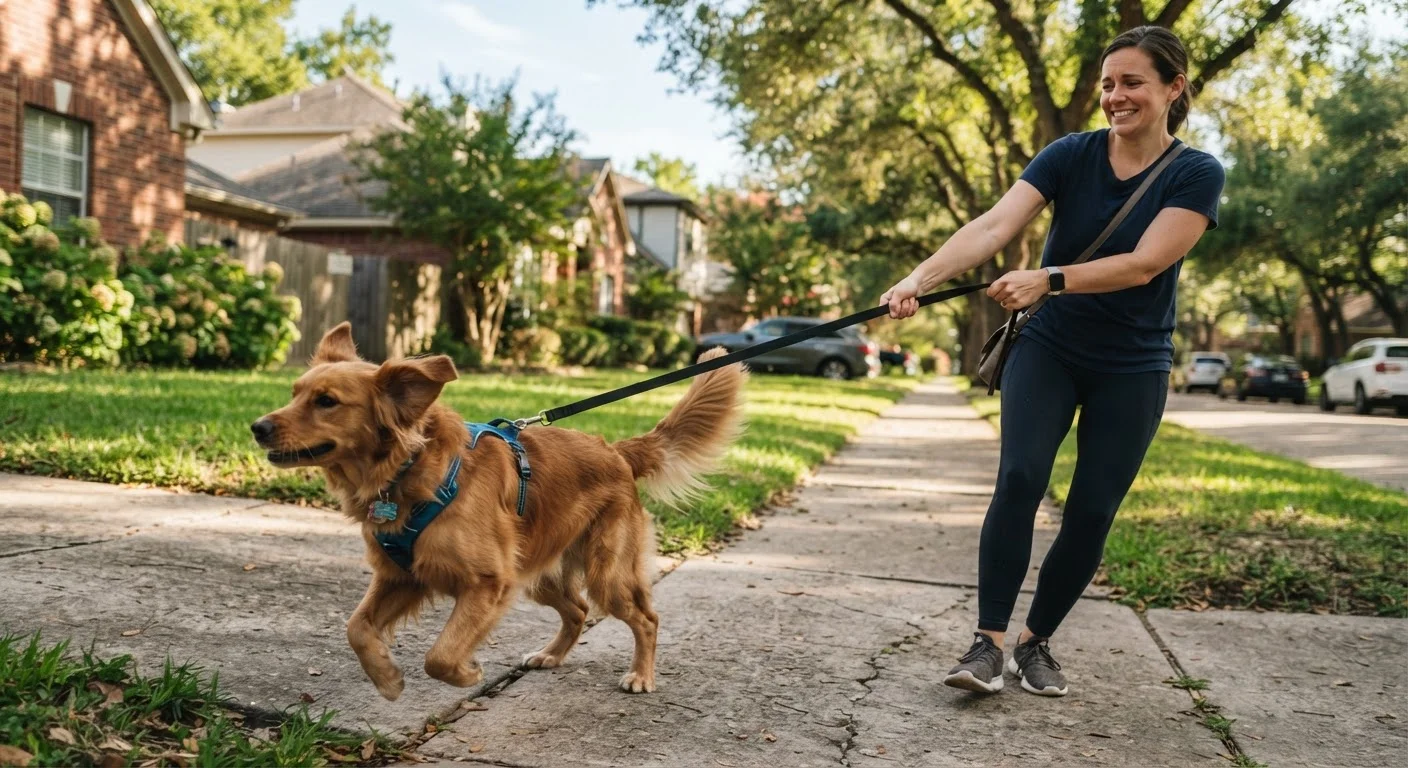
Why Dogs Pull: The Instinct Behind the Behavior
Leash pulling frustrates millions of dog owners, yet the behavior makes complete sense from a canine perspective. Dogs naturally move faster than humans, and the world ahead - smells, sights, other animals - is intensely compelling. When a dog surges forward and the walk continues, the dog learns a direct lesson: pulling works.
This is operant conditioning in its simplest form. The dog isn't being stubborn or trying to assert dominance over you. It's doing what the environment has repeatedly rewarded. According to veterinary behaviorists, the concept of "dominance" is widely misapplied to everyday dog behaviors like leash pulling, and acting on that misconception often makes training harder, not easier.
Breed tendencies matter too. Scent hounds, terriers, and high-energy working breeds were selectively developed to move with purpose and follow their noses - behaviors that translate directly into powerful forward drive on leash. Understanding this context helps owners approach training with patience rather than frustration.
Common Mistakes That Make Leash Pulling Worse
Even well-intentioned owners regularly make errors that reinforce the very behavior they're trying to stop. Recognizing these patterns is the first step toward changing them.
Continuing to walk while the leash is taut.
Why it happens: Owners want to complete the walk and may not notice the connection between movement and reinforcement in the moment.
Using punishment-based corrections such as leash jerks or choke chains.
Why it happens: These tools are widely sold and can produce an immediate suppression of pulling, which owners interpret as success.
Being inconsistent across different walks or handlers.
Why it happens: Family members may have different rules, or owners may enforce loose-leash walking only when it's convenient.
Starting training in high-distraction environments too soon.
Why it happens: Owners often head straight to busy parks or streets, where competing stimuli make it nearly impossible for a dog to focus on leash cues.
Expecting fast results and giving up after a few sessions.
Why it happens: Leash pulling is a deeply practiced habit, and owners may not see improvement immediately with a new method.
If you notice your dog becoming anxious or overstimulated before walks even begin, it may help to read our guide on reading your dog's body language - understanding those pre-walk signals can help you set a calmer tone from the start.
Training Principles That Actually Work
Reward-based training - sometimes called positive reinforcement - is the approach most strongly supported by veterinary behavioral science for addressing leash pulling. The core principle is straightforward: when the leash is loose, good things happen for the dog. When tension appears, forward progress stops.
Avoid Aversive Equipment Without Professional Guidance
Prong collars, choke chains, and electronic collars can suppress pulling in the short term but carry real risks including physical injury to the neck and trachea, and increased fear or aggression. The American Veterinary Society of Animal Behavior and the American College of Veterinary Behaviorists both recommend reward-based methods as the first-line approach. If you're considering any training tool beyond a standard flat collar or well-fitted harness, consult a certified professional trainer or veterinary behaviorist first.
Two techniques are particularly effective:
- Stop-and-wait: The moment your dog pulls, you stop completely and wait. No pulling, no scolding - just a neutral pause. When the leash slackens, you resume walking. This removes the reward (forward movement) from pulling and attaches it to a loose leash instead.
- Change direction: When your dog pulls, calmly turn and walk the other way. This teaches your dog to monitor your movement and stay attentive rather than charging ahead independently.
High-value treats - small, soft, and easy to deliver quickly - are useful during early training. Over time, praise and play can replace food rewards as the behavior becomes habitual. Keep sessions short: 10-15 minutes of focused practice is more productive than an exhausting hour-long struggle.
Building good leash habits connects naturally to broader training consistency. If you're also working on helping your dog feel secure at home, our article on crate training without punishment covers complementary principles.
#1
Most reported dog behavior problem
Leash pulling is consistently ranked the most common behavior complaint reported by dog owners in veterinary and training surveys.
~70%
Dogs never receiving formal training
Surveys by the American Pet Products Association suggest a significant majority of pet dogs receive little to no structured obedience training.
The content provided on our blog site traverses numerous categories, offering readers valuable and practical information. Readers can use the editorial team’s research and data to gain more insights into their topics of interest. However, they are requested not to treat the articles as conclusive. The website team cannot be held responsible for differences in data or inaccuracies found across other platforms. Please also note that the site might also miss out on various schemes and offers available that the readers may find more beneficial than the ones we cover.