

How Long Should a Car Battery Last?
The average car battery has a service life of 3 to 5 years, according to guidance from AAA and automotive industry standards. That range isn't fixed - it shifts based on where you live, how you drive, and how well the charging system is maintained.
Heat is the single biggest enemy of battery longevity. High under-hood temperatures - common in warm-climate states - cause internal fluid to evaporate and accelerate plate corrosion inside the battery. Cold weather, by contrast, reduces the battery's ability to deliver starting power, which is why dead batteries are so common on frigid winter mornings. See our seasonal car care guide for steps to protect your battery before each weather extreme hits.
Frequent short trips - school runs, quick errands - don't give the alternator enough time to fully recharge the battery after starting. Over months and years, this partial-charge cycling degrades battery capacity faster than longer highway drives would.
3-5 years
Typical car battery lifespan
AAA and automotive industry guidance consistently cites this as the standard range for most passenger vehicles under normal driving conditions.
~$100M+
Annual US roadside battery-related calls
Battery failure is consistently one of the top reasons drivers call for roadside assistance each year, according to AAA data.
50%
Battery capacity loss in freezing temps
At 0°F, a fully charged lead-acid battery may deliver only about half its rated capacity, according to battery industry data.
Warning Signs Your Battery Is Declining
Batteries rarely fail without giving some advance notice. Learning to recognise the early signals can save you from being stranded.
- Slow or labored engine cranking: If the engine turns over sluggishly - especially on a warm morning when cold shouldn't be a factor - the battery may not be delivering full voltage.
- Dimming headlights or interior lights: Noticeably dim lights when idling, which brighten when you rev the engine, can indicate a battery or alternator issue.
- Electrical gremlins: Intermittent problems with power windows, infotainment resets, or the clock losing time can sometimes trace back to an unstable battery.
- Swollen or misshapen case: Excessive heat can cause the battery casing to bulge. A swollen battery should be inspected by a professional promptly - do not ignore this sign.
- Corrosion on terminals: A white or bluish crusty buildup around the battery posts signals that gases are escaping. Mild corrosion can be cleaned; heavy buildup warrants a professional evaluation.
Dashboard warning lights can also flag charging system problems. Our dashboard warning lights reference explains what each indicator actually means and how urgently to act.
Test Before the Seasons Change
Have your battery load-tested in early fall and again in late spring - before winter cold and summer heat put peak demand on it. Testing takes only a few minutes and can catch a weakening battery before it leaves you stranded. Many auto parts retailers perform this test free of charge.
What You Can Safely Check Yourself
You don't need to be a mechanic to perform basic battery checks, but you do need to know the boundaries of safe DIY work.
Visual inspection is always appropriate. Look for corrosion on the terminals, a cracked or swollen case, and loose cable connections. Wear protective gloves and safety glasses - battery acid is corrosive.
Voltage testing with a multimeter is a straightforward task most motivated owners can do. A fully charged 12-volt battery should read approximately 12.6 volts or higher with the engine off. Readings below 12.2 volts suggest a partially discharged or weakening battery. Many auto parts retailers offer free in-store or in-vehicle testing if you prefer not to buy a meter.
Knowing where DIY is appropriate and where it isn't is a key part of responsible ownership. Our guide on DIY vs. professional car maintenance can help you draw that line confidently.
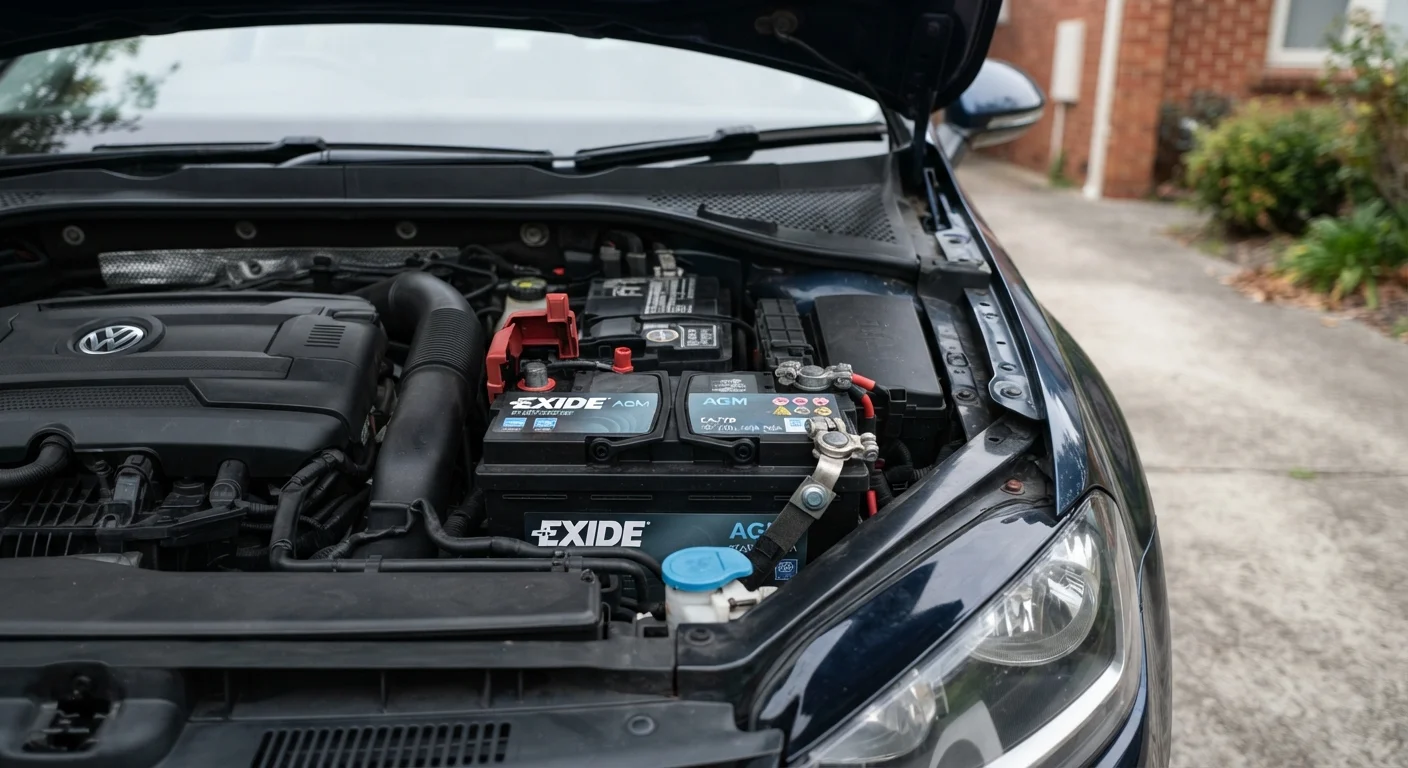
Battery replacement, while physically straightforward on many vehicles, carries additional considerations. Disconnecting the battery on some modern cars can reset the engine control unit, anti-theft systems, or power windows - requiring recalibration. Vehicles equipped with AGM (absorbed glass mat) batteries often require a specific charging profile during replacement. When in doubt, have a qualified mechanic handle the swap.
Safe Handling and Disposal
Car batteries contain sulfuric acid and lead - both hazardous materials. Follow these basic safety principles whenever you work near one:
- Always wear chemical-resistant gloves and eye protection.
- Work in a well-ventilated area. Batteries can emit hydrogen gas, which is flammable.
- Never smoke or use an open flame near a battery.
- When disconnecting, remove the negative (-) terminal first and reconnect it last. This reduces the risk of a short circuit.
- Do not dispose of old batteries in household trash. Lead-acid batteries are regulated hazardous waste. Most auto parts retailers and service shops accept old batteries for recycling at no charge - many are required to by state law.
AGM and Lithium Batteries Need Special Care
Vehicles with start-stop technology or premium audio systems often use absorbed glass mat (AGM) or enhanced flooded batteries rather than conventional lead-acid units. These batteries require chargers and testers matched to their chemistry. Using standard equipment on an AGM battery can give inaccurate readings or cause damage. Check your owner's manual or ask a qualified mechanic if you're unsure which type your vehicle uses.
Building strong maintenance habits - including monitoring your battery's age and condition - is one of the simplest ways to avoid unexpected repair costs. For a broader look at how routine care protects your vehicle long-term, see our article on responsible car ownership habits.
Frequently Asked Questions
Most car batteries last between 3 and 5 years, though driving habits, climate, and vehicle type all influence this. Frequent short trips that don't allow a full recharge and extreme temperatures can shorten battery life considerably.
You can check for obvious signs like corrosion on terminals or a swollen case without tools. For an accurate voltage or load test, a handheld multimeter works, but many auto parts retailers also offer free battery testing if you bring the vehicle in.
Leaving lights or accessories on overnight, frequent short drives, extreme heat, and extended periods of vehicle inactivity are common culprits. A failing alternator that isn't fully recharging the battery also shortens its life prematurely.
Jump-starting is generally safe if you follow the correct cable connection order: positive to dead, positive to good, negative to good, negative to unpainted metal on the dead car. Never connect negative to the dead battery terminal. Consult your owner's manual, as some vehicles have specific jump-start procedures.
If the battery is in a difficult location, the vehicle has a start-stop system or absorbed glass mat (AGM) battery, or you're unsure about disconnecting ancillary electronics, a mechanic should handle the replacement. Incorrect replacement in some modern vehicles can require system recalibration.
The content provided on our blog site traverses numerous categories, offering readers valuable and practical information. Readers can use the editorial team’s research and data to gain more insights into their topics of interest. However, they are requested not to treat the articles as conclusive. The website team cannot be held responsible for differences in data or inaccuracies found across other platforms. Please also note that the site might also miss out on various schemes and offers available that the readers may find more beneficial than the ones we cover.