

Summary
14 items · 10-20 minutes
Why Your Glove Compartment Is More Than a Junk Drawer
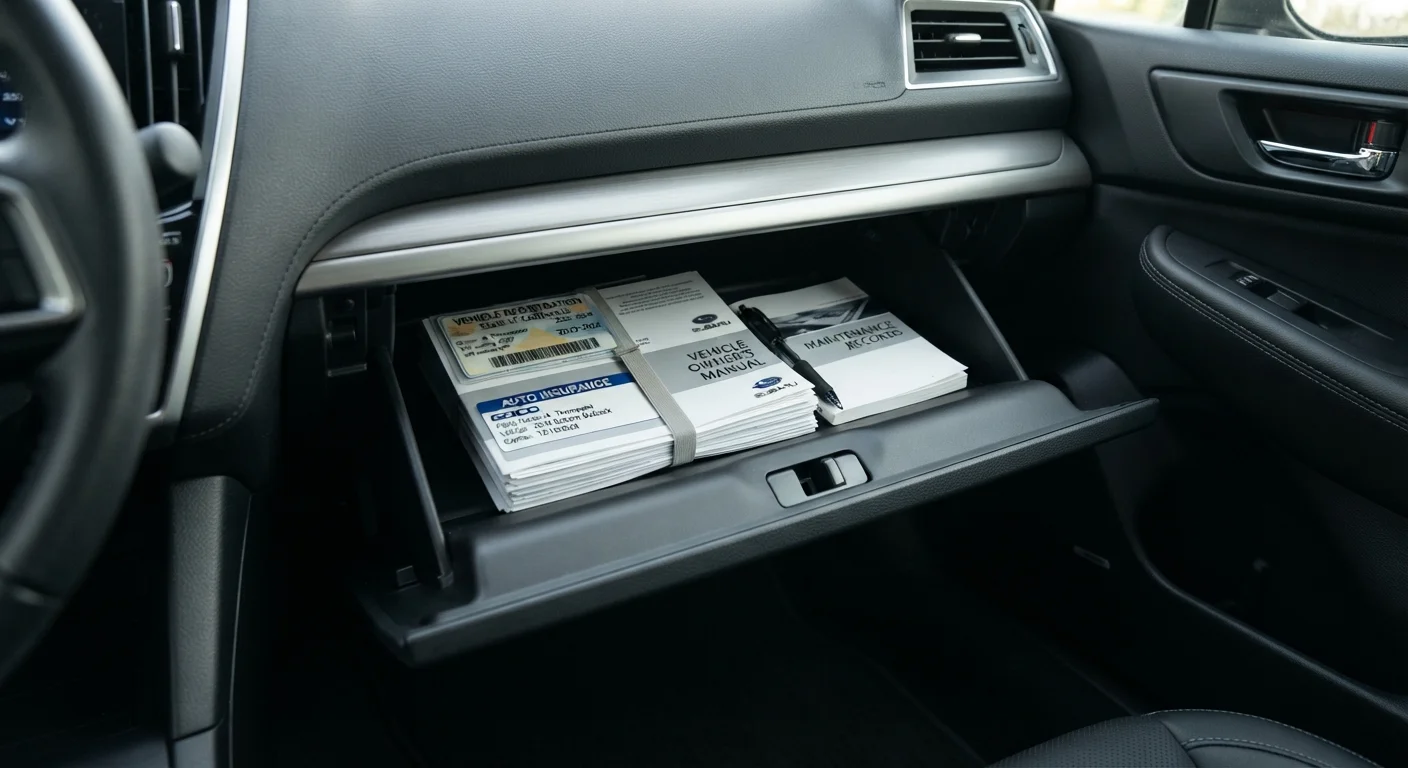
During a traffic stop or roadside emergency, the last thing you want is to dig through fast-food napkins searching for your insurance card. Law enforcement officers typically ask for three things immediately: your license, registration, and proof of insurance. Having those documents - and a few others - organized and accessible isn't just convenient; in most states, it's a legal requirement.
Beyond compliance, a properly stocked glove compartment helps your family handle unexpected situations with less stress. Whether you're involved in a minor fender-bender, pulled over for a broken taillight, or stranded with a flat tire, the right paperwork makes every interaction smoother. This checklist covers every document worth keeping in your car, organized by priority, plus notes on what not to leave in there.
For a broader look at staying prepared on longer drives, see our family road trip safety walkthrough before your next trip.
Never Store Your Social Security Card in Your Car
Your glove compartment is not a safe location for highly sensitive identity documents. Social Security cards, passports, and blank checks should never be left in a vehicle. Cars are a common target for break-ins, and losing these documents to theft can lead to serious identity fraud. Keep sensitive personal documents in a secure location at home.
The Complete Glove Compartment Document Checklist
Work through the checklist below to audit what's currently in your car and identify anything missing or outdated. Items marked must are non-negotiable in virtually every US state. Should items are strongly recommended for any driver, and nice-to-have items add a meaningful layer of preparedness.
Legally Required Documents
Accident & Emergency Readiness
Vehicle-Specific Reference Documents
Organizational & Practical Additions
If you've recently purchased a vehicle and are still sorting out paperwork, our article on what first-time car owners wish they'd known covers common documentation surprises at the DMV and beyond.
What to Know Before You File These Away
A few practical notes will help you store these documents correctly and keep them useful over time.
Originals vs. Copies
Your vehicle registration and proof of insurance are typically required as originals (or official insurer-issued cards) during traffic stops. Many states now accept digital insurance cards displayed on a smartphone - check your state's DMV website to confirm. Your actual driver's license must always be on your person while driving, never left in the glove compartment.
Theft Risk
Do Not Leave Your Title in the Car
Your vehicle title is proof of ownership and should be kept in a secure location at home - not in the glove compartment. If your car is stolen and the title is inside, the thief has documentation that could be used to transfer ownership. The title is rarely, if ever, required to be presented during routine traffic stops or minor accidents.
Keeping Documents Current
Set a reminder each year - coinciding with your registration renewal - to swap out expired documents. An expired insurance card or registration can complicate a routine stop even if your coverage is actually active. This annual review is one of the responsible car ownership habits that keeps ownership predictable and low-stress.
For families who maintain a vehicle service history, consider keeping a condensed version of your maintenance log in the glove compartment as well - it can help roadside mechanics or tow operators understand your vehicle faster.
Document Organizer Wallet
A small accordion-style envelope or zippered pouch keeps all glove compartment papers together, labeled, and easy to hand over during a stop.
State DMV Website
Use your state's official DMV site to confirm which documents are legally required in your state and whether digital insurance cards are accepted.
Insurance Company Mobile App
Many insurers provide digital ID cards through their app, which may be accepted in your state as valid proof of insurance during a traffic stop.
The content provided on our blog site traverses numerous categories, offering readers valuable and practical information. Readers can use the editorial team’s research and data to gain more insights into their topics of interest. However, they are requested not to treat the articles as conclusive. The website team cannot be held responsible for differences in data or inaccuracies found across other platforms. Please also note that the site might also miss out on various schemes and offers available that the readers may find more beneficial than the ones we cover.