

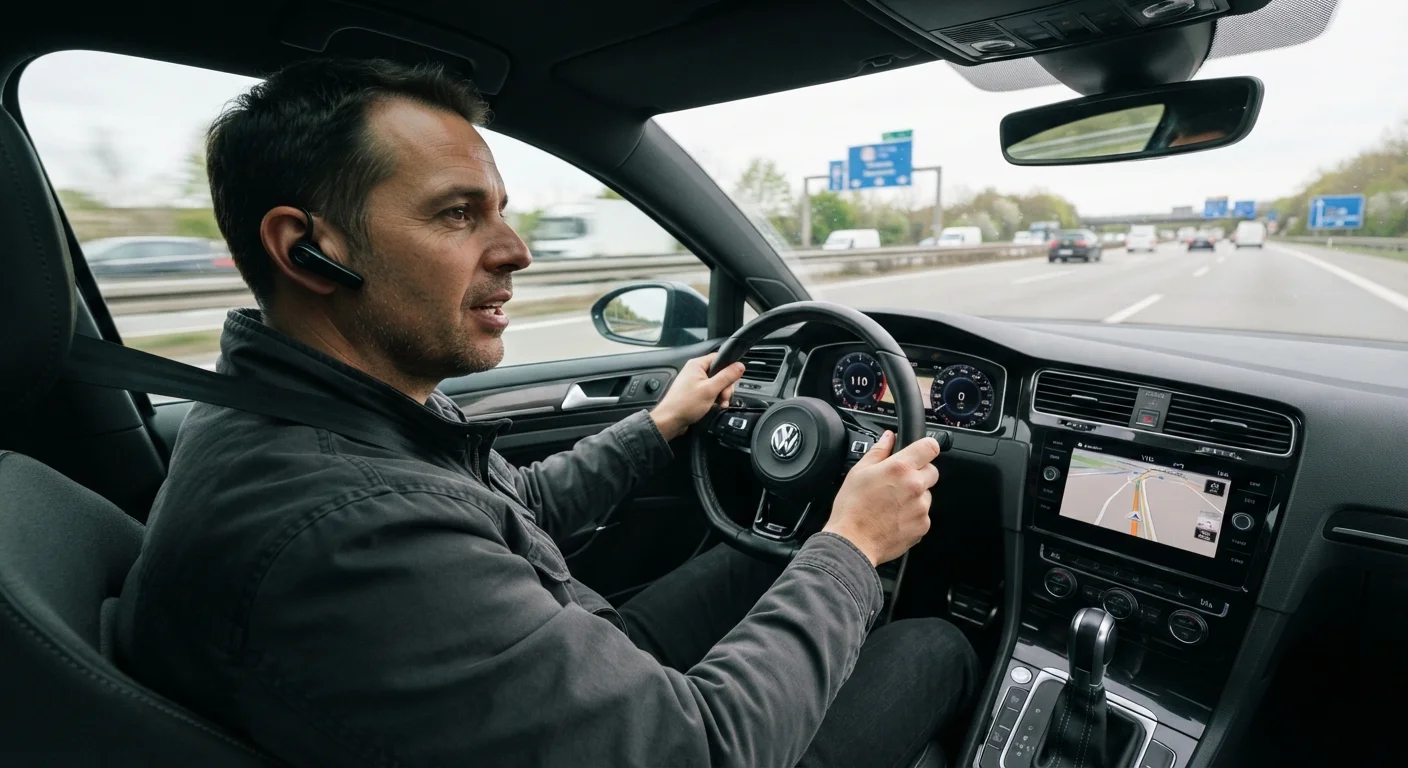
Why Hands-Free Feels Safer Than It Is
The logic seems sound: if your hands are on the wheel and your eyes are on the road, you're driving safely. That's the intuition millions of families act on every day when they connect a Bluetooth call or speak to a voice assistant. But safety research - including studies from the National Safety Council and the AAA Foundation for Traffic Safety - consistently finds that cognitive distraction, not just physical distraction, is a major driver of crash risk.
When your brain is engaged in a phone conversation, it allocates fewer mental resources to scanning traffic, reading road signs, and anticipating hazards. This phenomenon is sometimes called "inattention blindness" - your eyes can be pointed at the road while your brain fails to register what's there. Understanding this gap between perception and reality is the first step toward genuinely safer driving habits. For a broader look at the many forms distraction can take, see our guide to distracted driving beyond the phone.
Common Myths - and What the Evidence Actually Shows
The myths below are among the most widely held. Each one feels intuitive, but each one is contradicted by a consistent body of safety research. Recognizing them is essential for anyone who wants to build genuinely safer driving habits.
Myth
Using a hands-free device is safe because my hands stay on the wheel.
Fact
Hands-free calls still produce substantial cognitive distraction that impairs driving performance.
Physical engagement with a device is only one source of distraction. Research from the AAA Foundation for Traffic Safety identifies cognitive distraction - the mental effort of holding and managing a conversation - as a significant impairment factor on its own. Drivers on hands-free calls have been shown to miss visual cues, react more slowly to hazards, and scan the road less effectively than drivers not on calls at all.
Myth
Talking to a passenger is just as distracting as a hands-free call, so there's no real difference.
Fact
Passengers and remote callers create different types and levels of distraction.
A passenger in the vehicle can see traffic conditions and naturally pauses or simplifies conversation during complex driving situations - merging, navigating an intersection, or responding to a hazard. A caller on the phone has no awareness of road conditions and provides no such relief. Research has found that vehicle passengers may actually help by alerting the driver to hazards, while remote callers consistently increase cognitive load regardless of what's happening on the road.
Myth
If hands-free calling were truly dangerous, it would be illegal everywhere.
Fact
Legality reflects political and regulatory processes, not a safety endorsement.
Laws lag behind research. Many states have enacted restrictions on handheld device use but have not extended those rules to hands-free systems, often because of lobbying, enforcement challenges, and public acceptance factors - not because hands-free use has been found safe. The National Safety Council has publicly called for bans on all cell phone use while driving, including hands-free, based on the available evidence. Legal permission to do something is not the same as a scientific determination that it is without risk.
Myth
Voice-activated systems eliminate the distraction problem because I never touch the phone.
Fact
Voice-controlled interfaces introduce their own cognitive demands, particularly when errors occur.
AAA research has tested a range of in-vehicle voice systems and found that many of them produce moderate to high levels of mental distraction - especially when the system misunderstands a command and the driver must correct it. Composing a text by voice, for example, requires sustained mental attention and can take longer than drivers expect. The hands-free nature of voice interfaces does not neutralize the cognitive load involved in using them.
Myth
Experienced drivers can handle hands-free calls without any meaningful drop in performance.
Fact
Experience does not reliably protect against cognitive distraction from phone conversations.
Driving experience improves many skills - hazard anticipation, vehicle control, route familiarity - but cognitive distraction from an active phone call affects the brain's attentional resources in ways that experience does not offset. Studies have not found a consistent protective effect of driving experience against the reaction-time and awareness deficits associated with phone conversation. Confidence in one's ability to multitask while driving tends to exceed actual performance in controlled studies.
4x
Increased crash risk while using a phone while driving
The National Safety Council estimates drivers using cell phones - handheld or hands-free - are approximately four times more likely to be involved in a crash.
37%
Reduction in brain activity devoted to driving
Research cited by the National Safety Council found that listening to someone speak can reduce the brain activity associated with driving by approximately 37%.
Practical Steps for Safer Driving
Acknowledging the risk doesn't mean you need to become unreachable. It means making deliberate choices. The most effective approach is to let calls go to voicemail while driving and return them when safely parked - a habit that eliminates the distraction entirely. If a call can't wait, pulling off the road in a safe location is always preferable to managing the call at highway speed.
For families with teen drivers, the stakes are especially high. Adolescent brains are still developing the cognitive control needed to manage competing demands, making hands-free phone use proportionally more risky for new drivers. Setting explicit household rules - and modeling them - matters more than most parents expect. For context on other safety habits that protect young passengers, see what parents get wrong about child passenger safety.
Building these habits isn't always easy, but the evidence is clear that even small changes compound into meaningfully safer outcomes. Building safer driving habits that actually stick explores how to make these changes durable, not just well-intentioned.
Night Driving Adds Another Layer of Risk
Cognitive distraction is more consequential when visibility is already reduced. If you're driving after dark - when reaction time matters most - the combination of hands-free calls and low-light conditions compounds risk beyond either factor alone. See why night driving is riskier than most people think for evidence-backed guidance on after-dark safety.
The content provided on our blog site traverses numerous categories, offering readers valuable and practical information. Readers can use the editorial team’s research and data to gain more insights into their topics of interest. However, they are requested not to treat the articles as conclusive. The website team cannot be held responsible for differences in data or inaccuracies found across other platforms. Please also note that the site might also miss out on various schemes and offers available that the readers may find more beneficial than the ones we cover.