

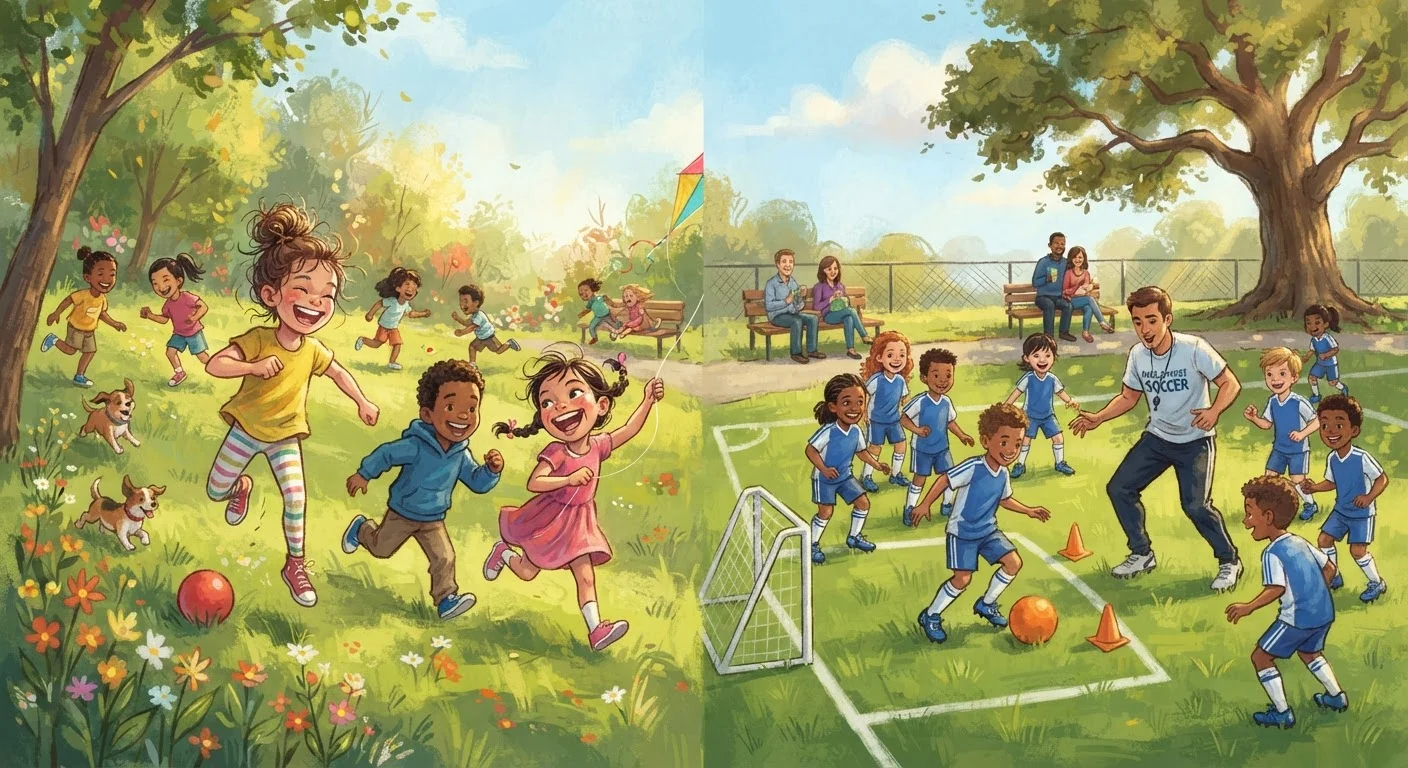
Option A
Active Play
The child-led, spontaneous movement foundation.
Best for: Young children building creativity, motor skills, and intrinsic love of movement through unstructured exploration.
Option B
Structured Exercise
The coached, goal-oriented physical development path.
Best for: School-age children and older who benefit from skill-building, teamwork, and progressive physical challenges.
Defining Each Approach
Active play refers to any physical activity that children initiate and direct themselves - climbing trees, kicking a ball in the backyard, building obstacle courses, or simply chasing friends around a park. There are no performance goals, coaches, or scorecards. Movement happens because it's enjoyable.
Structured exercise describes adult-organised physical activity with defined rules, schedules, and objectives. Youth soccer leagues, swimming lessons, martial arts classes, and school-based PE programs all fall into this category. A coach or instructor guides the session, and there's typically a skill or fitness aim being worked toward.
Both are forms of physical activity, but they engage children's bodies and minds differently - and at different developmental stages, one may serve a child better than the other. Understanding those differences helps families make more intentional choices about how their children move each day. For broader guidance on designing a child's daily schedule, see how to structure a child's learning day.
| Criterion | Active Play | Structured Exercise |
|---|---|---|
| Who directs it | The child | An adult coach or instructor |
| Primary motivation | Intrinsic enjoyment | Goals, skill, or social belonging |
| Best developmental stage | All ages; essential in early childhood | School age and older |
| Cost and logistics | Low cost; minimal scheduling | Variable cost; requires scheduling |
| Social structure | Informal peer interaction | Organised teamwork and competition |
| Skill development | Broad motor and creative skills | Specific, coached physical skills |
| Flexibility | Highly flexible; child-driven | Fixed schedule and rules |
What the Research Suggests About Each
Decades of child development research point to unstructured play as foundational - particularly in early childhood. Play-based physical activity supports gross motor development, spatial reasoning, risk assessment, and emotional regulation. Crucially, it also fosters an intrinsic relationship with movement: children who play freely tend to associate physical activity with enjoyment rather than obligation.
Structured exercise delivers different benefits. Organised sport and coached fitness programs build specific physical skills, teach rule-following, and offer meaningful social experiences including teamwork and handling competition. For older school-age children, these elements can be deeply motivating.
60 min
Daily physical activity recommended for children
The CDC and major pediatric health bodies recommend children aged 6-17 get at least 60 minutes of moderate-to-vigorous physical activity daily.
3 in 4
Children not meeting daily activity guidelines
Research published in public health literature suggests a significant majority of US children do not consistently meet recommended daily movement targets.
~75%
Children who quit organised sport by age 13
Studies on youth sport participation suggest many children disengage from organised activity in early adolescence, often citing lack of enjoyment as the primary reason.
The distinction matters most when families feel pressure to choose one over the other. Current guidance from major pediatric health organizations generally supports a mix of both - with the balance shifting as children age. Toddlers and preschoolers thrive on mostly unstructured movement; adolescents may engage more willingly with organised activity. For a look at how movement needs shift further into teen years, see how teenagers experience exercise differently.
When Each Approach Works Best
Active play tends to be most valuable in early childhood and as a daily baseline at any age. It requires minimal resources - outdoor space, time, and freedom - and can happen anywhere. On packed family days, weaving in short bursts of child-led movement is often more realistic than committing to a structured session. Movement snacks - brief active breaks distributed throughout the day - draw on this same principle.
Structured exercise earns its place when children are developmentally ready to follow instruction and engage with goals. It also provides a social infrastructure that unstructured play sometimes doesn't - scheduled practices create routine and belonging. However, it's worth being realistic about scheduling demands. Families considering multiple organised activities should weigh the enrichment against the risk of overcommitment - a tension explored in this look at extracurricular activities.
A Note on Screen Time and Sedentary Hours
Families tracking activity levels should also account for sedentary time. Both active play and structured exercise help offset long stretches of sitting - common during school hours and screen time. Even short bouts of movement across the day carry meaningful benefits for children's health and attention. Consulting your child's pediatrician can help clarify what balance looks right for your specific family situation.
One useful frame: active play builds the foundation of wanting to move; structured exercise builds the skills and habits to move well. Both matter, and neither fully replaces the other.
Building a Balanced Movement Routine
Rather than treating active play and structured exercise as competing priorities, most families find the most success blending them intentionally. A practical approach might include daily unstructured outdoor time - regardless of age - alongside one or two organised activities per week based on the child's interest and energy levels.
Pay attention to your child's signals. A child who dreads practice but lights up playing freely in the yard may need more unstructured time, not less. Conversely, a child who seems bored and craves challenge and structure may be ready for a coached activity. Temperament, age, and current life demands all factor in.
For children with physical differences or specific needs, always consult a pediatrician or qualified health professional before making significant changes to activity levels or types. General advice about movement applies broadly but never universally. This article provides general health information and is not a substitute for professional medical guidance tailored to your child's individual circumstances.
This article is for general informational and educational purposes only and is not medical advice. Always consult a qualified healthcare professional for questions about your child's health, development, or physical activity needs.
The content provided on our blog site traverses numerous categories, offering readers valuable and practical information. Readers can use the editorial team’s research and data to gain more insights into their topics of interest. However, they are requested not to treat the articles as conclusive. The website team cannot be held responsible for differences in data or inaccuracies found across other platforms. Please also note that the site might also miss out on various schemes and offers available that the readers may find more beneficial than the ones we cover.