

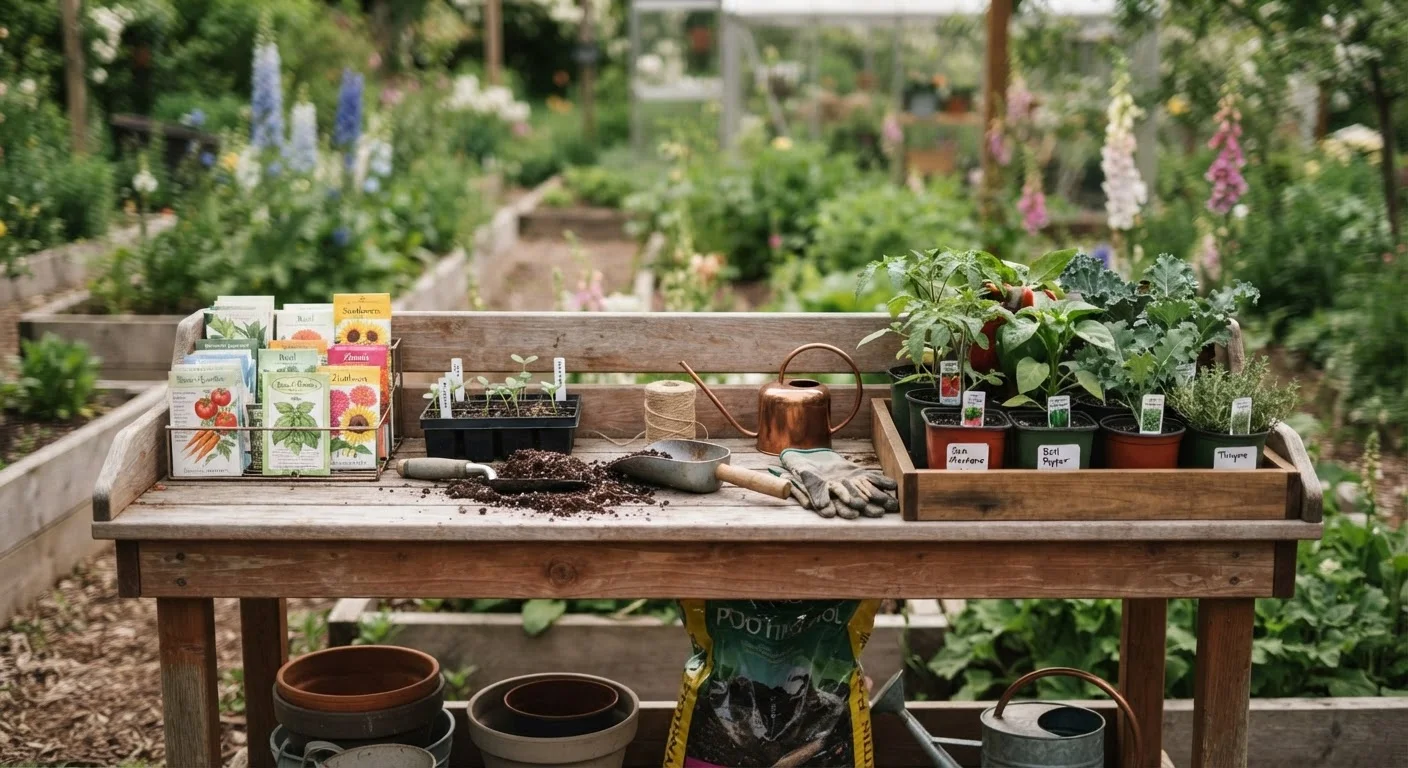
Option A
Starting from Seed
The economical, flexible choice for patient planners.
Best for: Gardeners who want maximum variety, lower per-plant cost, and full control from germination onward.
Option B
Buying Transplants
The fast, convenient option for immediate results.
Best for: Gardeners with short growing seasons, limited indoor space, or who want a reliable head start without the setup.
The Core Trade-Off: Time vs. Convenience
Every gardening season starts with the same fundamental question: do you grow your plants from scratch, or do you buy them already started? Both approaches work - but they suit different situations, and understanding the trade-offs helps you invest your time and money where it counts most.
Starting from seed means sowing into trays or small containers weeks (sometimes months) before your last frost date, then tending seedlings under lights or in a sunny window until they're ready for outdoor life. Buying transplants means visiting a nursery or garden center in spring, selecting young plants already several weeks old, and putting them in the ground much sooner.
Neither method is universally better. The right answer depends on the crops you're growing, your local frost calendar, the indoor space you can dedicate, and how much hands-on involvement you want. For a broader look at how this decision fits into your full vegetable garden plan, see The Complete Guide to Building and Maintaining a Vegetable Garden.
| Criterion | Starting from Seed | Buying Transplants |
|---|---|---|
| Upfront cost | Low (seeds are inexpensive) | Higher per plant |
| Setup required | Trays, lights, seed-starting mix | Minimal - just garden bed prep |
| Variety selection | Very wide - hundreds of options | Limited to nursery stock |
| Time to outdoor planting | 4-10 weeks of indoor care | Plant outdoors right away |
| Best crops | Root veg, beans, squash, heirlooms | Tomatoes, peppers, eggplant, celery |
| Skill level needed | Moderate (light, watering, hardening) | Beginner-friendly |
| Seasonal flexibility | High - start any time indoors | Limited to nursery availability |
When Seeds Are the Smarter Choice
Seeds shine in three specific situations: when variety matters, when you're planting crops that dislike transplanting, and when you're growing at a scale where per-plant cost adds up quickly.
Variety selection is arguably seeds' biggest advantage. While a typical nursery might carry five or six tomato varieties, seed catalogs routinely list dozens - including heirlooms, disease-resistant hybrids, and unusual colors that simply aren't available as commercial transplants. If growing a specific cultivar is important to you, seeds are often your only option.
Direct-sown crops represent another clear win for seeds. Vegetables with taproots - carrots, parsnips, beets, turnips, and radishes - develop poorly when transplanted because disturbing the root at a young age causes forking or stunted growth. Similarly, beans, peas, squash, cucumbers, and melons generally germinate so quickly outdoors that there's little benefit to starting them inside.
Cost at scale is a practical consideration for anyone planting more than a few beds. A packet of 50 tomato seeds costs a fraction of 50 individual transplants. If you're filling a large garden, starting from seed can represent meaningful savings - though that advantage narrows once you factor in the cost of seed-starting mix, trays, and supplemental lighting.
One real challenge: indoor seedlings are vulnerable. If you find yours struggling before they ever reach the ground, the common causes of seedling failure article covers the most fixable issues - from damping off to inadequate light.
6-10 weeks
Indoor lead time for tomatoes and peppers
Most cooperative extension guidelines recommend starting these crops indoors 6-10 weeks before the average last frost date in your area.
100+
Tomato varieties commonly available by seed
Major seed catalogs routinely list over 100 tomato varieties, compared to the handful typically found as transplants at retail nurseries.
When Transplants Make More Sense
Transplants remove the most technically demanding part of gardening - indoor seed starting - and replace it with a simple trip to the nursery. That trade-off is genuinely worthwhile in several scenarios.
Short growing seasons are the most common reason to choose transplants. Tomatoes, peppers, eggplant, and celery need 6-10 weeks of indoor growth before they're ready for outdoor planting. In northern states where the frost-free window may be only 90-120 days, starting these crops indoors without a proper setup is risky. Purchasing transplants that nurseries have already started professionally can be the difference between a productive harvest and plants that never fully mature.
No indoor growing space is another honest reason to buy transplants. Successful seed starting typically requires a light source providing 14-16 hours of consistent illumination daily - a south-facing window rarely delivers enough light intensity, particularly in late winter. If you don't have grow lights and can't dedicate space to a seed-starting area, transplants are a practical solution rather than a compromise.
Pest and disease pressure can also favor transplants. Commercially grown starts are often hardier and more uniform than home-started seedlings, and they arrive at the nursery already past the vulnerable seedling stage when damping off (a fungal condition that kills young seedlings at soil level) is most likely.
For gardeners growing in containers or small spaces, transplants also tend to be a natural fit. See Container Gardening: Growing More in Less Space for tips on maximizing a small plot - where buying one or two transplants per pot is often the most sensible approach.
Hardening Off: A Step That Applies to Both
Whether you start your own seeds or buy nursery transplants, young plants need a gradual transition - called hardening off - before they're ready for full outdoor exposure. Over 7-10 days, move plants outside for progressively longer periods, starting in a sheltered, partially shaded spot. Skipping this step is one of the most common reasons otherwise healthy transplants wilt or stall after planting, regardless of how they were started.
A Practical Mixed Approach
Most experienced gardeners don't choose one method exclusively. A practical middle path: buy transplants for slow-maturing, frost-sensitive crops like tomatoes, peppers, and head lettuce, while direct-sowing fast growers and root crops like beans, squash, radishes, and carrots straight into the garden.
This hybrid approach keeps costs reasonable without requiring a full seed-starting setup. It also lets you practice direct sowing - a lower-stakes skill to develop - while relying on purchased transplants for the crops where a failed start would cost you an entire season.
As you plan which plants will share the same beds, also consider how their placement affects each other. Companion planting principles can improve yields and reduce pest pressure regardless of whether you started those plants from seed or bought them as transplants.
Whatever approach you take, the goal is the same: getting healthy, well-timed plants into the ground in conditions that give them the best chance of thriving through the season.
The content provided on our blog site traverses numerous categories, offering readers valuable and practical information. Readers can use the editorial team’s research and data to gain more insights into their topics of interest. However, they are requested not to treat the articles as conclusive. The website team cannot be held responsible for differences in data or inaccuracies found across other platforms. Please also note that the site might also miss out on various schemes and offers available that the readers may find more beneficial than the ones we cover.