

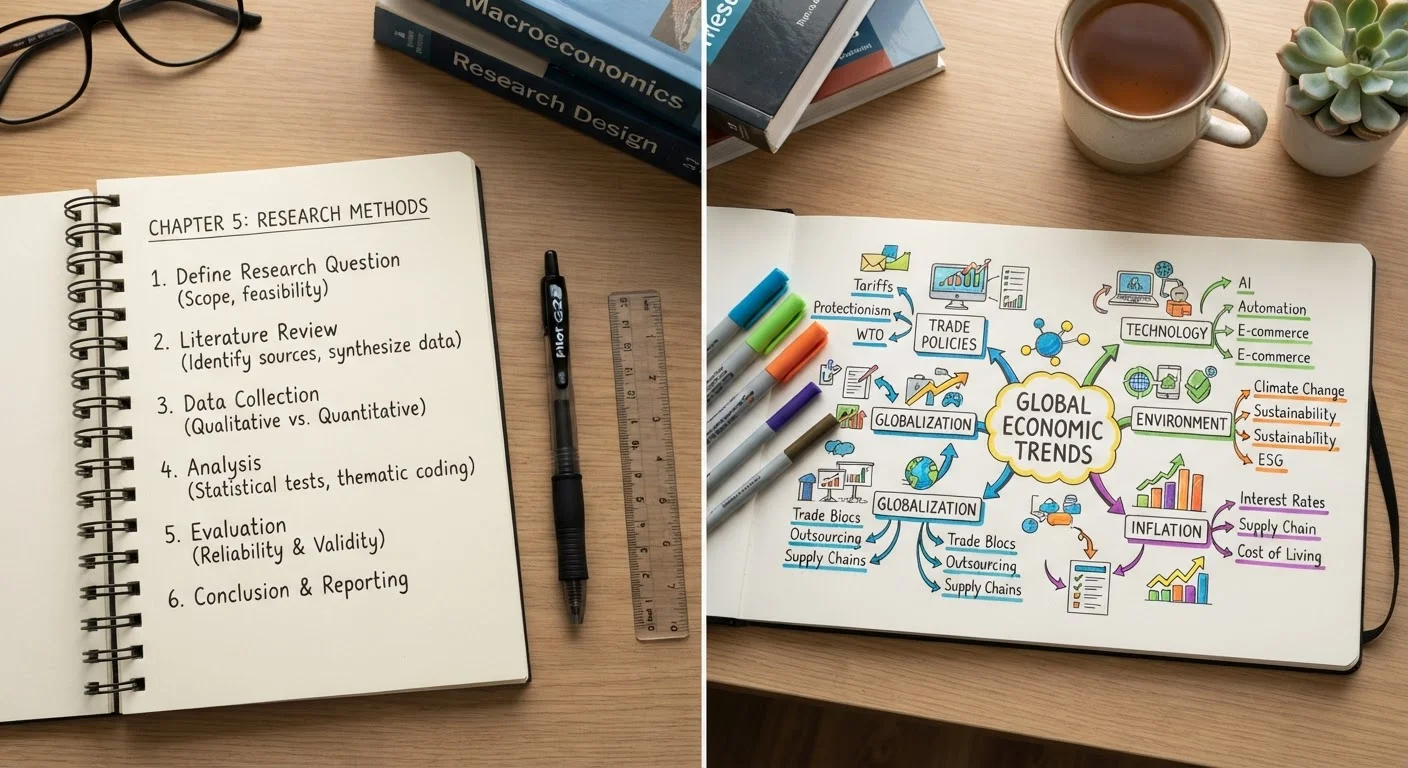
Option A
Linear Notes
The structured, sequential approach to capturing information.
Best for: Students who process information step-by-step, follow lecture formats, or need to review dense factual content in order.
Option B
Mind Maps
The visual, branching method for connecting ideas at a glance.
Best for: Students who think in concepts and relationships, brainstorm creatively, or need to see the big picture before diving into details.
What Each Format Actually Does
Linear notes follow a top-to-bottom structure: headings, sub-points, and details arranged sequentially on the page. This mirrors how most textbooks and lectures are organized, which is one reason the format feels natural to many students. Common variations include simple outlines, numbered lists, and the Cornell method (which adds a margin for questions and a summary box at the bottom).
Mind maps start with a central idea in the middle of the page and branch outward into related topics, sub-topics, and supporting details. The visual layout emphasizes relationships rather than sequence. Introduced as a formal learning tool by educator Tony Buzan in the 1970s, mind mapping has since been studied as a tool for improving conceptual understanding and creative thinking.
Neither approach is a gimmick - both draw on real cognitive principles. Linear notes leverage the brain's ability to process ordered information; mind maps tap into spatial memory and associative thinking. The question is which mode fits the content and the student. See our overview of note-taking methods for a broader look at where each system fits in a study toolkit.
Head-to-Head: Where Each Format Wins
The comparison below covers the dimensions that matter most for students and families choosing between the two approaches.
| Criterion | Linear Notes | Mind Maps |
|---|---|---|
| Best content type | Sequential facts, procedures, timelines | Concepts, themes, relationships |
| Ease of use during a fast lecture | High - easy to jot quickly | Lower - spatial layout takes more time |
| Visual overview of a topic | Limited - page-by-page | Strong - entire topic on one page |
| Showing connections between ideas | Weak - hierarchy only | Strong - cross-links are central |
| Pre-exam quick review | Easy to scan and annotate | Good as a summary overview |
| Creative brainstorming | Less suited | Highly effective |
| Works well digitally | Yes - any text editor | Yes - dedicated apps available |
One nuance worth noting: exam format matters as much as subject matter. Multiple-choice and short-answer tests that reward fast factual recall tend to favor linear notes, since information is easy to scan. Essay-heavy or project-based assessments often reward the kind of holistic thinking mind maps encourage.
10-15%
Recall improvement with visual organization
Studies published in educational psychology journals suggest visually organized notes can improve recall compared to unstructured writing, though effect sizes vary by subject and student.
~40%
Students who prefer visual learning approaches
Survey data from the National Center for Education Statistics indicates a significant share of students self-report preferring visual or spatial information processing styles.
Matching Format to Subject and Learner
A useful rule of thumb: if the content has a natural order or procedure, go linear. If the content is a web of ideas that connect in multiple directions, go visual.
- Math and foreign language grammar: Linear notes work well. Steps and rules build on each other, and the sequence matters.
- Biology or earth science: Mind maps shine here. A central concept like "the water cycle" branches naturally into evaporation, condensation, precipitation, and collection - all equally important and interconnected.
- History: Both work, depending on focus. Timelines and cause-effect chains suit linear formats; thematic comparisons (e.g., causes of multiple conflicts) suit mind maps.
- Essay preparation: Many skilled writers draft a mind map first to generate ideas, then convert it to a linear outline before writing.
Learning style also plays a role, though researchers caution against treating learning styles as rigid categories. Students who report preferring visual information often find mind maps more engaging - and engagement matters for retention. If your student finds linear notes tedious, experimenting with mind maps is a low-risk way to refresh motivation. For more on building effective home study routines, see structuring a learning day that works for your child.
A Note on Learning Style Research
The idea of fixed "visual," "auditory," or "kinesthetic" learner types has limited support in current cognitive science research. Most education researchers now suggest that matching format to the type of content - rather than the learner's stated preference alone - produces the most reliable gains. That said, student engagement and motivation are real factors, and a format a student actively enjoys is more likely to be used consistently.
How to Use Both Formats Together
The most flexible students don't commit to one format for all subjects - they switch based on what the material demands. A practical two-pass strategy works well: take linear notes during a lecture or initial reading (when keeping up with speed matters), then convert key sections into a mind map during review (to consolidate understanding and spot gaps).
This approach aligns with the principle of elaborative interrogation - asking yourself how and why ideas connect - which cognitive science research consistently links to stronger long-term retention. Converting linear notes into a map forces that kind of active processing. For more on why passive re-reading often falls short, see why re-reading notes rarely leads to real learning.
Families supporting younger students can introduce both formats through low-pressure practice: a numbered list for a weekend chore sequence, a hand-drawn map for a book's character relationships. Building familiarity early makes the choice instinctive by the time exam pressure arrives. For foundational guidance on building study habits from the start, our starter guide for new students is a helpful next step.
The content provided on our blog site traverses numerous categories, offering readers valuable and practical information. Readers can use the editorial team’s research and data to gain more insights into their topics of interest. However, they are requested not to treat the articles as conclusive. The website team cannot be held responsible for differences in data or inaccuracies found across other platforms. Please also note that the site might also miss out on various schemes and offers available that the readers may find more beneficial than the ones we cover.