

The Instinct Behind the Knock
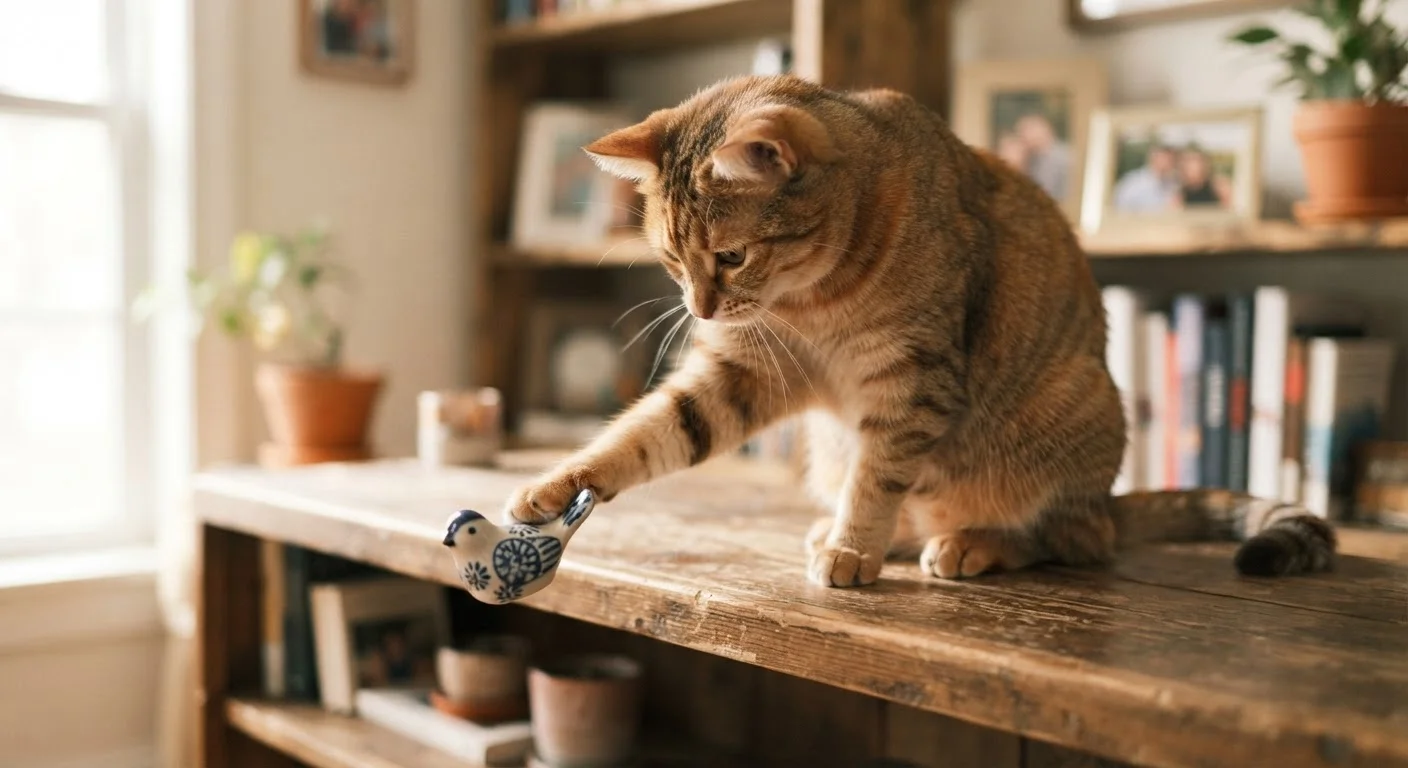
Watch a cat approach an unfamiliar object and you'll notice a ritual: sniff, stare, then a careful tap with one paw. That tap isn't random - it's data collection. A cat's paws contain a high density of sensory nerve endings that detect texture, temperature, and movement with remarkable precision. Nudging something off a shelf is, in part, your cat running a physical experiment on an object that caught its eye.
This connects directly to predatory wiring. Wild felids use their paws to test whether something is alive, injured, or worth pursuing. Domestic cats retain this impulse even when the "prey" is a lip balm cap or a TV remote. An object that wobbles or rolls is particularly compelling - it mimics the erratic movement of small animals.
Redirect Before the Object Hits the Floor
If you notice your cat approaching a shelf with that focused, deliberate look, intercept early with a wand toy or tossed crinkle ball. Redirecting before the behavior completes is far more effective than reacting after the fact. Timing is everything with feline behavioral intervention.
Understanding this predatory context reframes the behavior completely. Your cat isn't being defiant; it's being a cat. For a broader look at what other everyday feline signals mean, see our practical guide to cat body language.
When Your Cat Is Talking to You
There's a second, learned dimension to shelf-clearing that has little to do with prey drive. Many cats discover early that pushing something off a surface is one of the most reliable ways to get a human's immediate, undivided attention. You look up. You gasp. You walk over. From your cat's perspective, that's a result.
This is especially common in households where the cat's social or stimulation needs aren't consistently met. If play sessions are infrequent or unpredictable, a cat may develop its own workaround. Shelf-clearing becomes a communication strategy: I need something from you right now.
~67%
US households that own at least one cat
According to the American Pet Products Association's National Pet Owners Survey, cats are among the most common household companions in the United States.
2x daily
Recommended interactive play sessions for indoor cats
Veterinary behaviorists broadly recommend at least two dedicated play sessions per day to meet a typical indoor cat's activity and stimulation needs.
Reacting strongly - even with a firm "no" - can accidentally reinforce the behavior. The cat received engagement, which was the goal. A more effective response is to stay calm, avoid eye contact, and redirect the cat to an interactive toy before it escalates. Enrichment strategies for indoor cats can help address the root cause rather than just the symptom.
Boredom, Under-stimulation, and Environmental Gaps
Indoor cats live in environments that rarely match the sensory complexity their brains are built for. Without adequate outlets for hunting, climbing, and exploring, cats often redirect their energy into whatever gets a rise - and shelves full of moveable objects are, functionally, a perfect interactive toy that no one intentionally provided.
Cats who knock things over most persistently tend to be younger, higher-energy, or living in homes with few structured play opportunities. The solution isn't simply removing objects from shelves (though protecting breakables is practical). It's providing appropriate alternatives: wand toys used twice daily, puzzle feeders that require paw manipulation, and vertical space your cat is actively encouraged to use.
If you've noticed your cat's behavior shifting alongside other changes - less appetite, altered grooming, increased hiding - those patterns deserve closer attention. Cats are skilled at concealing discomfort, and behavioral changes sometimes signal something worth discussing with your veterinarian.
Frequently Asked Questions
Cats tap and push objects to gather information through their paws, which are densely packed with sensory receptors. They may also do it to trigger a reaction from you, especially if they've learned it gets your attention. It's instinctive behavior, not deliberate defiance.
Often, yes. If your cat has learned that clearing a shelf brings you over - even to say 'no' - they may repeat the behavior as a reliable way to engage you. Consistent enrichment and interactive play sessions tend to reduce attention-motivated object displacement.
Punishment is generally not effective and can damage your relationship with your cat. Because even negative attention can reinforce the behavior, a better approach is to avoid reacting dramatically and instead redirect your cat to appropriate activities.
In most cases it's purely behavioral, but a sudden increase in any attention-seeking behavior can sometimes reflect underlying anxiety, pain, or cognitive changes - particularly in older cats. If the behavior appears abruptly or alongside other changes, a veterinary check-up is a sensible step.
Increase daily interactive play, provide puzzle feeders, and offer approved cat-safe surfaces for climbing and exploration. Clearing high-traffic shelves of fragile items removes the opportunity while you work on enrichment. Consistent, structured play before your cat typically acts out is one of the most effective interventions.
The content provided on our blog site traverses numerous categories, offering readers valuable and practical information. Readers can use the editorial team’s research and data to gain more insights into their topics of interest. However, they are requested not to treat the articles as conclusive. The website team cannot be held responsible for differences in data or inaccuracies found across other platforms. Please also note that the site might also miss out on various schemes and offers available that the readers may find more beneficial than the ones we cover.