

Why Luggage Decisions Are a Budget Decision
Most families think of packing as a logistics problem - what to bring, how to fit it, whether the kids will need an extra pair of shoes. But every bag that goes on a plane is also a financial decision. Checked bag fees, overweight surcharges, and last-minute gate-check charges are among the most predictable hidden costs in family travel, and they're almost entirely avoidable with a bit of planning before the trip begins.
For context: a family of four on a domestic round trip, checking two bags each way at a commonly charged rate, could spend $140 to $200 in bag fees alone - money that could fund a memorable meal or a family activity at the destination. Part of a broader family travel planning framework is recognizing that savings before you leave are just as real as savings at the destination.
Luggage choices also have ripple effects: lighter loads mean easier airport navigation with kids, faster security lines, and no waiting at baggage claim. The benefits go beyond the bottom line.
Airline Bag Fees Vary Widely - Always Check First
Checked bag fees differ significantly by airline, route, fare class, and loyalty status. Never assume a fee structure based on a previous trip or a different carrier. Before finalizing packing decisions, visit your airline's official website and confirm current baggage fees for your specific itinerary. Policies can change without notice.
How to Pack Smarter and Spend Less
The steps below walk through a practical process for making luggage decisions that keep more money in your family's travel budget. Before you start, gather your prerequisites and tools.
What you will need
Look Up Your Airline's Exact Baggage Policy
Before you pull a single bag from the closet, visit your airline's official website and find the baggage fee schedule for your specific route and fare type. Basic economy fares often prohibit carry-on bags or charge for them - a detail that completely changes your packing strategy. Note the allowed dimensions and weight limits for both carry-on and checked bags. Screenshot or save the page in case you need to reference it at the airport.
Calculate the True Cost of Checking Bags
Do the math before deciding on a bag strategy. Multiply the per-bag fee by the number of bags you're considering, then double it for the return flight. A family of four checking two bags at $35 each, round trip, pays $140 - before factoring in any overweight charges. Write this number down. It becomes your motivation for every packing decision that follows.
Decide on a Bag Strategy for Your Family
Three common approaches work well for families:
- Carry-on only: Every traveler (including kids old enough to manage a small backpack) brings one carry-on and one personal item. Zero checked bag fees.
- One shared checked bag: Combine kids' clothing into a single checked bag and keep adults in carry-ons. Cuts checked bag fees by half or more.
- Checked bags with weight strategy: If checking is unavoidable (think: car seats, medical equipment, ski gear), consolidate into the fewest bags possible and stay well under the weight limit.
For most trips under 10 days, carry-on only is achievable with planning. Longer trips, beach destinations with bulky gear, or cold-weather travel often warrant one strategic checked bag.
Build a Packing List Around Mix-and-Match Outfits
This is where most families recover the most space. Instead of packing per-outfit, pack per-piece. Choose a two or three-color palette for each family member and select items that work in multiple combinations. Lay everything on the bed before it goes in the bag and ask: does this piece pair with at least two other items in this pile? If not, it doesn't make the trip.
Plan to re-wear bottoms (pants, shorts, skirts) at least twice and use accessories or layering to vary the look. Kids' clothing compresses well and takes up less space than parents usually expect.
Use Packing Cubes to Organize and Compress
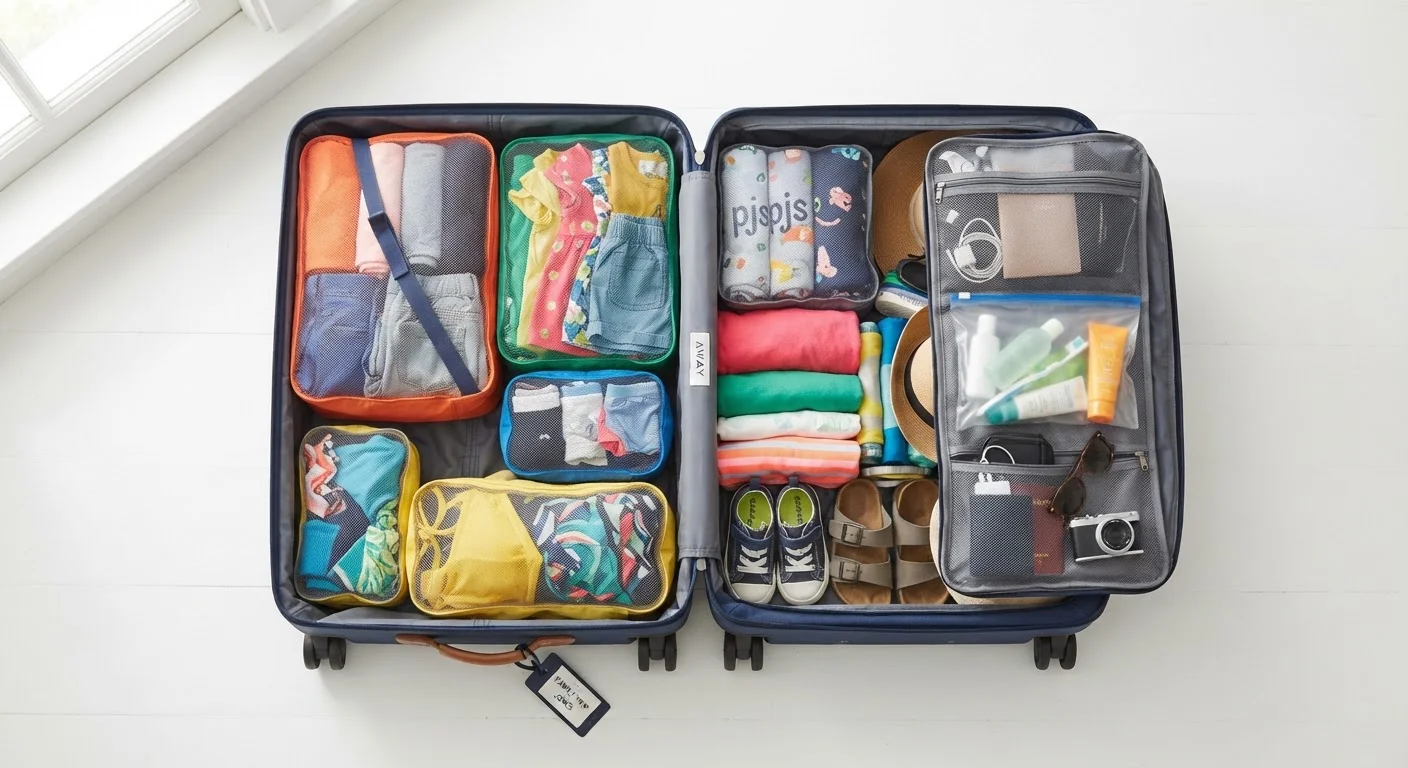
Packing cubes are one of the most effective low-cost tools for maximizing bag space. Assign one cube per person or per category (tops, bottoms, kids' items) and roll clothing tightly before placing it in each cube. Rolled clothes compress better than folded ones and resist wrinkling. Once all cubes are packed, stack them in the bag like building blocks - this structure prevents the shifting that wastes space and makes repacking a nightmare mid-trip.
[tool_cards]Weigh Every Bag Before Leaving Home
Attach a luggage scale to each bag's handle and lift. Do this after the bag is fully packed, including any last-minute additions. If a bag is close to the weight limit, remove something - not shuffle it - before leaving for the airport. A bag that is two pounds over the limit at check-in can cost as much as a second bag fee.
Keep a small buffer of at least three to four pounds below the limit to account for any items you add on travel day (water bottles, jackets, snacks).
Pack Personal Items Strategically for Free Overflow
Every passenger on most major US carriers is allowed one free personal item (a bag that fits under the seat in front of you). For a family of four, that's four free personal item spaces. Use them intentionally: shoes, snacks, kids' entertainment, a change of clothes, and any valuables should go here. A well-packed personal item backpack often holds the equivalent of two to three days of essentials - which can tip the balance toward true carry-on-only travel.
Pack a Capsule Wardrobe for Every Family Member
Choose a limited color palette and pack pieces that can mix and match across multiple outfits. Three bottoms and five tops can generate more than a week of varied looks. This approach alone can cut a family's total clothing volume by 30-40%, making carry-on travel far more achievable.
Overweight Bags Can Erase Any Savings
Most airlines charge a separate surcharge - often $50-$100 per bag - when luggage exceeds 50 pounds. A family that packs one big bag to avoid paying for two can end up paying more if that bag tips the scale. Always weigh bags at home before leaving for the airport.
Once you've locked in your packing strategy, it's worth auditing the rest of your trip for similar hidden costs. The family travel budget checklist is a useful next stop - it surfaces other commonly overlooked expenses before you finalize your booking. And if you're heading out by car rather than plane, the calculus is different: see what families actually need in the car for a road trip-specific approach to packing light and packing right.
Luggage is just one piece of the budget puzzle. Destination decisions and food spending on the road are two other areas where families frequently overspend without realizing it until they're home reviewing the credit card statement.
The content provided on our blog site traverses numerous categories, offering readers valuable and practical information. Readers can use the editorial team’s research and data to gain more insights into their topics of interest. However, they are requested not to treat the articles as conclusive. The website team cannot be held responsible for differences in data or inaccuracies found across other platforms. Please also note that the site might also miss out on various schemes and offers available that the readers may find more beneficial than the ones we cover.